
-
- ExosomesVirus-like Nanoparticles (VNPs)
- LiposomesHeparosanCyclodextrins
- Polymeric NanocarrierPolymer-Drug ConjugatesHydrogelResponsive Polymer



Inorganic Nanoparticles
In biomedicine, nanoparticles (NPs) are attractive support because the tunable size is compatible with cells (10–100μm), viruses (20–450 nm), proteins (5–50 nm) and nucleic acids (2 nm wide by 10–100 nm long). This is of special importance to drug delivery applications because NPs are small enough to move inside the body without disruptingnormal functions and can distribute to places that are inaccessible to other materials. Other important and unique advantages of NPs include high surface to mass ratios, characteristic quantum properties and their ability to adsorband carry other molecules. In a drug/carrier complex system, drugs can be bound to NPs through a solid solution ordispersion; adsorption to the surface; or chemical linkage.
One of the most commonly used inorganic NPs in drug delivery is magnetic nanoparticles (MNPs), which exhibit avariety of unique magnetic phenomenon drastically differ them from other materials. The magnetically-guided drugtargeting process involves several steps: First, loading MNPs with a drug; then the drug/carrier complex areinjected into the subject, either via intravenous or intra-arterial injection; and finally, MNPs can be directed toa chosen site by applying a localized external magnetic field. Creative BioMart achieves precise design through engineering strategies that utilizethe abundant chemically-active sites on MNPs surface for biomolecule conjugation. This enables many intendedfunctions such as prevention of aggregation, long-lasting circulation in the blood stream, target specificity tolesion tissue, optical detectability and therapeutic delivery. Several surface coating materials have been appliedto MNPs including polymer, organic surfactant, metals and bioactive molecules. Below are other NPs that have been carried out in different studies:
- Metallic NPsExamples: Iron oxide NPs. Gold NPs. Silver NPs.
- Non-metallic NPsExamples: Silica NPs.
- Polymer/small ligand functionalized NPs
- Nanoshperes, nanorods, nanotubesExample: Carbon nanotubes (CNTs)
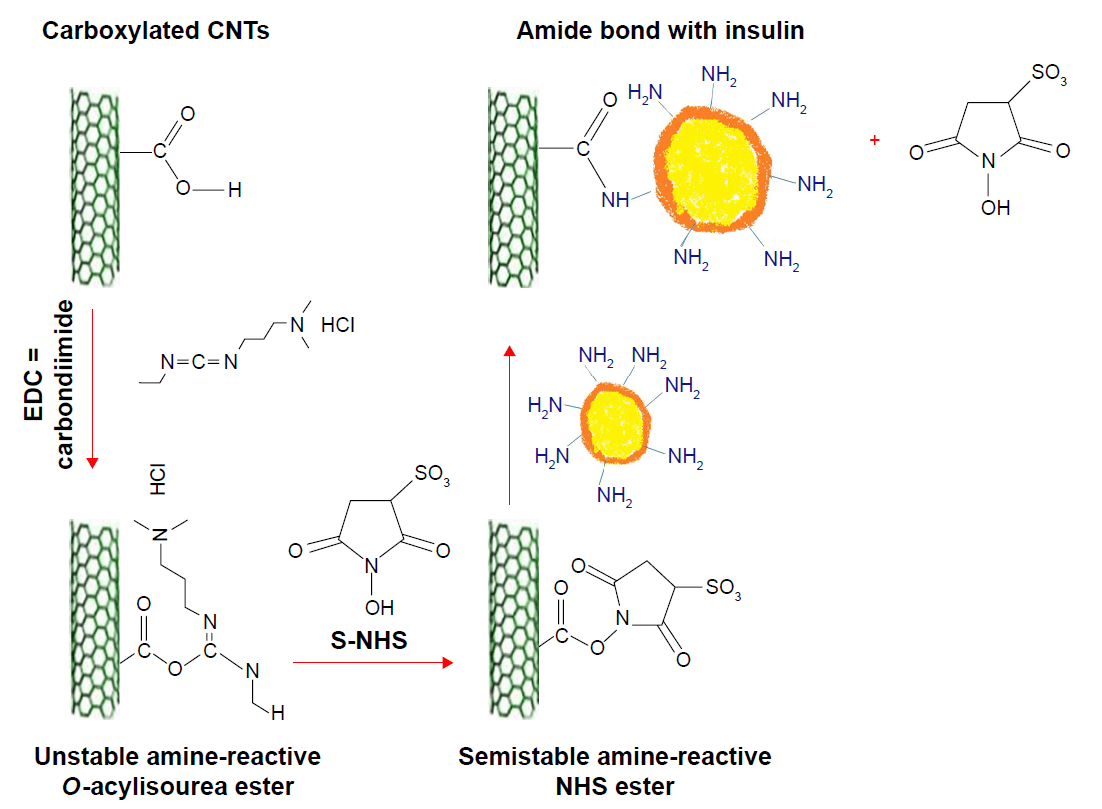 Using CNT as a multifunctional insulin carrier. Reprinted from Jahangirian, Hossein, et al.
International journal of nanomedicine 2017.
-
