
-
- ExosomesVirus-like Nanoparticles (VNPs)
- LiposomesHeparosanCyclodextrins
- Polymeric NanocarrierPolymer-Drug ConjugatesHydrogelResponsive Polymer



Synthetic Polymer Drug Carriers Design
The ideal drug delivery system should be inert, free of leachable impurities, biocompatible, mechanically strong, comfortable for the patient, capable of loading a higher amount of drugs, safe from accidental release, simple to administer and remove, easy to fabricate and sterilize, and efficient drug targeting specificity.
Nowadays, therapies using nanoparticles have widely been achieved for the treatments of cancer, diabetes, allergy, infection, and inflammation. The reasons that nanoparticles have been used in the therapeutic application are the fact that nanoparticles exist in the same size domain as proteins. Their large surface areas can also allow for displaying a large number of surface functional groups such as ligands. Furthermore, they have a rapid absorption and release behavior provided by the high abilities of their diffusion and volume change. In addition, the particle sizes and surface characteristics of nanoparticles can be tailored or controlled.
Biodegradable polymers that are susceptible to biodegradation to biologically acceptable molecules in the physiological environment can be considered as ideal for the controlled delivery of drugs. They provide the possibility of transporting bioactive compounds to specific tissues, cells, and cell compartments. Compared to ceramic or metal nanoparticles, polymeric nanoparticles can be fabricated in a wide range of sizes and varieties and can sustain localized drug therapeutic agents for weeks.
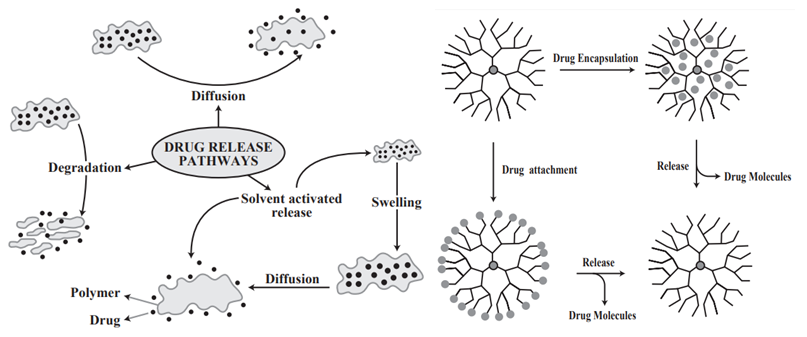 Fig1. 1)Drug release mechanism; 2)Dendrimers
During the design of polymeric drug delivery devices employing diffusion, the parameters such as size of drug molecules, porosity of polymer matrix, degree of crosslinking, and swelling characteristics of polymer play an important role. Examples of surface modification of nanoparticles are covalent binding between the surface and functional molecules or polymers and layer-by-layer assembly. Generally, the well-defined structure of synthetic polymers exhibits well-defined and fine-tunable degradation kinetic as well as mechanical properties.
Proper variation of each of these factors allows researchers to adjust the rate of matrix degradation and subsequently control the rate of drug delivery.
- More hydrophilic backbone chain – ester, ether, amide, peptide linkages improves biodegradation.
- More hydrophilic end-groups – hydroxyl, carboxyl, and carbonyl accelerate biodegradation.
- Lower degree of crystallinity
- Enhanced porosity
- Presence of lower molecular weight fraction
- Geometry as related to size/shape and surface area.
Over the last few years, a variety of polymer-controlled drug delivery systems have been successfully developed for better therapeutic efficacy and better targeting of drug agents.
We provide some of the synthetic polymers listed below:
Our experts could design suitable drug delivery carriers according to your requirements. Creative BioMart is your reliable partner in studying of novel drug delivery systems. We will support you with superb expertise, advanced equipment, and satisfactory customer service.
Please feel free to contact us for a detailed quote or custom requirement!

-
