
-
- ExosomesVirus-like Nanoparticles (VNPs)
- LiposomesHeparosanCyclodextrins
- Polymeric NanocarrierPolymer-Drug ConjugatesHydrogelResponsive Polymer



Hydrogel
Hydrogel is composed of a large amount of water and crosslinked polymer networks. Hydrogel drug delivery systems can be categorized based on their size: macroscopic hydrogels, microgels and nanogels. One of the most important advantages of hydrogel is its excellent biocompatibility and the capability to easily encapsulate hydrophilic drugs, which are given by its high water content. Additionally, the manufacturing of hydrogels does not require organic solvents, eliminating toxicity risks and the potential for protein denaturation. The release of the loaded drugs from the hydrogel carriers may occur through diffusion, hydrogel matrix swelling, or chemical reactivity of the drug/matrix. The physical properties of hydrogels (i.e., swelling, permeation, mechanical strength, and surface characteristics) can be optimized by structural modification, i.e., tuning the crosslinking degree. Many hydrogel particles are also environmentally sensitive and have the ability to respond to changes of pH, temperature, or the concentration of metabolites, and release their load as a response to these stimuli for controlled drug release. At Creative BioMart, we committed to keep working on the synthesis of new polymers and crosslinkers with greater biocompatibility and better biodegradability that would increase and enhance current hydrogel based drug delivery applications.
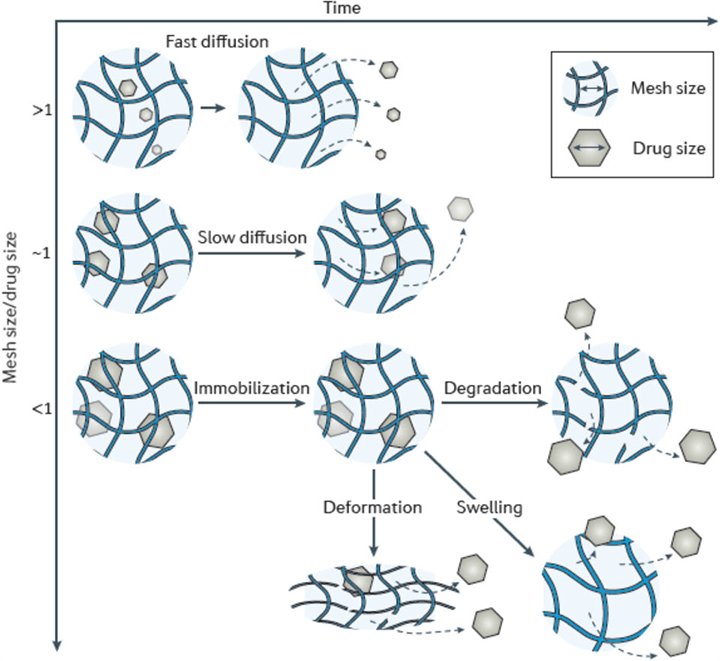 Hydrogel mesh size mediates drug diffusion. Reprinted from Li, Jianyu, et al. Nature Reviews Materials2016.
-
