
-
- ExosomesVirus-like Nanoparticles (VNPs)
- LiposomesHeparosanCyclodextrins
- Polymeric NanocarrierPolymer-Drug ConjugatesHydrogelResponsive Polymer



Polymeric Nanocarrier
Biodegradable synthetic polymers represent a revolution in medical sciences, spanning over 50 years and leading to significant biotechnological advancements. They are being used extensively in drug delivery devices. Hydrophobic or hydrophilic drugs can be incorporated into polymer nanocarriers either by nanoencapsulation or surface conjugation, which protect drugs from degradation, facility cell entry, increase solubility and bioactivity. Polymers serving as drug carrier should be water soluble, nontoxic and non-immunogenic. They work passively to achieve controlled and targeted drug delivery of small molecules, DNA and proteins in order to improve the bioavailability and bioactivity of a drug. Polyester-based nanoparticles, formed by emulsion or nanoprecipitation techniques can be designed to have a range of degradation times. The particle degradation and drug release kinetics are controlled by the physiochemical properties of the polymer (e.g., molecular weight, hydrophobicity, and polydispersity). Polymeric micelles are nanoscopic spherical structures formed by amphiphilic block copolymers. Both the inherent core and shell of polymeric micelles could be modified to make them particularly well suited for drug delivery purposes, and in the meantime achieve abilities to reduce toxicities, enhance target delivery and improve the therapeutic efficacy. At Creative BioMart, we provide various types of off-the-shelf polymer products, such as poly(N-isopropylacrylamide-b-butylmethacrylate) (PNIPAM), polypyrrole (PPy), poly(lactide) (PLA), poly(glycolide) (PGA), and the copolymer of lactide and glycolide referred to as poly(lactide-co-glycolide) (PLGA). Customized polymerization services are also available for designing a specific polymeric nanocarrier.
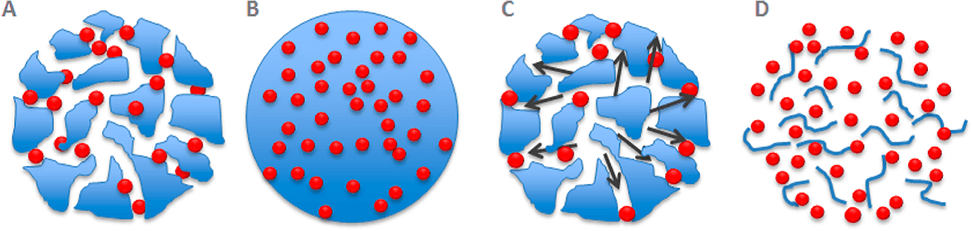 Drug release mechanisms from polymeric nanocarriers: (A) diffusion through water filled pores, (B) diffusion through the polymer matrix, (C) osmotic pumping, and (D) degradation. Reprinted from Kamaly, Nazila, et al. Chemical reviews 2014.
-
