
Uncategorized Tuesday, 2026/06/16
The study shows that alcohol consumption is associated with an increased risk of breast cancer, colorectal cancer, esophageal cancer, laryngeal cancer, cancers of the lip and oral cavity, pharyngeal cancer, liver cancer, stomach cancer, pancreatic cancer, and prostate cancer. It is also linked to higher risks of pancreatitis, cirrhosis and other chronic liver diseases, lower respiratory tract infections, tuberculosis, and atrial fibrillation.
The Complex Relationship Between Alcohol and Health
The relationship between alcohol consumption and health is highly complex. Evidence on the links between drinking and various cardiovascular diseases, cancers, and other illnesses continues to evolve. In addition, drinking guidelines vary widely across countries.
“Moderate drinking may be pleasant, but excessive drinking harms the body” is a long-standing saying that reflects a common belief: moderate alcohol consumption is harmless to health. Now, this idea has once again been challenged by the latest scientific evidence.
Researchers from the University of Washington analyzed a vast body of data from 843 studies spanning more than 60 years and reached a clear conclusion: any amount of alcohol intake increases the risk of multiple diseases, and there is no such thing as a “safe level” of drinking.
The study was published in Nature Health, a Nature portfolio journal, under the title “Health effects associated with alcohol consumption: a Burden of Proof study.”
Alcohol Is Linked to a Broad Range of Health Risks
The study found that alcohol consumption is associated with increased risks of breast cancer, colorectal cancer, esophageal cancer, laryngeal cancer, cancers of the lip and oral cavity, pharyngeal cancer, liver cancer, stomach cancer, pancreatic cancer, and prostate cancer.
It was also associated with elevated risks of pancreatitis, cirrhosis and other chronic liver diseases, lower respiratory tract infections, tuberculosis, and atrial fibrillation.
In addition, alcohol consumption showed J-shaped or U-shaped relationships with type 2 diabetes, Alzheimer’s disease and other dementias, ischemic heart disease, ischemic stroke, and hemorrhagic stroke. Although the health effects of low-to-moderate alcohol consumption varied depending on the specific outcome, high levels of alcohol intake were associated with increased risk across all health outcomes.
Reassessing “Alcohol and Health”
There has long been a contradiction in both scientific and public understanding of the relationship between alcohol and health. On the one hand, alcohol is classified by the World Health Organization as a Group 1 carcinogen. On the other hand, some observational studies have suggested that small amounts of alcohol may benefit cardiovascular health.
This contradiction has led to large differences in drinking guidelines around the world and has left many people confused: how much alcohol, if any, is actually safe?
To help resolve the debate, a team from the Institute for Health Metrics and Evaluation, or IHME, at the University of Washington adopted a more rigorous “Burden of Proof” analytical framework. The researchers systematically assessed dose-response relationships between alcohol intake and 20 different health outcomes. The goal of the study was to provide a clearer and more conservative overall picture of alcohol-related health risks.
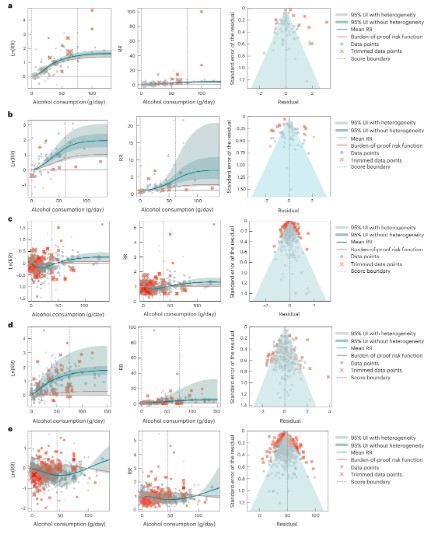
Fig. 1: Risk–outcome-specific risk curves and funnel plots.
The Harms of Alcohol May Be Greater Than Expected
The study categorized alcohol-related health risks into ratings from one star to five stars, based on the strength of evidence and the magnitude of risk. A higher star rating indicates stronger evidence and a greater increase in risk.
Five-Star Risk: Strong Evidence and Extremely High Risk
Pharyngeal cancer showed the greatest increase in risk. The study found that when alcohol intake reached about 76 grams per day, or roughly 7.5 standard drinks, the risk of developing pharyngeal cancer was 4.24 times that of non-drinkers. Even within typical daily drinking ranges, the risk increased by at least 105%.
Three-Star Risks: Strong Evidence and Significant Risk
For laryngeal cancer, the risk increased by at least 49%.
For cirrhosis and other chronic liver diseases, the risk increased by at least 40%.
For pancreatitis, colorectal cancer, and oral cancer, the risk increased by at least 22%.
Two-Star Risks: Clear Associations That Still Require Caution
For esophageal cancer and breast cancer, the risks increased by at least 15% and 12%, respectively.
For atrial fibrillation, the risk increased by at least 6%.
For liver cancer, pancreatic cancer, lower respiratory tract infections, and prostate cancer, the risk increased slightly, by around 1% to 3%.
For type 2 diabetes, Alzheimer’s disease, and other dementias, the relationship was “J-shaped” or “U-shaped.” This means that at very low doses, such as about 18 grams per day, risk appeared to decline slightly, but once intake exceeded a certain threshold, around 47 grams per day, the risk surpassed that of non-drinkers.
The research team emphasized that this weak “protective effect” is observational, uncertain, and may be influenced by other confounding factors.
One-Star Risks: Weak or Inconsistent Evidence
For stomach cancer, hemorrhagic stroke, ischemic stroke, tuberculosis, and ischemic heart disease, the evidence linking these outcomes to alcohol was very weak or inconsistent.
The Truth About Dose and Risk
The study clearly illustrated a “the more you drink, the higher the risk” pattern.
For most cancers, risk continued to rise as alcohol intake increased, with no safe threshold. For example, drinking one standard drink per day, equivalent to 10 grams of alcohol, increased breast cancer risk by 13% and colorectal cancer risk by 17%.
For some cardiovascular and metabolic diseases, the curve was J-shaped or U-shaped, meaning that risk was lowest at extremely low levels of alcohol intake. However, this “lowest point” occurred at a very low dose, around 18 grams per day, and the benefit was weak. Once intake exceeded a typical moderate drinking level, risk rose quickly.
Rethinking Drinking Habits
The policy implications of this study are very clear.
First, the illusion of a “safe threshold” should be abandoned. Even low-to-moderate alcohol consumption clearly increases the risk of multiple cancers. Any potential, small benefit, such as a possible cardiovascular benefit, must be weighed against these well-established harms.
Second, guidelines should be based on the full body of evidence. Public health policies and drinking guidelines should not focus on only a few disease categories, but should instead be developed based on the overall risks of alcohol across all health outcomes.
Third, the safest choice is zero alcohol. From the perspective of reducing the overall disease burden, not drinking is the lowest-risk option.
A New Look at What Is in the Glass
Scientific understanding is always evolving, and this most comprehensive and rigorous analysis to date tells us that the harms of alcohol to health are broad and well supported by evidence.
For long-term health, it may be time to reexamine what is in our glass. A healthy lifestyle is far more reliable than the uncertain benefits that might come from a fleeting moment of intoxication.
Related Products & Services
- Cell and Gene Therapy
- Immune Checkpoint Proteins
- ADC Target Protein
- PROTAC Targets
- Targets of CAR-T Cell Therapy
- Cancer Drug Targets
- Protein Engineering Services
- Protein Interaction Service
- Protein Expression and Purification Services
- Drug Discovery Screening
- Protein Pathway Profiling
Reference
- Dai, X., Nicholson, S.I., Lawlor, H.R. et al. Health effects associated with alcohol consumption: a Burden of Proof study. Nat. Health (2026). https://doi.org/10.1038/s44360-026-00139-5