
Uncategorized Tuesday, 2026/06/16
CKAP4 is a negative regulator of macrophage mechanosensing. Targeting CKAP4-related mechanotransduction pathways may offer a new mechanotherapeutic strategy for chronic wounds.
The Challenge: Chronic Wounds Stuck in Inflammation
Wound healing requires a timely transition from the inflammatory phase to the proliferative phase, whereas chronic wounds often remain stalled in the inflammatory stage for prolonged periods. How physical signals in injured tissues regulate macrophages and mediate this phase transition has remained unclear.
A research paper titled “Targeting the macrophage mechanosensing regulator CKAP4 accelerates the inflammatory-to-proliferative transition in wound healing” was published online in Cell Reports. The study was jointly led by corresponding authors Bei Li and Feng Xu from Xi’an Jiaotong University, and Yimin Zhao from Air Force Medical University. The researchers found that loss of CKAP4 in macrophages accelerated wound healing in mice and promoted the resolution of inflammation.
Our Related Proteins
| Cat.No. # | Product Name | Source (Host) | Species | Tag | Protein Length | Price |
|---|---|---|---|---|---|---|
| CKAP4-11261H | Recombinant Human CKAP4, GST-tagged | E.coli | Human | GST | 254-602a.a. | |
| CKAP4-28002TH | Recombinant Human CKAP4 protein, His-tagged | E.coli | Human | His | 254-602 aa | |
| CKAP4-001H | Recombinant Human CKAP4 protein, His-tagged | HEK293 | Human | His | 128-602 aa | |
| TLN1-3256H | Recombinant Human TLN1, His-tagged | E.coli | Human | His | 2193-2541aa | |
| TLN1-16819M | Recombinant Mouse TLN1 Protein | Mammalian Cells | Mouse | His |

|
|
| PIEZO1-3750H | Recombinant Human PIEZO1 Protein, GST-tagged | Wheat Germ | Human | GST |
|
|
| PIEZO1-4446R | Recombinant Rat PIEZO1 Protein | Mammalian Cells | Rat | His |
|
|
| PIEZO1-4106R | Recombinant Rat PIEZO1 Protein, His (Fc)-Avi-tagged | HEK293 | Rat | Avi&Fc&His |
|
|
| DKK1-12010H | Recombinant Human DKK1, GST-tagged | E.coli | Human | GST | 32-191a.a. | |
| DKK1-2340R | Recombinant Rhesus macaque DKK1 protein(256 Asn/Gln), mFc-tagged | HEK293 | Rhesus macaque | mFc | 1-266 aa, 256Asn/Gln | |
| DKK1-32H | Recombinant Human DKK1 protein, His-tagged | HEK293 | Human | His | 2-266 aa | |
| DKK1-278H | Active Recombinant Human DKK1 protein, Fc-Avi-tagged, Biotinylated | HEK293 | Human | Avi&Fc | 32-266 a.a. |
CKAP4 Deficiency Accelerates Wound Repair
CKAP4-deficient wounds exited the inflammatory state earlier, showed upregulation of repair-related genes, and exhibited significantly enhanced angiogenesis and tissue regeneration.
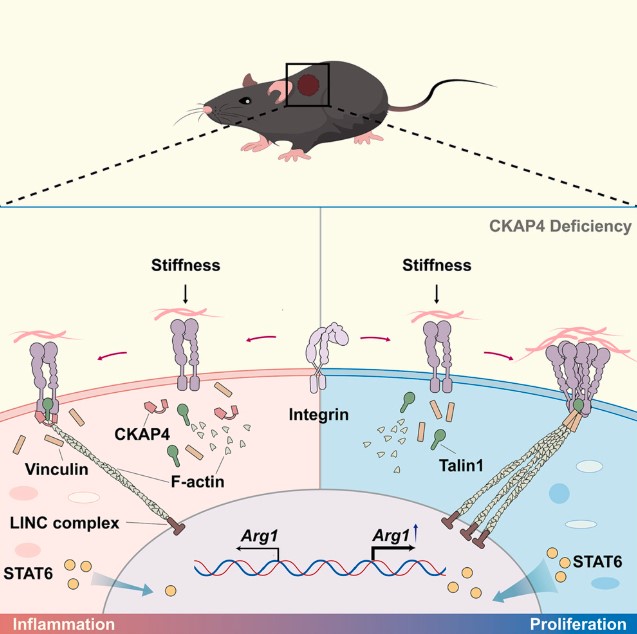
Mechanistically, CKAP4 binds to Talin1, thereby suppressing adhesion-related signaling and STAT6 nuclear translocation. After CKAP4 knockout, macrophages displayed enhanced sensitivity to matrix stiffness. Even under conditions of relatively low matrix stiffness, they underwent cytoskeletal remodeling and activated tissue repair-related programs.
In a diabetic wound model, local silencing of Ckap4 in macrophages restored their mechanosensitive response, promoted the transition from the inflammatory phase to the proliferative phase, and improved wound healing outcomes.
Taken together, CKAP4 acts as a negative regulator of macrophage mechanosensing. Targeting this pathway may provide a new mechanotherapeutic intervention strategy for wound treatment.
Chronic Diabetic Wounds Remain a Major Clinical Problem
Chronic, non-healing wounds, including diabetic foot ulcers (DFUs), are an urgent clinical challenge. Their prognosis is extremely poor: the five-year survival rate for patients with newly diagnosed DFUs is only 50%–60%, lower than that of many common malignancies.
Wound healing is a highly coordinated biological process consisting of three stages: inflammation, proliferation, and tissue remodeling. These stages overlap with one another but remain biologically distinct.
Among them, the transition from the inflammatory phase to the proliferative phase is a critical step in wound healing. Disruption of this process can lead to impaired re-epithelialization and persistent inflammation, which are typical pathological features of chronic wounds such as diabetic ulcers.
Macrophages as Key Regulators of Wound Healing
Macrophages are central cells that regulate each stage of wound healing. After circulating monocytes are recruited to sites of tissue injury, they differentiate into pro-inflammatory macrophages, which clear pathogens and cellular debris.
Subsequently, macrophages undergo phenotypic switching and transform into reparative, pro-proliferative cells that support angiogenesis, cell proliferation, and tissue regeneration.
Therefore, clarifying the molecular mechanisms that regulate macrophage transition from a pro-inflammatory phenotype to a reparative phenotype is essential for restoring healing in stalled wounds.
In addition to soluble factors, macrophages can also sense and respond to physical signals in their microenvironment, which significantly influence macrophage activation and polarization. Biophysical signals can regulate macrophage inflammatory responses through the YAP pathway. The mechanosensitive cation channel Piezo1 is an important mechanosensor in macrophages; in high-stiffness matrices, Piezo1-mediated calcium influx can establish a positive feedback loop between actin polymerization and inflammatory activation.
Although the role of physical signals in macrophage phase transition has been demonstrated, how mechanosensing is regulated and how it mediates the shift from an inflammatory to a proliferative phenotype remain unclear.
CKAP4: From ER Protein to Mechanotransduction Regulator
Cytoskeleton-associated protein 4, also known as CKAP4 or CLIMP-63, is a type II transmembrane protein localized to the endoplasmic reticulum (ER). It primarily maintains ER morphology, regulates organelle distribution, and mediates ER–mitochondria contacts.
Previous studies have often regarded CKAP4 as a receptor for Dickkopf-1 (DKK1). More recent research has found that CKAP4 is also involved in cellular mechanotransduction and the regulation of cell motility.
In bladder cancer cells, CKAP4 can generate a stiffness gradient across the cell membrane from the center to the periphery, helping cells establish front–rear polarity and achieve directional migration. While the function of CKAP4 in tumor progression has been relatively well studied, its role in immune cells remains unclear.
Because macrophages must continuously adapt to the mechanical features of the wound microenvironment, the researchers hypothesized that CKAP4 may regulate macrophage function through biomechanical mechanisms.
CKAP4 Restrains Reparative Macrophage Polarization
This study demonstrates that CKAP4 inhibits macrophage polarization toward a reparative phenotype from a biomechanical perspective. Loss of CKAP4 in macrophages promoted an earlier transition of wounds from the inflammatory phase to the proliferative phase, thereby accelerating healing.
Mechanistically, CKAP4 binds to TLN1 and regulates adhesion-related mechanotransduction. CKAP4 knockout enhances macrophage sensitivity to matrix stiffness.
The study further confirmed the interaction between CKAP4 and TLN1. When this interaction was disrupted, TLN1-mediated mechanotransduction was activated, leading to nuclear translocation of signal transducer and activator of transcription 6, or STAT6, which in turn induced macrophage polarization toward a reparative phenotype.
In a diabetic wound model, local silencing of Ckap4 in macrophages restored cellular mechanosensitivity, accelerated the transition from the inflammatory phase to the proliferative phase, and significantly improved wound healing outcomes.
A New Mechanotherapeutic Strategy for Chronic Wounds
In summary, CKAP4 is a negative regulator of macrophage mechanosensing. Targeted intervention in CKAP4-related mechanotransduction pathways may provide a new mechanotherapeutic strategy for chronic wounds.
Related Products & Services
- Cell and Gene Therapy
- Immune Checkpoint Proteins
- PROTAC Targets
- Protein Engineering Services
- Protein Interaction Service
- Protein Expression and Purification Services
- Drug Discovery ScreeningProtein Pathway Profiling
Reference
- Wang H, Liu W, Cheng J ...Targeting the macrophage mechanosensing regulator CKAP4 accelerates the inflammatory-to-proliferative transition in wound healing. Cell Reports, 2026; 45