
Uncategorized Tuesday, 2026/06/16
The study shows that activation of the IL-4–FLT3–STAT6 signaling axis in multipotent progenitors, or MPPs, can restore lymphocyte production under conditions of inflammation and aging.
Aging, Inflammation, and Hematopoietic Imbalance
Chronic inflammation and aging disrupt hematopoietic balance, driving a process known as myeloid skewing. In this state, hematopoietic stem and progenitor cells, or HSPCs, preferentially generate myeloid cells, while the production of lymphoid cells is suppressed.
This imbalance can create a self-reinforcing cycle. Expanded myeloid cells continue to secrete pro-inflammatory factors, which further intensify myeloid skewing and weaken lymphocyte generation. Over time, this contributes to immune decline, chronic inflammation, increased susceptibility to infection, and broader age-related functional deterioration.
Related Proteins
| Cat.No. # | Product Name | Source (Host) | Species | Tag | Protein Length | Price |
|---|---|---|---|---|---|---|
| IL4-10H |
Active Recombinant Human IL4 protein


|
E.coli | Human | Non | 129 amino acids | |
| Il4-297M |
Active Recombinant Mouse Il4
|
CHO | Mouse | Non | ||
| IL4-14204H | Recombinant Human IL4, His-tagged | E.coli | Human | His | 24-153 aa | |
| IL4-375H | Recombinant Human IL4 protein, Biotinylated | E.coli | Human | Non | His25-Ser153 | |
| IL4-139H | Recombinant Human IL4 protein, His-Avi-tagged, Biotinylated | HEK293 | Human | Avi&His | His25-Ser153 | |
| IL4-4323O | Recombinant Ovine IL4 Protein | Yeast | Ovine | Non | 111aa | |
| Il4-4344R | Recombinant Rat Il4 Protein | Yeast | Rat | Non | 123aa | |
| IL4-5183H | Recombinant Human IL4 Protein, GST-tagged | Wheat Germ | Human | GST | ||
| FLT3-12937H | Recombinant Human FLT3, GST-tagged | E.coli | Human | GST | 27-376a.a. | |
| FLT3-2243H | Active Recombinant Human FLT3 protein, His-tagged, Low Endotoxin | HEK293 | Human | His | 27-541 aa | |
| FLT3-107H | Recombinant Human FLT3 protein, His-Avi-tagged | HEK293 | Human | Avi&His | It contains Asn 27 - Asn 541. | |
| FLT3-2243HAF488 | Recombinant Human FLT3 Protein, His-tagged, Alexa Fluor 488 conjugated | HEK293 | Human | His | 526 | |
| STAT6-7039H | Recombinant Human STAT6 protein, His-tagged | Insect Cells | Human | His | 1-847 aa | |
| STAT6-01M | Recombinant Mouse STAT6 Protein, His-tagged | E.coli | Mouse | His | 1-837 aa |
A New Study Published in Immunity
Professor Yi Zhang’s team from Harvard Medical School and Boston Children’s Hospital published a research paper in Immunity. Dr. Jingfei Yao was the first author of the paper, titled “Activating an interleukin 4-FLT3-STAT6 axis in multipotent progenitors restores lymphopoiesis in inflammation and aging.”
The study demonstrates that activating the IL-4–FLT3–STAT6 signaling axis in MPPs can restore lymphopoiesis under inflammatory and aging conditions. This finding identifies IL-4 not merely as an anti-inflammatory cytokine, but also as an external signal capable of reshaping blood cell lineage decisions at the progenitor-cell level.
Screening for Signals That Restore Lymphoid Potential
In this latest study, the researchers screened type 2 and anti-inflammatory cytokines to identify extrinsic signals that could restore the lymphoid lineage differentiation capacity of HSPCs.
The results showed that interleukin-4, or IL-4, specifically suppressed inflammation-induced myeloid production and redirected MPP differentiation toward the lymphoid lineage. This suggests that IL-4 has a unique ability to counteract inflammatory hematopoietic remodeling.
Further experiments showed that IL-4 increased lymphoid-biased progenitor populations while reducing myeloid-biased progenitor populations, indicating that the cytokine acts at an early stage of hematopoietic lineage commitment.
The IL-4–FLT3–STAT6 Signaling Axis
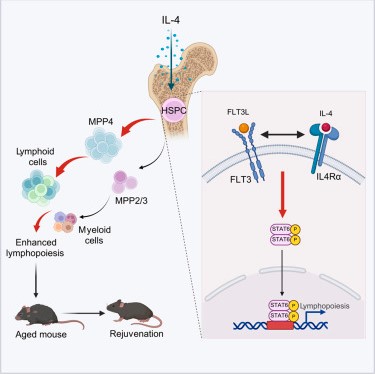
Mechanistically, IL-4 activated a STAT6-dependent transcriptional program in MPPs, thereby increasing the expression of lymphoid-specific genes.
A key feature of this mechanism is the interaction between FLT3 and the IL-4 receptor. FLT3 is a receptor tyrosine kinase that is highly expressed in MPPs, while IL-4 signals through the IL-4 receptor alpha chain, or IL-4Rα. The study found that FLT3 cooperates with IL-4Rα to promote STAT6 activation.
Once activated, STAT6 drives a lymphoid-associated gene-expression program, helping MPPs shift away from myeloid differentiation and toward lymphoid development. In other words, IL-4 appears to reset the developmental trajectory of progenitor cells by engaging a FLT3-assisted STAT6 signaling pathway.
Reversing Inflammation-Induced Myeloid Skewing
In in vivo experiments, IL-4 reversed inflammation-induced hematopoietic imbalance and accelerated the recovery of lymphoid tissues.
Under inflammatory conditions, hematopoiesis often becomes dominated by myeloid output, while lymphoid regeneration is impaired. IL-4 treatment counteracted this effect by suppressing excessive myelopoiesis and restoring lymphoid differentiation. This suggests that IL-4 may help interrupt the vicious cycle between inflammation, myeloid expansion, and further inflammatory signaling.
Importantly, the study indicates that this effect is not simply a broad anti-inflammatory response. Instead, IL-4 directly acts on MPPs and changes their lineage output, making it a targeted regulator of hematopoietic fate.
Restoring B Cell and T Cell Output in Aged Mice
In aged mice, IL-4 administration redirected MPPs toward lymphoid differentiation and restored the production of both B cells and T cells.
This is particularly important because aging is commonly associated with reduced lymphocyte generation, impaired adaptive immunity, weaker vaccine responses, and increased vulnerability to infection. By restoring lymphoid output, IL-4 treatment may help rebuild key components of the aging immune system.
Long-term IL-4 treatment in aged mice improved multiple aspects of organismal function, including immune, metabolic, physical, and cognitive performance. These findings suggest that correcting hematopoietic aging may have systemic benefits beyond the immune system itself.
Anti-Aging Effects Reproduced Through Treated HSPC Transplantation
The researchers further showed that the anti-aging effects could be reproduced by transplanting IL-4-treated hematopoietic stem and progenitor cells.
This finding supports the idea that IL-4 acts directly on the hematopoietic system rather than producing benefits only through indirect systemic effects. It also suggests that progenitor-cell reprogramming may be a central mechanism behind the observed improvements in aged animals.
From a therapeutic perspective, this raises the possibility that enhancing IL-4 signaling in MPPs could become a strategy for correcting inflammation- and aging-associated hematopoietic dysfunction.
Core Findings of the Study
The study’s major findings can be summarized as follows:
- IL-4 drives lymphoid differentiation of multipotent progenitors through the STAT6 pathway.
- FLT3 cooperates with IL-4 signaling to enhance STAT6 activation in MPPs.
- IL-4 counteracts inflammation-induced myeloid skewing and restores lymphopoiesis.
- IL-4 treatment restores aging-associated hematopoietic function and improves systemic performance in aged mice.
A Potential New Strategy for Immune Rejuvenation
Overall, this study reveals a previously underappreciated role for IL-4 in regulating hematopoietic lineage balance. By activating the IL-4–FLT3–STAT6 axis in MPPs, IL-4 can suppress inflammatory myeloid bias, promote lymphocyte generation, and improve functional outcomes in aged animals.
These findings provide new insight into how type 2 cytokine signaling influences hematopoietic aging. They also suggest that targeting IL-4 signaling in progenitor cells may offer a potential strategy for rejuvenating the aging immune system and treating hematopoietic dysfunction associated with chronic inflammation and aging.
However, the current evidence is still primarily based on experimental models. Whether IL-4-based interventions can safely and effectively restore hematopoietic balance in humans will require further investigation, especially given the broad immunological functions of IL-4 and the need to avoid unwanted inflammatory or allergic responses.
Related Products & Services
- Cell and Gene Therapy
- Immune Checkpoint Proteins
- ADC Target Protein
- PROTAC Targets
- Targets of CAR-T Cell Therapy
- Cancer Drug Targets
- Protein Engineering Services
- Protein Interaction Service
- Protein Expression and Purification Services
- Drug Discovery Screening
- Protein Pathway Profiling
Reference
- Yao J, Wang Y, Zhang Y. Activating an interleukin 4-FLT3-STAT6 axis in multipotent progenitors restores lymphopoiesis in inflammation and aging. Immunity, 2026; 0