
Uncategorized Tuesday, 2026/06/16
Researchers from the Center for Molecular Medicine at MaineHealth Institute for Research, the University of Maine, and other institutions have found that a protein called CTHRC1 acts as an “accomplice” in the microenvironment of colorectal cancer.
The Tumor Microenvironment: More Than a Passive Bystander
Colorectal cancer is one of the most common and deadliest digestive system malignancies worldwide. According to statistics from the International Agency for Research on Cancer of the World Health Organization, more than 1.9 million new cases of colorectal cancer and over 900,000 related deaths occurred globally in 2022.
For a long time, cancer research focused mainly on genetic mutations within cancer cells themselves. However, an increasingly clear fact has emerged: tumors are not isolated masses of cells. They are surrounded by a complex microenvironment composed of fibroblasts, immune cells, and various secreted proteins. Whether this microenvironment suppresses tumors or instead aids their progression has become a major frontier in cancer biology.
CTHRC1 Identified as a Pro-Tumorigenic Factor
Recently, in a research article published in the international journal Oncotarget titled “Microenvironmental CTHRC1 has a pro-tumorigenic role in colorectal cancer,” researchers from the Center for Molecular Medicine at MaineHealth Institute for Research, the University of Maine, and other institutions reported that a protein called CTHRC1 plays an “accomplice” role in the colorectal cancer microenvironment.
CTHRC1 stands for collagen triple helix repeat containing 1. It is a secreted protein that has previously been explored mainly in the context of tissue remodeling and cancer. Although CTHRC1 was known to be expressed in tumor-associated stroma, its specific function within the tumor microenvironment had long remained unclear.
This study provides the first direct evidence that host-derived CTHRC1 drives colon cancer progression, and this phenomenon was consistently validated across three independent mouse experimental cohorts.
Our Featured Proteins
| Cat.No. # | Product Name | Source (Host) | Species | Tag | Protein Length | Price |
|---|---|---|---|---|---|---|
| CTHRC1-3225H |
Recombinant Human CTHRC1 protein, His-tagged

|
HEK293 | Human | His | 1-243 aa | |
| CTHRC1-3570H | Recombinant Human CTHRC1 protein, His-tagged | E.coli | Human | His | 1-243 aa |
CTHRC1 Knockout Suppresses Tumor Growth in Mice
In the study, the researchers used a global Cthrc1 knockout mouse model and compared it with normal wild-type mice. After injecting the same colorectal cancer cells into both groups of mice, striking differences emerged.
Compared with wild-type mice, tumors that developed in Cthrc1 knockout mice were significantly smaller in volume and had lower tissue density. More importantly, the survival data were compelling: wild-type mice had a median survival of 28 days after tumor inoculation, whereas CTHRC1-deficient mice had a median survival of 69 days, representing an approximately 2.5-fold increase.
This result strongly suggests that CTHRC1 protein in the tumor microenvironment actually promotes tumor growth.
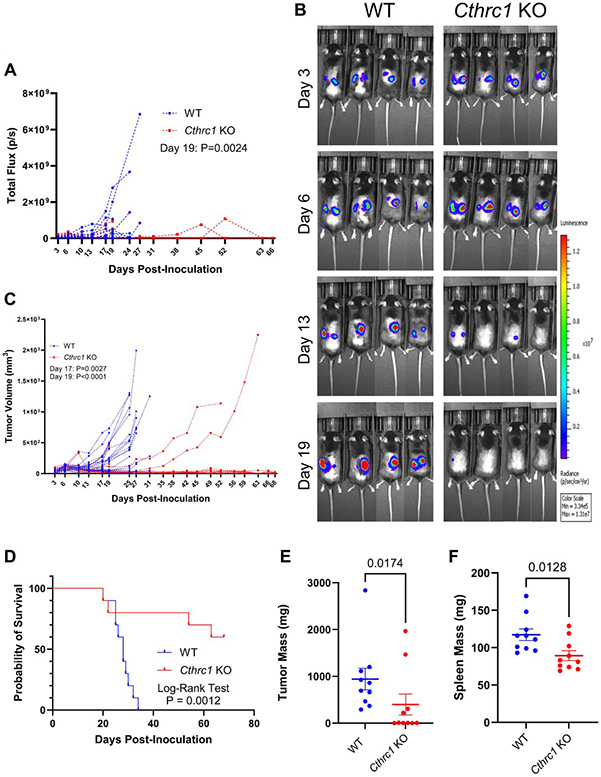
Fig2. Knocking out Cthrc1 leads to decreased CRC tumor burden and increases survival.
CTHRC1 May Weaken Anti-Tumor Immunity
The researchers further investigated the underlying mechanism. Immune cell lineage analysis showed that the percentage of CD3-positive T cells was significantly increased in the tumors and spleens of Cthrc1 knockout mice.
CD3-positive T cells are key effectors of anti-tumor immunity, and their increase indicates that the immune system’s ability to recognize and eliminate tumors is enhanced. At the same time, the proportion of Gr-1-positive myeloid cells was reduced in the spleens of knockout mice, and these cells are typically associated with immunosuppressive functions.
Taken together, CTHRC1 may weaken the body’s immune surveillance against tumors by suppressing T-cell activity or promoting the accumulation of suppressive myeloid cells, thereby creating an “immune-privileged” refuge for cancer cells.
A Microenvironment-Derived Signal Rather Than a Cancer Cell Product
A key finding of the study is that colorectal cancer cells themselves do not produce detectable levels of CTHRC1. Instead, the protein mainly comes from fibroblasts and other stromal components surrounding the tumor.
This rules out the possibility that cancer cells produce and use CTHRC1 in an autocrine manner, and clearly defines CTHRC1 as an external pro-cancer signal originating from the microenvironment.
Histopathological analysis further supported this conclusion. Tumor tissues from CTHRC1-deficient mice contained fewer cells and showed signs of degenerative changes, whereas tumors in normal mice maintained a highly cellular state and continued to expand.
Consistent Evidence Across Independent Mouse Cohorts
Professor Sergey Ryzhov summarized that, when immunocompetent C57BL/6 mice were compared with systemic Cthrc1 knockout mice, all three independent cohorts showed that loss of CTHRC1 significantly inhibited the growth of subcutaneous colorectal cancer xenografts.
These results identify CTHRC1 as a key driver of colorectal cancer. Its mode of action may involve suppressing the immune system, allowing tumor cells to more easily achieve immune escape.
A Potential New Target for Colorectal Cancer Therapy
This discovery not only deepens our understanding of how the colorectal cancer microenvironment regulates tumor progression, but also suggests that CTHRC1 may become a new target for future anticancer therapies.
If drugs can be developed to block CTHRC1 function, they may help reactivate suppressed anti-tumor immune responses and provide new therapeutic opportunities for patients with colorectal cancer who currently respond poorly to immunotherapy.
Of course, the current research remains at the animal-experiment stage. The specific role of CTHRC1 in human colorectal cancer patients, as well as the clinical translational value of targeting this protein, will require further investigation.
Related Products & Services
- Cell and Gene Therapy
- Immune Checkpoint Proteins
- ADC Target Protein
- PROTAC Targets
- Targets of CAR-T Cell Therapy
- Cancer Drug Targets
- Protein Engineering Services
- Protein Interaction Service
- Protein Expression and Purification Services
- Drug Discovery Screening
- Protein Pathway Profiling
Reference
- Haylee Duval,Barbara Toomey,Michelle Karam,et al. Microenvironmental CTHRC1 has a pro-tumorigenic role in colorectal cancer. Oncotarget 2026. DOI:10.18632/oncotarget.28878.