
Uncategorized Thursday, 2026/08/06
This study demonstrates that ABCB8 functions as a tumor suppressor gene in acute myeloid leukemia (AML) carrying −7/del(7q) abnormalities and reveals an epigenetic synergistic regulatory mechanism between two adjacent tumor suppressor genes. This process is driven by iron ion-mediated chromatin remodeling.
Chromosomal copy number alterations (CNAs) are important drivers of human malignancies, yet their underlying mechanisms remain incompletely understood. Monosomy 7 and deletion of the long arm of chromosome 7 (del(7q)) are frequently observed in acute myeloid leukemia and are strongly associated with poor patient prognosis. Current evidence suggests that this chromosomal region contains multiple tumor suppressor genes. Previous studies from this research team have identified the histone methyltransferase KMT2C as a tumor suppressor located within this region.
Liu Yu and Chen Chong from Sichuan University published a research article entitled “Intracellular iron homeostasis-regulated epigenetic reprogramming contributes to −7/del(7q) leukemia” online in Nature Communications. The study established a CRISPR-based hematopoietic stem and progenitor cell (HSPC) differentiation screening system and identified the mitochondrial iron transporter ABCB8 as an essential factor required for normal hematopoietic differentiation.
In vivo experiments demonstrated that loss of ABCB8 accelerates leukemia development, disrupts intracellular iron homeostasis, reduces the availability of cytoplasmic iron ions, and impairs the activity of multiple iron-dependent enzymes, including the histone demethylase KDM6A. Consequently, ABCB8 deficiency increases H3K27me3 modification levels and suppresses the expression of differentiation-associated genes through an iron- and KDM6A-dependent mechanism.
ABCB8 and KMT2C are neighboring genes located within the chromosome 7q region. These two genes cooperate to regulate H3K27me3 chromatin modification and jointly exert tumor-suppressive effects against leukemia development.
Overall, this study establishes ABCB8 as a tumor suppressor gene in AML with −7/del(7q) abnormalities and reveals an epigenetic cooperative regulatory mechanism between adjacent tumor suppressor genes, driven by iron-dependent chromatin remodeling.
Our Featured Proteins
| Cat.No. # | Product Name | Source (Host) | Species | Tag | Protein Length | Price |
|---|---|---|---|---|---|---|
| KMT2C-130H | Recombinant Human KMT2C Complex, His-tagged | E.coli | Human | His | 4689-4911;22-334;1-538;2-534;1-99 a.a. |

|
| ABCB8-8128H | Recombinant Human ABCB8 protein, His & T7-tagged | E.coli | Human | His&T7 | Val472~Ser735 |
|
| Abcb8-8129M | Recombinant Mouse Abcb8 protein, His & T7-tagged | E.coli | Mouse | His&T7 | Gly468~Ala717 |
|
| KDM6A-84H |
Active Recombinant Human KDM6A protein, FLAG-tagged

|
Insect Cells | Human | Flag | 1-1401 a.a. |
|
| KDM6A-8124H | Recombinant Human KDM6A protein(1095-1258aa), His&Myc-tagged | E.coli | Human | His&Myc | 1095-1258aa |
|
| TP53-3412H |
Active Recombinant Human TP53, His-tagged
|
E.coli | Human | His | ||
| TP53-1162CAF488 |
Active Recombinant Cynomolgus TP53 Protein, Alexa Fluor 488 conjugated
|
E.coli | Monkey | 393 | ||
| EIF5A-12388H | Recombinant Human EIF5A, GST-tagged | E.coli | Human | GST | 1-154a.a. | |
| PHF23-12729M | Recombinant Mouse PHF23 Protein | Mammalian Cells | Mouse | His |
|
|
| ALOX15B-408H | Recombinant Human ALOX15B, Gly & Pro tagged | Insect Cells | Human | Fc&His | 1-676 a.a. |
|
| ALOX15B-486H | Recombinant Human ALOX15B Protein, GST-tagged | Wheat Germ | Human | GST |
|
Chromosomal Copy Number Alterations and Tumor Suppressor Gene Loss in Cancer
Somatic copy number alterations (CNAs) represent a hallmark feature of malignant tumors, occurring at frequencies comparable to single nucleotide variants (SNVs). Current studies indicate that more than 70% of cancers harbor CNAs, and some tumors may lack identifiable driver SNVs altogether.
Unlike SNVs, which typically affect the function of individual genes through gain-of-function or loss-of-function mutations, CNAs frequently involve amplification or deletion of large chromosomal regions or entire alleles. Representative examples include loss of chromosome 17p, chromosome 7 monosomy, and deletion of chromosome 7q.
Such alterations can simultaneously affect the copy number of hundreds of genes. Tumors carrying these chromosomal CNAs are often characterized by increased aggressiveness, enhanced drug resistance, and unfavorable clinical outcomes. Therefore, elucidating the molecular mechanisms by which CNAs drive tumor initiation and progression is critical for advancing cancer biology research and therapeutic development.
Multiple studies have demonstrated that frequently deleted chromosomal regions are enriched for tumor suppressor genes (TSGs). For example, chromosome 17p, one of the most commonly deleted regions in human cancers, contains the classical tumor suppressor gene TP53. Recent studies have also identified additional TSGs within this region, including EIF5A, PHF23, and ALOX15B.
These findings not only reveal the complexity of tumor-promoting mechanisms associated with 17p deletion but also uncover multiple tumor suppressor regulatory networks, including:
- the polyamine–hypusine signaling axis;
- the PHF23–SIN3–HDAC epigenetic regulatory pathway;
- the arachidonic acid metabolism reprogramming pathway.
Tumor suppressor genes located within chromosomal deletion regions often exhibit extremely low mutation frequencies in cancer.
Furthermore, some TSGs can promote tumor development even when their mRNA expression is reduced by only half, indicating that the remaining wild-type allele remains essential for tumor cell survival and proliferation. Since chromosomal deletions simultaneously alter the copy number of hundreds of genes, the integrated effects of these changes on tumor biology remain insufficiently characterized.
A deeper understanding of these mechanisms will improve our knowledge of tumor progression and facilitate the identification of potential therapeutic targets.
ABCB8–KDM6A Axis Reveals an Iron–Epigenetic Regulatory Circuit in Leukemia
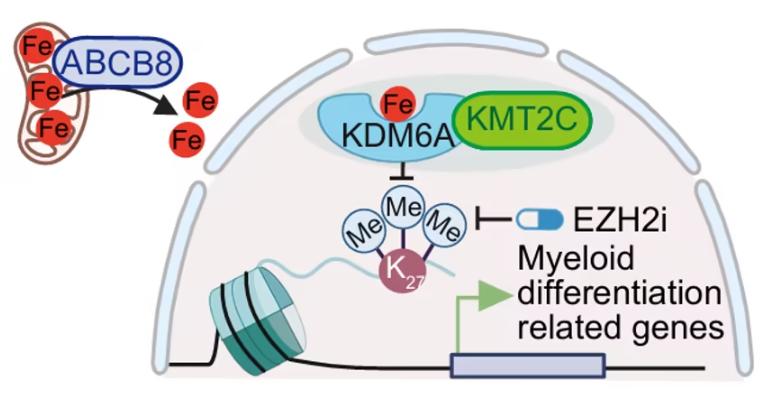
Graphical Abstract
This study provides the first evidence that ABCB8 is a tumor suppressor gene located at chromosome 7q36. Similar to KMT2C, ABCB8 deficiency inhibits differentiation of hematopoietic stem and progenitor cells (HSPCs) and promotes AML development in mouse models.
Complete chromosome 7 loss or chromosome 7q deletion is frequently observed in myelodysplastic syndromes (MDS) and AML and is generally associated with poor clinical outcomes.
ABCB8 encodes ATP-binding cassette subfamily B member 8 (ABCB8), a mitochondrial transporter involved in iron trafficking. Mechanistically, the tumor-suppressive function of ABCB8 is associated with epigenetic reprogramming, likely through regulation of the iron-dependent histone demethylase KDM6A.
Loss of ABCB8 reduces intracellular iron availability, impairs KDM6A activity, and ultimately increases the level of the key epigenetic mark histone H3 lysine 27 trimethylation (H3K27me3).
The study identifies an ABCB8–KDM6A-mediated iron–epigenetic regulatory circuit and demonstrates its essential role in leukemia biology. These findings provide new insights into how chromosomal deletions contribute to cancer development through coordinated regulation of metabolism, chromatin remodeling, and tumor suppressor networks.
Related Products & Services
- Cell and Gene Therapy
- Immune Checkpoint Proteins
- ADC Target Protein
- PROTAC Targets
- Targets of CAR-T Cell Therapy
- Cancer Drug Targets
- Protein Engineering Services
- Protein Interaction Service
- Protein Expression and Purification Services
- Drug Discovery Screening
- Protein Pathway Profiling
Reference
- Zheng, J., Peng, Y., Deng, X., Zhang, L., Wang, Z., Chen, X., Li, H., Li, Y., Zhang, Q., Zheng, L., Qi, Z., Wang, L., Lu, M., Cui, W., Wang, L., Wu, Y., Zhao, W., Niu, T., Chen, C., . . . Liu, Y. (2026). Intracellular iron homeostasis-regulated epigenetic reprogramming contributes to −7/del(7q) leukemia. Nature Communications. https://doi.org/10.1038/s41467-026-75292-2