
Uncategorized Sunday, 2026/09/13
A landmark study has demonstrated that genome language models can generate complete, viable, and functional bacteriophage genomes. Much like large language models generate coherent text, these AI systems can learn the underlying “grammar” of DNA and use it to design genomes that are substantially different from known natural phages.
Evolution continuously explores genetic sequence space, producing new biological functions through mutation, recombination, and natural selection. If scientists could systematically explore this enormous design space, they might be able to create biological systems with useful properties for biotechnology, medicine, and synthetic biology.
However, designing an entire genome is far more difficult than engineering an individual protein or gene. Even relatively small genomes contain tightly interconnected coding sequences, regulatory elements, structural constraints, and functional dependencies. A single unfavorable mutation may disrupt essential interactions and render an organism nonviable.
For this reason, most advances in biological design have historically focused on individual proteins, genes, or relatively simple genetic circuits. Designing a complete functional genome remains one of the most challenging goals in synthetic biology.
A research team led by Brian L. Hie at Stanford University and the Arc Institute published a study in Science entitled Generative Design of Bacteriophages with Genome Language Models. The work provides the first peer-reviewed demonstration that genome-scale generative AI can produce complete bacteriophage genomes that remain functional after synthesis.
Using the small bacteriophage ΦX174 as a design template, the researchers applied the genome language models Evo 1 and Evo 2 to generate thousands of candidate phage genomes. After computational selection and experimental evaluation, the researchers identified 16 viable AI-generated bacteriophages with diverse biological properties.
Evo 1 and Evo 2: AI Models That Learn to “Write” Genomes
Genome language models apply concepts similar to those behind large language models, but instead of learning patterns in human language, they learn statistical and biological relationships within DNA sequences.
These models are trained on massive collections of genomic data representing organisms across the tree of life. By processing large amounts of DNA sequence information, they can learn patterns associated with genes, regulatory regions, genome organization, evolutionary conservation, and interactions among different parts of a genome.
In a simplified analogy, ChatGPT learns which words and sentences are likely to form meaningful language, whereas a genome language model learns which combinations of DNA sequences are more likely to form biologically plausible genetic systems.
Importantly, however, generating a genome is much more demanding than simply producing a DNA sequence that “looks” realistic. The resulting sequence must encode proteins correctly, maintain essential regulatory relationships, preserve compatible structural elements, and ultimately support a complete biological life cycle.
The researchers therefore selected ΦX174, a well-studied bacteriophage that infects Escherichia coli, as the template for genome design. Its genome is only about 5 kilobases long, making it one of the more manageable systems for testing whether AI can move from designing individual biological components to designing an entire functional genome.
Evo 1 and Evo 2 generated thousands of complete candidate bacteriophage genomes with realistic genetic architectures. Nearly 300 selected designs were chemically synthesized and experimentally tested.
Ultimately, 16 of the AI-designed genomes produced viable bacteriophages capable of infecting bacterial hosts.
This result is particularly important because it demonstrates that a generative model can capture enough of the complex evolutionary constraints encoded in DNA to generate entire functional biological systems—not merely isolated genes or proteins.
Our Related Proteins


AI-Generated Genomes Unlike Those Found in Nature
The viable AI-generated phages displayed substantial genetic and functional diversity.
Rather than simply reproducing ΦX174 with a few mutations, the generated genomes contained combinations of sequence changes, altered genes and regulatory elements, and variation in genome organization and length. Their fitness profiles also differed considerably under laboratory conditions.
In other words, the models did not merely “copy and paste” existing bacteriophage genomes. They explored combinations of genetic features that differed substantially from known natural sequences while still preserving enough functional coherence for the resulting phages to survive and reproduce.
One particularly striking example was revealed using cryo-electron microscopy.
The researchers found that one generated phage incorporated a DNA-packaging protein associated with an evolutionarily distant group of phages into its capsid architecture.
Conceptually, this resembles an AI system assembling a new biological design by drawing compatible components from evolutionary “toolboxes” that would normally be separated by considerable genetic distance.
This observation suggests that genome language models may be able to identify combinations of biological components that natural evolution has not commonly explored—or that scientists would not necessarily select through conventional genome engineering.
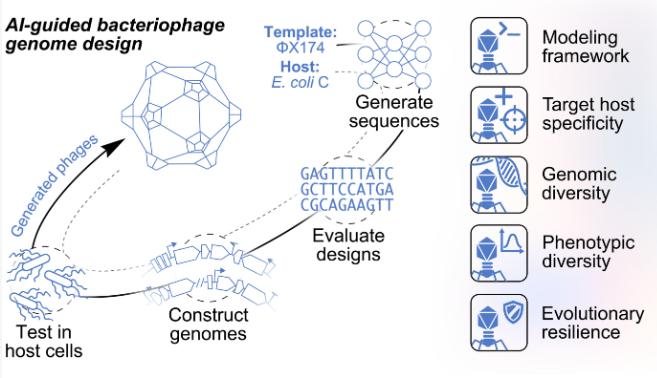
Fig1. A framework for AI-guided bacteriophage genome design. (from Science)
AI-Designed Phages Can Help Overcome Bacterial Resistance
One of the most interesting aspects of the study involved bacterial resistance.
Bacteriophages naturally infect and kill bacteria, which has made them attractive candidates for treating bacterial infections, particularly as antibiotic resistance becomes an increasingly serious global health challenge.
However, bacteria can also evolve resistance to bacteriophages. This creates an evolutionary arms race: a phage may effectively infect a bacterial strain initially, but resistant bacterial populations can eventually emerge.
The researchers therefore asked whether AI-generated phages could provide greater genetic diversity for overcoming this resistance.
They tested combinations of generated phages against E. coli strains that had developed resistance to ΦX174.
The results showed that a cocktail of AI-generated phages rapidly overcame ΦX174-resistant bacterial strains. In comparison, a similar mixture composed of naturally derived ΦX174-like phages was unable to achieve the same effect under the tested conditions.
The experiment highlights one potentially important advantage of generative genome design: AI may be able to search a much broader genetic design space than researchers could practically explore through conventional screening alone.
Instead of searching only among bacteriophages already found in nature, researchers could potentially generate additional sequence diversity computationally and then experimentally identify candidates with desirable host specificity or fitness characteristics.
This does not mean that AI-designed phages are ready for clinical use. Considerably more research would be required to evaluate efficacy, stability, host range, immune responses, manufacturing, environmental effects, and safety. Nevertheless, the study provides an important proof of concept for future phage engineering.
From Protein Design to Whole-Genome Design
AI-assisted biological design has advanced rapidly in recent years.
Many systems have already demonstrated impressive capabilities in predicting protein structures, designing proteins, generating antibodies, and optimizing individual biological molecules. Whole genomes, however, represent a fundamentally more complicated level of organization.
A genome is not simply a collection of independent genes. Its biological function depends on interactions among coding sequences, regulatory regions, genome topology, expression timing, protein-protein interactions, and numerous evolutionary constraints.
The successful generation of viable phage genomes therefore suggests that genome language models are beginning to learn biological relationships extending beyond individual genes.
This represents an important conceptual transition from AI-assisted molecular design toward AI-assisted genome-scale biological design.
Important Limitations Remain
Despite the significance of the findings, several limitations should be considered.
First, the study focused on small bacteriophage genomes of approximately 5 kb. These genomes are dramatically smaller and less complex than bacterial genomes, and even further removed from the complexity of eukaryotic genomes.
Moving from several thousand bases to genomes containing millions or billions of bases would create major computational and biological challenges. Long-range genomic interactions, chromosome organization, gene regulation, epigenetic mechanisms, developmental processes, and cellular metabolism would all need to be considered.
Second, computational generation is only part of the process. Candidate genomes must ultimately be synthesized and experimentally validated. As genomes become larger, DNA synthesis, assembly, quality control, and functional testing become substantially more difficult and expensive.
Third, biosafety and biosecurity considerations are increasingly important as genome-generation capabilities improve.
The current study used bacteriophages that infect bacteria, but the broader ability of AI systems to generate functional viral genomes raises important questions about how such models, datasets, experimental workflows, and future applications should be governed. Responsible development will require appropriate safeguards, risk assessment, transparency, and scientific oversight.
The publication of a Science commentary specifically discussing the biosafety and biosecurity implications of AI-designed viral genomes underscores that these issues are likely to become increasingly important as generative biology advances.
Why This Study Matters
Despite these limitations, the study establishes a new paradigm for synthetic genomics.
For the first time, researchers have demonstrated in a peer-reviewed study that a generative genome model can capture enough of the evolutionary constraints embedded within DNA to produce complete, viable bacteriophage genomes with substantial genetic novelty and experimentally measurable functions.
The achievement expands the concept of generative biology beyond designing individual proteins or genes.
In the future, similar approaches could potentially help researchers explore larger genomic design spaces, develop specialized bacteriophages for biotechnology, investigate fundamental principles of genome organization, and create synthetic biological systems with predefined properties.
One particularly promising area is bacteriophage research aimed at addressing antibiotic-resistant bacteria. Because bacterial pathogens can evolve rapidly, therapeutic strategies may also need to adapt rapidly. Generative genome models could eventually provide another tool for exploring phage diversity and developing candidates capable of targeting bacterial strains that have become resistant to existing phages.
At the same time, the technology needs to advance alongside appropriate biological containment, safety evaluation, and governance frameworks.
The larger significance of this work therefore extends beyond the 16 viable bacteriophages generated in the study. It demonstrates that AI is beginning to move from reading biological information and predicting biological structures to actively generating genome-scale biological designs.
The ability to “write genomes” with AI remains at an early stage, but this study marks an important milestone toward a future in which generative models could become powerful tools for synthetic genomics and biological engineering.
Related Products & Services
- Cell and Gene Therapy
- Immune Checkpoint Proteins
- ADC Target Protein
- PROTAC Targets
- Targets of CAR-T Cell Therapy
- Cancer Drug Targets
- Protein Engineering Services
- Protein Interaction Service
- Protein Expression and Purification Services
- Drug Discovery Screening
- Protein Pathway Profiling
Reference
King, S. H., Driscoll, C. L., Li, D. B., et al. Generative Design of Bacteriophages with Genome Language Models. Science (2026). DOI: 10.1126/science.aec2657.