
Uncategorized Sunday, 2026/09/13
A seven-decade longitudinal study suggests that persistent financial adversity across adulthood is associated with poorer cognitive performance in midlife and signs of greater brain atrophy later in life. By combining prospectively collected socioeconomic data with cognitive testing and MRI-based neuroimaging, the research provides compelling life-course evidence that long-term financial hardship may leave measurable marks on brain health.
Dementia is one of the leading contributors to the global burden of disease, and the number of people living with dementia worldwide is expected to rise dramatically over the coming decades.
Although age and genetics are major determinants of dementia risk, growing evidence suggests that potentially modifiable environmental and social factors also influence how the brain ages. Socioeconomic circumstances—including income, education, occupation, housing conditions, and financial insecurity—have increasingly emerged as important factors associated with cognitive health.
However, an important limitation of many previous studies is that socioeconomic status has been measured only at a single point in time.
A temporary period of financial difficulty may have very different consequences from financial insecurity that persists for decades. Capturing this cumulative exposure requires exceptionally long-term studies that follow the same individuals across much of their lives.
Yiwen Liu and colleagues at University College London (UCL) published a study in Innovation in Aging entitled Persistent Financial Adversity and Cognitive Aging: A Life Course Investigation.
Using data collected over approximately seven decades, the researchers examined a central question:
What happens to cognitive and brain health when financial adversity persists throughout a substantial portion of adult life?
Their findings suggest that sustained financial hardship is associated with poorer cognitive performance by midlife and structural indicators of poorer brain health decades later.
A 70-Year Study: From Birth Records to Brain MRI
The researchers used data from the 1946 British birth cohort, formally known as the National Survey of Health and Development (NSHD).
The NSHD is one of the world's longest-running continuously followed birth cohort studies. Participants have been assessed repeatedly since birth, allowing researchers to examine how childhood circumstances, adult socioeconomic conditions, health behaviors, disease, and other exposures relate to health later in life.
The current analysis included 2,759 participants.
The researchers assessed two complementary indicators of financial adversity between approximately ages 26 and 53:
- low household income; and
- reported financial hardship.
Using repeated measurements rather than a one-time assessment allowed the researchers to distinguish persistent financial difficulties from more temporary periods of economic adversity.
The study then linked these exposures to several measures of cognitive and neurological health:
- cognitive performance at age 53;
- changes in cognitive performance between ages 53 and 69; and
- brain MRI measurements at approximately ages 69–71.
A subset of participants also took part in Insight 46, the NSHD neuroimaging study. Depending on the specific imaging analysis, approximately 356–468 participants contributed neuroimaging data.
This design allowed the researchers to connect socioeconomic circumstances measured decades earlier with objectively measured brain structure in later life.
Key Finding 1: Persistent Financial Adversity Was Associated With Poorer Midlife Cognition
One of the clearest findings involved cognitive performance at age 53.
Participants who experienced greater exposure to low household income or financial hardship tended to perform worse on tests measuring:
- processing speed, and
- verbal memory.
Processing speed reflects how efficiently the brain can perceive, interpret, and respond to information. Verbal memory, meanwhile, measures the ability to encode, retain, and recall verbally presented information.
Both abilities are important components of cognitive aging.
The relationship also showed evidence of a cumulative pattern: greater exposure to financial adversity across adulthood was generally associated with poorer cognitive performance.
This supports a life-course accumulation model, in which repeated or persistent disadvantage may have a greater impact than an isolated episode of financial difficulty.
In other words, it may not simply be whether someone has ever experienced financial stress that matters. How long that financial hardship persists may also be important.
Key Finding 2: Slower Memory Decline Did Not Mean Financial Hardship Was Protective
At first glance, one finding appeared counterintuitive.
Participants exposed to more persistent financial adversity showed somewhat slower rates of verbal memory decline between ages 53 and 69.
This might seem to suggest that financial hardship somehow protected against cognitive decline.
The researchers emphasized that this interpretation would be misleading.
People who had experienced persistent financial adversity already had lower verbal memory scores at age 53. Their apparently slower subsequent decline therefore likely reflected an earlier cognitive disadvantage rather than any beneficial effect.
Put simply, the more financially disadvantaged group started from a lower cognitive baseline.
This distinction is important when interpreting longitudinal cognitive studies. A person who begins with relatively high cognitive performance may have more measurable capacity to lose over time, whereas someone who has already experienced cognitive disadvantages by midlife may show a smaller numerical decline later.
The finding therefore points toward an important possibility: the cognitive consequences associated with long-term financial adversity may already be detectable by middle age, well before the period when dementia is typically diagnosed.
Key Finding 3: Persistent Low Income Was Associated With Greater Brain Atrophy
The neuroimaging findings provided another important layer of evidence.
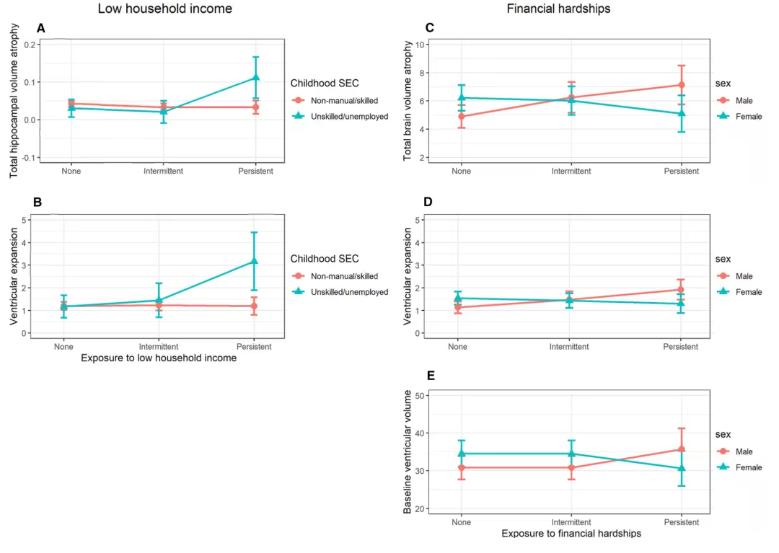
Persistent exposure to low household income was associated with greater ventricular volume later in life.
The estimated difference was approximately 4.67 mL.
The brain contains fluid-filled spaces known as ventricles. As brain tissue is lost through aging or neurodegenerative processes, these spaces can become larger.
For this reason, increased ventricular volume is commonly used as an imaging marker associated with brain atrophy.
The association between long-term financial adversity and ventricular enlargement is particularly noteworthy because it extends the findings beyond cognitive test scores.
Rather than relying only on subjective reports or behavioral measures, the study found that decades of financial adversity were also associated with measurable differences in brain structure at around age 70.
This does not prove that financial adversity directly causes neuronal loss. Nevertheless, the finding strengthens the evidence that socioeconomic conditions across adulthood may be related to biological processes involved in brain aging.
Who Appeared Most Vulnerable?
The researchers also examined whether the association between financial adversity and brain aging differed across population subgroups.
Three groups appeared particularly vulnerable.
1. Men
Associations between persistent financial adversity, cognition, and brain atrophy were stronger among men in this cohort.
This finding is interesting because sex differences in the relationship between stress and health are complex, and vulnerability can vary substantially depending on the outcome being studied.
One possible consideration is the historical context of the participants.
Because these individuals were born in Britain in 1946, traditional employment and gender roles were much more pronounced during much of their working lives. Financial insecurity may therefore have had different social or psychological implications for men and women in this particular generation.
The authors consequently caution against assuming that exactly the same sex differences would necessarily appear in younger generations.
2. People From Disadvantaged Childhood Backgrounds
Participants who grew up in poorer socioeconomic circumstances appeared more susceptible to the effects associated with financial adversity during adulthood.
This supports the idea of cumulative disadvantage.
Early-life socioeconomic adversity may affect educational opportunities, health, nutrition, environmental exposures, employment prospects, and access to resources. When financial difficulties continue into adulthood, disadvantages from different stages of life may accumulate rather than operate independently.
The findings therefore suggest that adult financial hardship cannot always be understood separately from childhood socioeconomic circumstances.
3. APOE-ε4 Carriers
The association with poorer brain outcomes was also stronger among carriers of APOE-ε4.
APOE-ε4 is the best-established common genetic risk factor for late-onset Alzheimer's disease.
Importantly, carrying APOE-ε4 does not mean that a person will develop Alzheimer's disease. Instead, it alters statistical risk.
The findings suggest a possible gene–environment interaction, in which individuals with greater inherited vulnerability to neurodegeneration may also be more susceptible to the effects associated with long-term socioeconomic adversity.
This is particularly relevant to modern dementia research, which increasingly recognizes that genetic and environmental risks do not necessarily operate independently.
Our Related Proteins
| Cat.No. # | Product Name | Source (Host) | Species | Tag | Protein Length | Price |
|---|---|---|---|---|---|---|
| Apoe-25M |
Recombinant Mouse Apoe protein, His-tagged, Low Endotoxin

|
HEK293 | Mouse | His | 19-311 aa | |
| APOE-1377H |
Recombinant Human APOE protein, His-tagged, Low Endotoxin
|
HEK293 | Human | His | 19-317 aa | |
| APOE-2630H |
Recombinant Human Apolipoprotein E, E2 Isoforms
|
S.frugiperda | Human | Non | 112-158 a.a. | |
| APOE-17H | Recombinant Human APOE Protein, His-tagged | HEK293 | Human | His | ||
| APOE-726R | Recombinant Full Length Rat apolipoprotein E Protein, His tagged | HEK293 | Rat | His | Full L. 1-312 aa |
How Could Financial Hardship Affect Cognitive Aging?
The study was not designed to identify a single biological mechanism, and several pathways could potentially contribute.
One possibility is chronic psychological stress.
Persistent worries about rent, debt, bills, employment, housing, or basic living expenses can activate physiological stress systems repeatedly over many years. Chronic stress has been associated with changes in cardiovascular, metabolic, inflammatory, and neuroendocrine processes that may influence brain health.
Financial scarcity may also impose a substantial cognitive load.
When a significant proportion of mental resources must constantly be devoted to urgent financial decisions, fewer cognitive resources may be available for attention, planning, learning, and other tasks.
Over decades, socioeconomic disadvantage may also influence brain aging indirectly through factors such as:
- educational opportunities;
- occupational complexity;
- diet and nutrition;
- physical activity;
- smoking and alcohol use;
- cardiovascular health;
- chronic disease;
- sleep quality;
- healthcare access;
- housing and neighborhood conditions;
- social participation; and
- exposure to chronic stress.
These mechanisms are not mutually exclusive.
Financial adversity may instead represent a cluster of interconnected exposures that accumulate throughout the life course.
An Important Strength: Prospective Data Rather Than Memories of Poverty
One of the most important strengths of the study is its unusually long follow-up period.
Many studies examining childhood or early-adult socioeconomic circumstances rely on participants who are already older adults being asked to remember conditions from decades earlier.
Such retrospective reports can be affected by recall bias.
The NSHD, by contrast, collected information prospectively while participants were actually progressing through different stages of life.
Financial conditions were measured repeatedly during adulthood rather than reconstructed decades later.
The study also combined these longitudinal socioeconomic measures with cognitive testing and objective neuroimaging.
Together, these features provide unusually detailed evidence about how persistent economic adversity across adulthood is associated with later cognitive and neurological outcomes.
But Association Does Not Prove Causation
Despite its strengths, the study should not be interpreted as evidence that poverty inevitably causes brain atrophy or dementia.
It remains an observational study.
People who experience persistent financial adversity can differ from more financially secure individuals in many ways that are difficult to measure completely.
Even with statistical adjustment, residual confounding may remain.
For example, chronic illnesses, occupational exposures, healthcare access, health behaviors, psychosocial stress, education, and numerous environmental factors could contribute both to economic circumstances and to cognitive aging.
Reverse relationships are also possible in some contexts. Health or cognitive difficulties earlier in adulthood may, for example, influence employment opportunities and income.
The study therefore demonstrates a robust long-term association, rather than proving a simple one-directional causal pathway in which low income directly produces brain tissue loss.
Another Limitation: The Cohort Represents a Specific Generation
The participants were members of a British birth cohort born in 1946 and were predominantly White.
Their social environment differed considerably from that experienced by younger generations today.
Employment patterns, gender roles, educational access, healthcare, welfare systems, retirement structures, and the meaning of household income have all changed since these participants entered adulthood.
The findings therefore need to be replicated in more ethnically, geographically, and socioeconomically diverse populations.
Nevertheless, few datasets in the world can provide comparable prospective information across seven decades, making the NSHD uniquely valuable for studying life-course cognitive aging.
Why the Study Matters
The broader significance of the study lies in the idea that dementia prevention may need to begin much earlier than old age.
If socioeconomic disadvantage is already associated with poorer cognitive performance by the early 50s, then waiting until memory problems appear in the 70s may miss an important window for prevention.
Traditionally, discussions about dementia prevention have focused heavily on individual behaviors—for example, exercise, diet, smoking cessation, and intellectual activity.
These factors remain important.
However, this study adds to growing evidence that brain health is also shaped by social and economic environments.
An individual living with decades of unstable income, financial stress, insecure employment, or limited access to resources may face health risks that cannot be addressed solely by advising them to adopt healthier behaviors.
From a public-health perspective, policies that reduce persistent financial insecurity may therefore have consequences extending beyond immediate living standards.
Supporting financially vulnerable adults during working age could potentially contribute to healthier cognitive aging decades later.
Conclusion
The study provides unusually detailed life-course evidence linking persistent financial adversity with cognitive performance and later-life brain structure.
People who experienced repeated or sustained low income and financial hardship across adulthood tended to show poorer processing speed and verbal memory by age 53. Persistent low income was also associated with greater ventricular volume—an imaging marker consistent with greater brain atrophy—around age 70.
These associations were particularly pronounced among men, people from disadvantaged childhood socioeconomic backgrounds, and APOE-ε4 carriers.
The findings do not mean that being poor automatically causes dementia, nor do they establish financial hardship as a direct biological cause of brain atrophy.
Instead, they highlight a broader and increasingly important principle in aging research:
Brain aging does not begin in old age, and it does not occur independently of the social conditions in which people spend their lives.
Financial security may therefore matter not only for present-day quality of life but also for cognitive and brain health decades into the future.
Related Products & Services
- Cell and Gene Therapy
- Immune Checkpoint Proteins
- ADC Target Protein
- PROTAC Targets
- Targets of CAR-T Cell Therapy
- Cancer Drug Targets
- Protein Engineering Services
- Protein Interaction Service
- Protein Expression and Purification Services
- Drug Discovery Screening
- Protein Pathway Profiling
Reference
Liu Y, Wels J, James S-N, et al. Persistent financial adversity and cognitive aging: a life course investigation. Innovation in Aging. 2026;10(8). doi:10.1093/geroni/igag054.