
Uncategorized Sunday, 2026/03/22
-Nobel Prize Team Uncovers the Molecular Switch Behind Touch
This study fully reveals the core mechanism behind the human sense of touch and its remarkable ability to distinguish subtle differences in force.
When someone gently taps your shoulder, what seems like a simple action actually involves an intricate, nanoscale molecular code. Why can your skin precisely distinguish between a gentle touch and a rough impact? Why can it sense the brush of a feather, yet not mistake the constant pressure of clothing for touch?
Recently, the team led by Ardem Patapoutian, winner of the 2021 Nobel Prize in Physiology or Medicine, published a groundbreaking paper in Nature titled “The molecular basis of force selectivity by PIEZO2”, uncovering the fundamental mechanism behind this “precision force discrimination” in human touch.
The Mystery of Two Similar but Different Sensors
Patapoutian was awarded the Nobel Prize for discovering PIEZO1 and PIEZO2, two mechanically activated ion channels. These proteins act like “biological switches” embedded in the cell membrane: when triggered by mechanical force, they open and allow charged ions to flow into the cell, converting physical stimuli into electrical signals that give rise to touch, proprioception, and pain.
However, a long-standing puzzle remained. Although PIEZO1 and PIEZO2 have highly similar structures (as revealed by cryo-electron microscopy), their functions are strikingly different:
- PIEZO1 responds to membrane stretching and is involved in sensing forces such as blood flow shear stress and cell swelling.
- PIEZO2 is highly specialized for detecting localized indentation and is essential for sensing light touch.
Why would two structurally similar channels evolve into such distinct “mechanical sensors”? This question has puzzled scientists for years.
Our Related Proteins
| Cat.No. # | Product Name | Source (Host) | Species | Tag | Protein Length | Price |
|---|---|---|---|---|---|---|
| PIEZO1-3750H | Recombinant Human PIEZO1 Protein, GST-tagged | Wheat Germ | Human | GST |

|
|
| PIEZO1-4446R | Recombinant Rat PIEZO1 Protein | Mammalian Cells | Rat | His |
|
|
| PIEZO1-4106R | Recombinant Rat PIEZO1 Protein, His (Fc)-Avi-tagged | HEK293 | Rat | Avi&Fc&His |
|
|
| PIEZO1-4106R-B | Recombinant Rat PIEZO1 Protein Pre-coupled Magnetic Beads | HEK293 | Rat |
|
||
| PIEZO2-31H | Recombinant Human PIEZO2 protein(2427-2661aa), His-tagged | E.coli | Human | His | 2427-2661aa |
|
| FLNB-1387H | Recombinant Human FLNB protein, His-tagged | E.coli | Human | His | Gly1175~Val1457 |
|
A Breakthrough: Opposite Mechanical Responses
The research team combined MINFLUX fluorescence nanoscopy with electrophysiological recordings to directly observe protein conformational changes in living cells.
They discovered that the two channels respond to mechanical forces in opposite ways:
- Membrane stretching causes PIEZO1 to expand and activate, but PIEZO2 to contract and remain closed.
- Membrane relaxation (e.g., under hyperosmotic conditions) causes PIEZO1 to contract and PIEZO2 to expand.
Even more importantly, PIEZO2 is inherently more rigid than PIEZO1 and does not function independently. Instead, it is tightly anchored to the cell’s actin cytoskeleton through a protein called filamin B (FLNB)—acting like a molecular “tether.”
A Tale of Two Doorbells
This difference can be understood with a simple analogy:
- PIEZO1 is like a loose doorbell—any vibration of the door can trigger it.
- PIEZO2, in contrast, is firmly anchored by FLNB. Only a direct, localized indentation can precisely activate it.
When researchers disrupted the connection between FLNB and PIEZO2, or removed the IDR5 region responsible for anchoring, PIEZO2 essentially “malfunctioned”:
- Its sensitivity to light touch dropped dramatically
- It began responding to membrane stretch—something it normally ignores
This provided direct evidence that FLNB is the key molecular anchor enabling PIEZO2’s force selectivity, forming the basis for our ability to distinguish touch from stretch.
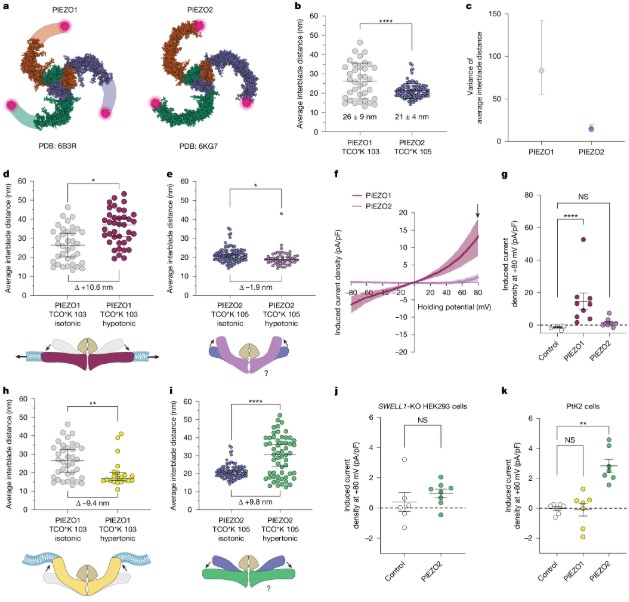
Fig 1. The divergent structural mechanics of PIEZO1 and PIEZO2 in a cell membrane.
Nanometer-Scale Precision
Using super-resolution imaging, the researchers showed that PIEZO2 and FLNB co-localize within tens of nanometers in sensory nerve endings of the skin. This nanoscale arrangement allows touch signals to be transmitted rapidly and precisely.
They also found strong co-expression of PIEZO2 and FLNB in mouse dorsal root ganglion neurons, further confirming the central role of this “channel–anchor” complex in touch sensation.
Clinical Implications
The findings have important medical relevance:
- PIEZO2 mutations are linked to sensory disorders such as loss of touch and joint contractures
- FLNB mutations are associated with skeletal abnormalities
This study provides a unified molecular explanation for these conditions and opens new avenues for therapy.
Millions of patients worldwide suffer from conditions like diabetic peripheral neuropathy and hereditary sensory neuropathies, experiencing either loss of touch or abnormal pain. Targeting the PIEZO2–FLNB anchoring mechanism could offer a novel strategy to restore normal sensation and alleviate pathological pain.
Redefining Our Understanding of Touch
This research fundamentally reshapes our understanding of how touch works. The function of mechanosensitive channels is not determined solely by their structure, but also by how they are physically connected within the cell.
Every breeze, tap, or embrace you feel is, in essence, the result of millions of PIEZO2 channels, precisely regulated by FLNB, converting mechanical force into electrical signals at the nanoscale.
Behind the simplicity of everyday touch lies one of the most elegant molecular designs evolved by life—offering new hope for future therapies in nerve repair and sensory disorders.
Related Products & Services
- Signal Transduction
- Ion Channel Screening Assays
- Protein Pathway Profiling
- Protein Engineering Services
- Protein Interaction Service
- Protein Expression and Purification Services
- Drug Discovery Screening
- Protein Pathway Profiling
Reference
- Mulhall, E.M., Yarishkin, O., Hill, R.Z. et al. The molecular basis of force selectivity by PIEZO2. Nature (2026). doi:10.1038/s41586-026-10182-7