
Uncategorized Tuesday, 2026/05/05
Pancreatic cancer has long been notorious as the “king of cancers.” Globally, its incidence has continued to rise over the past several decades, with particularly notable growth among younger populations. In the coming years, pancreatic cancer is expected to become the second leading cause of cancer death in developed countries, behind only lung cancer. Even more discouraging is the fact that the five-year survival rate after diagnosis has long hovered around 10%. Over the past 40 years, drug treatment for this disease has seen almost no substantive progress. Recently, however, results from a series of clinical trials of new therapies have finally begun to break this long winter.
Recently, in a research paper published in the international journal Nature titled “Netrin1 blockade alleviates resistance to chemotherapy in pancreatic cancer,” researchers from the Léon Bérard Cancer Center in Lyon, France, and other institutions reported the results of a phase 1b clinical trial. They evaluated an antibody drug called NP137 combined with the chemotherapy regimen mFOLFIRINOX as first-line treatment for patients with locally advanced pancreatic cancer. The study enrolled 43 patients, who received the combination therapy once every two weeks for up to 12 cycles. The results showed that NP137 was well tolerated. Patients had a median progression-free survival of 10.85 months and a median overall survival of 16.43 months. At the data cutoff, 21 patients were still alive. Notably, 23% of patients became eligible for surgical resection after treatment—for patients with locally advanced pancreatic cancer, conversion to an operable state is itself a major breakthrough.
Our Related Proteins
| Cat.No. # | Product Name | Source (Host) | Species | Tag | Protein Length | Price |
|---|---|---|---|---|---|---|
| Ntn1-257R |
Recombinant Rat Ntn1 protein, His/GST-tagged

|
E.coli | Rat | GST&His | Pro313~Pro565 | |
| NTN1-2173H | Recombinant Human Netrin 1, FLAG-tagged | HEK293 | Human | Flag | 28-604 a.a. | |
| NTN1-1088H |
Active Recombinant Human NTN1

|
Mammalian Cells | Human | His |

|
|
| Neo1-611M |
Active Recombinant Mouse Neo1 Protein, Fc Chimera
|
Mammalian Cells | Mouse | Fc |
|
|
| NEO1-1362H |
Recombinant Human NEO1 protein, hFc-tagged
|
C-hFc | Human | Ala34-Leu1105 |
|
|
| NEO1-3002R | Recombinant Rhesus monkey NEO1 Protein, His-tagged | Mammalian Cells | Rhesus macaque | His |
|
|
| NEO1-1499H | Recombinant Human NEO1 Protein, His (Fc)-Avi-tagged | HEK293 | Human | Avi&Fc&His |
|
The central mechanism of this study is particularly ingenious. NP137 does not directly kill tumor cells; instead, it targets a signaling molecule called netrin1. Netrin1 is originally a guidance factor involved in embryonic development, but in tumors it becomes a “traitor”: it promotes epithelial-mesenchymal transition, or EMT, in tumor cells, and EMT is a key pathway through which cancer cells acquire resistance to chemotherapy. By blocking netrin1, NP137 effectively removes the “shield” that cancer cells use to resist chemotherapy, allowing chemotherapy drugs to work again. The researchers performed laser-capture microdissection and RNA sequencing on biopsy tissues taken before and after treatment, confirming that the main change after combination therapy was a significant downregulation of the EMT pathway.
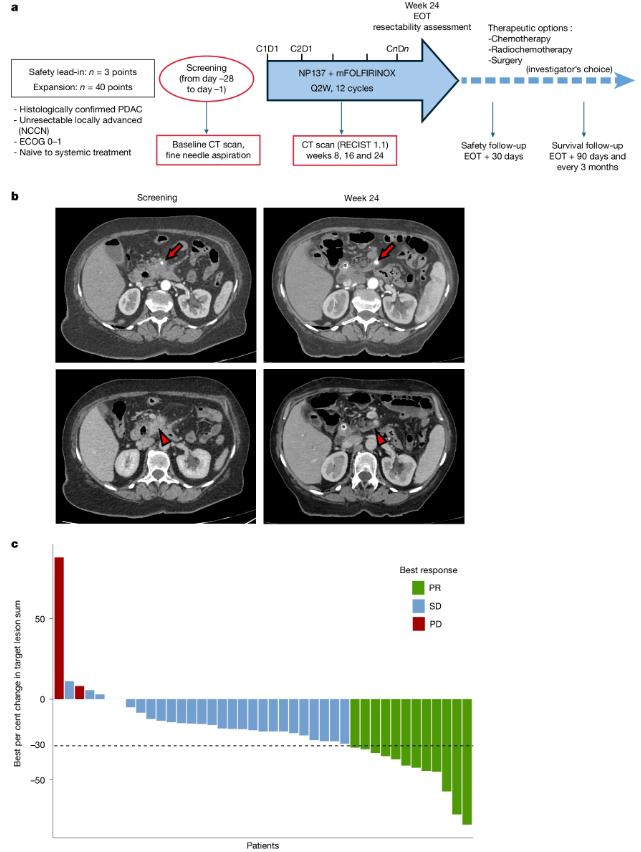
Fig1. Clinical activity of NP137 plus mFOLFIRINOX in patients with LAPC
Even more interestingly, the researchers identified a potential biomarker for predicting treatment response: neogenin, a receptor for netrin1. Patients whose tumor cells expressed high levels of neogenin benefited more clearly from treatment—their median progression-free survival reached 15.65 months, compared with 10.22 months in the low-expression group. This suggests that neogenin levels may help doctors identify, before treatment begins, which patients are most likely to benefit.
In the field of pancreatic cancer treatment, NP137 is not the only recent highlight. Daraxonrasib, a KRAS-targeted drug developed by the U.S. company Revolution Medicines, has also delivered encouraging results in a phase 3 clinical trial: patients in the treatment group had a median overall survival of more than 13 months, twice that of the chemotherapy control group. For a cancer that progresses extremely rapidly, doubling survival time is an unprecedented breakthrough. Former Nebraska senator Ben Sasse was diagnosed late last year with stage 4 metastatic pancreatic cancer, and doctors initially estimated he had only three to four months to live. After receiving daraxonrasib, the 54-year-old told The New York Times, “I’m much better off than I was at Christmas.” Although he also acknowledged that the drug’s side effects were considerable, including facial peeling and bleeding, its effect was indeed significant.
In addition, an mRNA pancreatic cancer vaccine jointly developed by BioNTech and Genentech has also shown encouraging data in a phase 1 trial. After 16 pancreatic cancer patients who had already undergone surgical resection received the vaccine, eight developed an effective immune response. Among those eight responders, seven were still alive six years later; by contrast, among the eight patients who did not mount a response, only two remain alive today. Although the primary purpose of a phase 1 trial is to assess safety rather than efficacy, such a striking survival difference is enough to make researchers optimistic about larger follow-up trials.
From a netrin1 antibody that “strips away the armor” of cancer cells, to KRAS-targeted drugs that directly attack key driver mutations, to mRNA vaccines that activate the immune system for long-term surveillance, the field of pancreatic cancer treatment is making progress on multiple fronts at once. After 40 years of silence, patients finally have more reasons to hold on to hope. As Mehlen noted, the team next plans to explore combining NP137 with new drugs such as daraxonrasib, to see whether the benefits can be pushed even further.
Related Products & Services
- Cell and Gene Therapy
- Immune Checkpoint Proteins
- ADC Target Protein
- PROTAC Targets
- Targets of CAR-T Cell Therapy
- Cancer Drug Targets
- Protein Engineering Services
- Protein Interaction Service
- Protein Expression and Purification Services
- Drug Discovery Screening
- Protein Pathway Profiling
Reference
- Roth, G., Artru, P., Bouche, O. et al. Netrin1 blockade alleviates resistance to chemotherapy in pancreatic cancer. Nature (2026). doi:10.1038/s41586-026-10436-4