
Uncategorized Tuesday, 2026/05/05
Research shows that cysteine—an amino acid and one of the basic building blocks of life—is essential for T cells, but it is used in different ways. Once inside the cell, the supply of cysteine is divided between two internal pathways, each driving different T cell behaviors.
A research team from the Johns Hopkins Kimmel Cancer Center, the Bloomberg~Kimmel Institute for Cancer Immunotherapy, and the Johns Hopkins Bloomberg School of Public Health has discovered how CD8+ T cells in the immune system use the nutrient cysteine to regulate two key functions that compete for this resource: the immune cells’ ability to proliferate and their ability to kill cancer cells. The study was published in Cell.
Research shows that cysteine—an amino acid and one of the basic building blocks of life—is essential for T cells, but it is used in different ways. Once inside the cell, the available cysteine is allocated to two internal pathways that drive different T cell behaviors. One pathway supports cell growth and proliferation, while the other regulates immune activity, including the production of cancer-fighting molecules.
Using a variety of laboratory and animal models, the research team found that cysteine, on the one hand, supplies the raw material for producing the antioxidant glutathione, thereby regulating T cell activity. On the other hand, it also helps T cells proliferate and maintain their anticancer function by providing sulfur atoms for iron-sulfur clusters, which are formed with the help of the enzyme NFS1.
Our Related Proteins
| Cat.No. # | Product Name | Source (Host) | Species | Tag | Protein Length | Price |
|---|---|---|---|---|---|---|
| NFS1-2543C | Recombinant Chicken NFS1 | Mammalian Cells | Chicken | His |

|
|
| NFS1-4074Z | Recombinant Zebrafish NFS1 | Mammalian Cells | Zebrafish | His |
|
|
| NFS1-3844HCL | Recombinant Human NFS1 293 Cell Lysate | HEK293 | Human | Non |
|
|
| NFS1-01H | Recombinant Human NFS1 protein, GST-tagged | Wheat Germ | Human | GST |
|
“Once cysteine enters the cell, it can go toward different fates,” said senior author Erika Pearce, Ph.D., Bloomberg Distinguished Professor in the Departments of Oncology and Biochemistry and Molecular Biology. “Figuring out where it goes, and when, is essential for determining how T cells behave.”
When the researchers restricted cysteine in laboratory models, T cells became more active and produced higher levels of immune signaling molecules, enhancing their ability to kill cancer cells. At the same time, however, they lost the ability to divide and proliferate. Disrupting the formation of iron-sulfur clusters weakened T cell expansion and impaired antitumor immunity.
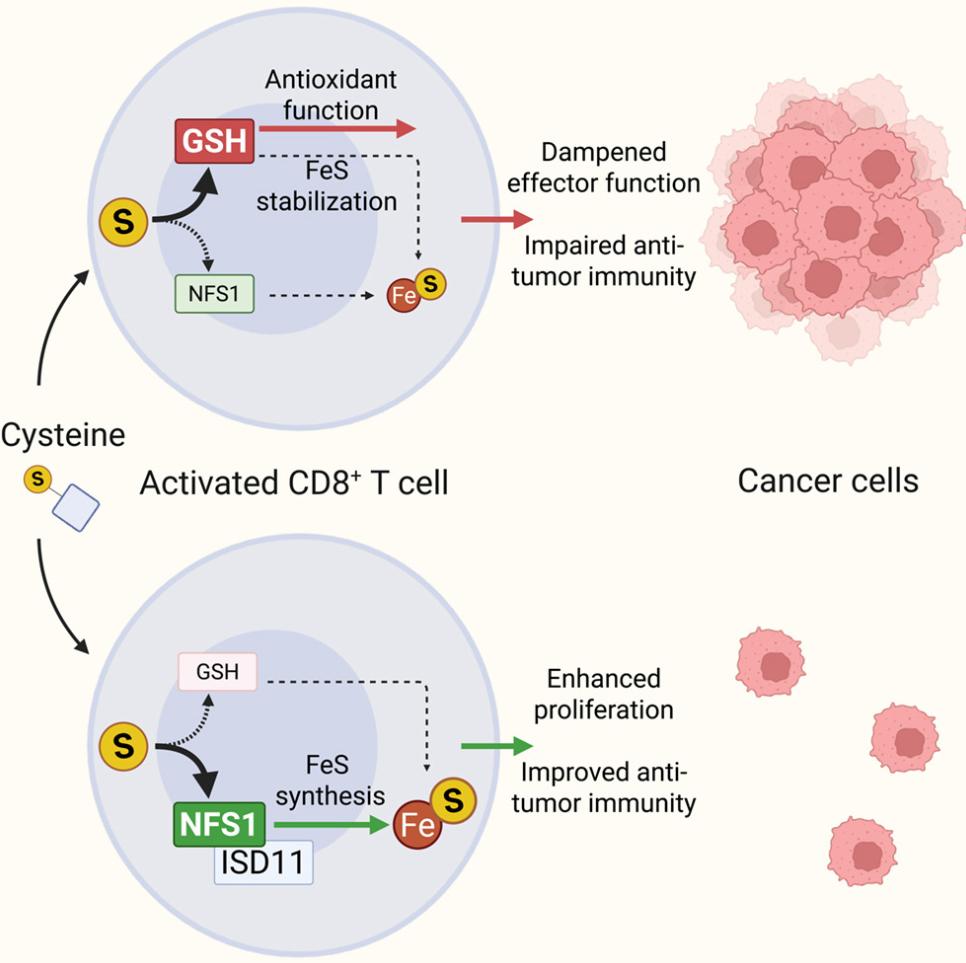
Because cysteine supports different immune functions through distinct cellular pathways, first author Beth Kelly, Ph.D., an associate researcher in the Pearce laboratory, noted that the study suggests the possibility of selectively regulating how cysteine is used inside T cells: enhancing its use in some pathways while inhibiting it in others. The goal, she said, is to preserve beneficial functions while preventing CD8+ T cell exhaustion.
In laboratory studies using mouse models of melanoma skin cancer, the researchers found that T cells lacking NFS1 had a reduced ability to control tumors and showed signs of exhaustion. By contrast, enhancing NFS1 activity promoted T cell proliferation and improved tumor control. Blocking glutathione production after the initial activation of T cells also strengthened antitumor responses.
The researchers said these findings reveal a previously unrecognized level of metabolic control over immune cell function. Although more research is still needed, the findings point to the potential of selectively directing how T cells use cysteine to support anticancer immune responses while suppressing processes that inhibit this activity.
“Understanding how these pathways work gives us new opportunities to fine-tune T cell responses in cancer and other diseases,” Pearce said.
Related Products & Services
- Cell and Gene Therapy
- Immune Checkpoint Proteins
- ADC Target Protein
- PROTAC Targets
- Targets of CAR-T Cell Therapy
- Cancer Drug Targets
- Protein Engineering Services
- Protein Interaction Service
- Protein Expression and Purification Services
- Drug Discovery Screening
- Protein Pathway Profiling
Reference
- Beth Kelly et al, Sulfur partitioning from cysteine controls T cell proliferation and effector function, Cell (2026). DOI: 10.1016/j.cell.2026.03.012.