
Uncategorized Wednesday, 2026/03/11
Findings suggest that some molecular changes associated with aging may not be purely harmful but could instead represent protective adaptations of stem cells.
After injury, aging muscles heal more slowly—a frustrating reality familiar to many older adults. A research team at the University of California, Los Angeles (UCLA) has uncovered an unexpected explanation for this phenomenon through studies in mice: stem cells in aging muscle accumulate a protein called NDRG1. While this protein slows the activation of stem cells and their ability to repair tissue, it helps the cells survive longer in the harsh environment of aging tissues.
Now published in the journal Science, the discovery suggests that certain molecular changes associated with aging are not simply detrimental effects but may instead be protective adaptations of stem cells.
“This leads us to think about aging in a new way,” said Dr. Thomas Rando, senior author of the study and director of the Eli and Edythe Broad Center of Regenerative Medicine and Stem Cell Research at UCLA. “Counterintuitively, the stem cells that successfully persist during aging may actually be the least functional ones. They survive not because they are best at repair, but because they are best at survival. This provides a completely different perspective on why tissues decline with age.”
Led by postdoctoral researchers Jengmin Kang and Daniel Benjamin, the team first compared muscle stem cells (MuSCs) from young mice (3 months old) and old mice (22 months old). They found that NDRG1 protein levels increase significantly with age, reaching 3.5 times higher in older cells than in younger ones. NDRG1 acts like a cellular “brake,” inhibiting the key PI3K–AKT–mTOR signaling pathway, which normally promotes cell activation, growth, and entry into the cell cycle. Immunofluorescence staining and Western blot analyses further confirmed that NDRG1 accumulation was prominent both in isolated muscle fibers and in purified muscle stem cells.
To test whether NDRG1 is a central cause of slower muscle repair in aging, the researchers created muscle stem cell–specific conditional knockout mice lacking NDRG1 (NDRG1 cKO). These mice were allowed to age normally to about 20 months old—roughly equivalent to 75 years in humans—after which NDRG1 activity was blocked.
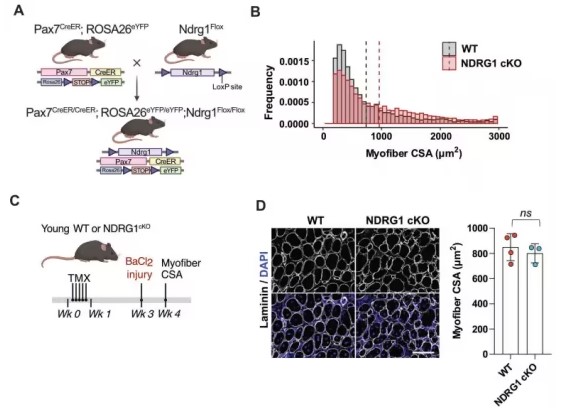
The results were striking. Aging muscle stem cells immediately began behaving like young cells: their entry into the S phase of the cell cycle and mitochondrial accumulation increased significantly, they activated rapidly both in vitro and in vivo, muscle repair after injury accelerated markedly, and the cross-sectional area of regenerated muscle fibers approached that seen in young mice.
However, this apparent “rejuvenation” came at a cost. Without the protective effects of NDRG1, the survival rate of aging muscle stem cells declined significantly, and the number of quiescent stem cells was reduced. After 21 days, the number of PAX7-positive stem cells in the muscles of knockout mice was significantly lower than in control mice. More importantly, when the muscles experienced repeated injury, the regenerative capacity of the knockout mice was markedly impaired. Repair after the second injury dropped sharply because the pool of surviving stem cells had been depleted, leaving too few “seed cells” for continued regeneration.
Our Related Proteins
| Cat.No. # | Product Name | Source (Host) | Species | Tag | Protein Length | Price |
|---|---|---|---|---|---|---|
| NDRG1-3770H | Recombinant Human NDRG1 protein, GST-tagged | E.coli | Human | GST | 45-109 aa | |
| NDRG1-1398H | Recombinant Human N-myc Downstream Regulated 1, His-tagged | E.coli | Human | His |

|
|
| NDRG1-28796TH | Recombinant Human NDRG1, T7 -tagged | E.coli | Human | T7 | Full L. |
|
| PAX7-2924H | Recombinant Human PAX7 protein, His-tagged | E. coli | Human | His | 330-378 aa | |
| PAX7-132H |
Recombinant Human PAX7 protein, T7/His-tagged

|
E.coli | Human | His&T7 |
|
|
| PAX7-29057TH | Recombinant Human PAX7 | Wheat Germ | Human | Non | 111 amino acids |
|
“You can think of it like the difference between marathon runners and sprinters,” explained Rando, who is also a professor of neurology at the David Geffen School of Medicine at UCLA. “Stem cells in young animals are like sprinters—highly active and excellent at rapid repair, but not very good at long-term survival. They can run 100 yards but not a marathon. Aging stem cells, on the other hand, are marathon runners—slower to respond but better suited for long-term persistence. The very traits that make them good at endurance make them less effective at rapid repair.”
Using a combination of cell culture experiments, in vivo tissue analysis, and cell transplantation, the researchers confirmed that the accumulation of NDRG1 suppresses the mTOR pathway, which both slows rapid stem cell activation and enhances their resilience under harsh conditions such as oxidative stress. Muscle stem cells in young mice that naturally expressed high levels of NDRG1 also showed slower activation. Similarly, overexpressing NDRG1 in young stem cells slowed their activation but improved their survival under stress.
This phenomenon reflects what scientists call “cellular survival bias.” As organisms age, stem cells that fail to accumulate sufficient NDRG1 gradually die off, leaving behind a population of slower but more resilient cells. Rando compares this to evolutionary trade-offs in nature: just as animals in harsh environments may enter hibernation—sacrificing reproduction to conserve energy—stem cells under aging stress shift resources from “proliferation and repair” toward “survival and maintenance.”
“Some seemingly harmful age-related changes, such as slower tissue repair, may actually be necessary compromises to prevent something worse—complete depletion of the stem cell pool,” he said.
Importantly, this NDRG1-mediated trade-off differs from the traditional antagonistic pleiotropy theory, which proposes that age-related decline results from genes that are beneficial early in life but harmful later. In contrast, NDRG1 is expressed at low levels in youth (to avoid impairing repair efficiency) and at high levels in old age (to support cell survival), representing an adaptive adjustment across life stages driven by survival pressures.
These findings provide new insights for the development of anti-aging therapies, though Rando cautions against overly simple solutions: “There’s no free lunch. We may be able to improve the function of aging cells at certain times, but every intervention could come with trade-offs.” For example, short-term inhibition of NDRG1 might accelerate repair after acute injury, but long-term suppression could deplete the stem cell pool and impair regeneration after repeated injuries.
The research team plans to continue exploring molecular mechanisms that regulate the balance between cell survival and functional activity. “NDRG1 opens a door for us to understand these trade-offs,” Rando said. “They are critical not only for species evolution but also for how tissues age within individuals.”
Related Products & Services
- Cell and Gene Therapy
- Alzheimer's Disease
- Parkinson's Disease Related Molecules
- Neurological Disorders Targets
- Protein Engineering Services
- Protein Interaction Service
- Protein Expression and Purification Services
- Drug Discovery Screening
- Protein Pathway Profiling
Reference
- Jengmin Kang et al, Cellular survivorship bias as a mechanistic driver of muscle stem cell aging, Science (2026). DOI: 10.1126/science.ads9175.