
Uncategorized Sunday, 2026/03/22
This new study made a surprising discovery: at least for several types of solid cancers, a molecule called CD70 can serve as a homing beacon for cell therapies.
CAR-T cell therapy has revolutionized the treatment of many blood cancers, but it has had limited success against solid tumors, which account for more than 85% of all cancers. Researchers at Columbia University have now found that a new type of cell therapy—HIT cells, considered a “cousin” of CAR-T cells—has enhanced sensitivity. This feature helps overcome a major barrier in using cell therapies to treat solid tumors and was able to completely eliminate kidney, pancreatic, and ovarian cancers in mice. The study was published in the journal Science.
The work was carried out by researchers from the Columbia Initiative for Cell Engineering and Therapy (CICET). CICET director Michel Sadelain is a pioneer of CAR-T therapy, which reprograms a patient’s own immune cells into trained “assassins” that seek out and destroy cancer cells. In recent years, his laboratory has also led the development of HIT cell therapy.
“Curing solid tumors is not easy, but this work solves part of the problem,” Sadelain said.
The Challenge of Solid Cancers
Although several obstacles are known to limit CAR-T cell activity in solid cancers, the primary challenge for any cell therapy is locating every cancer cell.
Blood cancer cells are relatively easy for CAR-T cells to find because each cancer cell is typically covered with large numbers of CD19 molecules, which act as homing beacons for CAR-T cells. In contrast, solid tumors are more heterogeneous, and no single molecule serves as a universal target for cell therapy.
“Some molecules have been identified that are present in 25%, 50%, or 75% of tumor cells,” said Sadelain, who is also the Herbert and Florence Irving Professor of Medicine at Columbia University’s Vagelos College of Physicians and Surgeons.
“Even if therapies targeting these molecules successfully eliminate some tumor cells, removing only a fraction of them—or even 90%—will not cure the patient. You must eliminate every last cancer cell.”
Our Related Proteins



CD70 Marks Many Solid Cancers
The new study made a surprising discovery: for several types of solid cancers, the molecule CD70 can function as a homing beacon for cell therapies.
Although earlier studies suggested that CD70 levels vary among tumor cells, Sophie Hanina, the study’s lead author and associate research scientist at CICET, suspected those studies may have missed cells with extremely low levels of CD70.
She developed a new method to detect the molecule and discovered that CD70 levels vary widely across cancer cells, but every cell still has at least some CD70 on its surface.
Solid Tumors Require More Powerful HIT Cells
To translate this discovery into a therapeutic approach, Hanina turned to a new cell therapy called HIT, currently being developed in Sadelain’s CICET laboratory.
Traditional CAR-T cells can only detect cancer cells that display high levels of target molecules. Hanina observed this in laboratory experiments when testing CD70-targeted CAR-T cells against solid tumors, which helps explain why CD70-targeted CAR-T therapies have shown limited success in patients with solid cancers.
“HIT cells are the next generation of CAR-T cells,” Hanina said. “They can be programmed like CAR-T cells, but they possess the natural sensitivity of T cells, allowing them to detect cancer cells that display only very small amounts of the target molecule.”
Hanina found that HIT cells programmed to target CD70 completely eradicated tumors in mice with pancreatic, kidney, and ovarian cancers, while conventional CAR-T cells eliminated only part of the tumor cells. Importantly, HIT cells spared healthy cells, since most normal cells in the body do not express CD70.
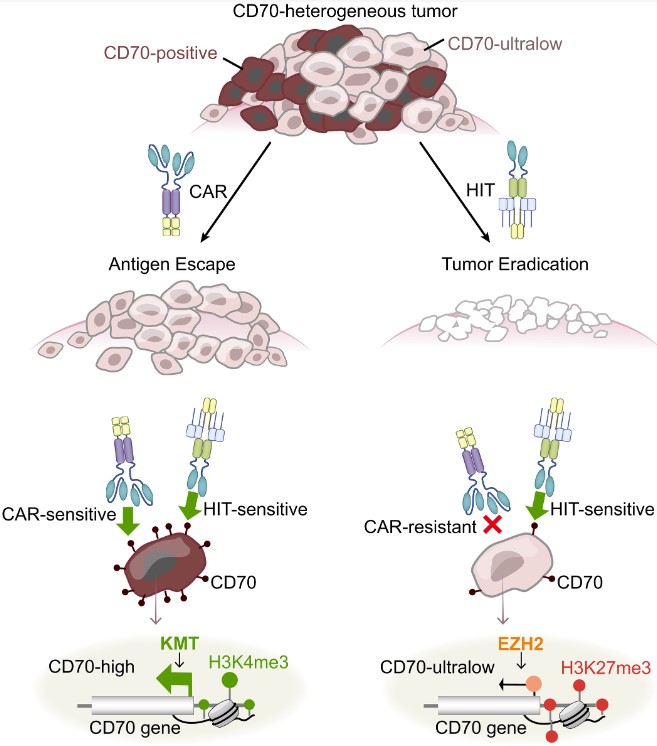
Fig1. Overcoming solid tumor antigen heterogeneity with sensitive CAR T cells.
Preparing for Clinical Trials
Hanina and Sadelain are now planning clinical trials at Columbia University Irving Medical Center to test CD70-targeted HIT cells in patients with ovarian cancer and other cancers.
CD70-targeted HIT cells may also have potential in nearly 20 additional cancer types, including glioblastoma and pancreatic adenocarcinoma, which are known to express CD70 to some extent.
Although solid tumors present other obstacles for cell therapy, tracking down every cancer cell may be a key barrier for cancers that express CD70.
“Research suggests that the escape of undetected cancer cells is a major obstacle to the success of conventional CAR-T therapy,” Hanina said. “We hope our CD70-targeted HIT cells will help us find a way to eradicate entire tumors.”
Related Products & Services
- Cell and Gene Therapy
- Immune Checkpoint Proteins
- ADC Target Protein
- PROTAC Targets
- Targets of CAR-T Cell Therapy
- Cancer Drug Targets
- Protein Engineering Services
- Protein Interaction Service
- Protein Expression and Purification Services
- Drug Discovery Screening
- Protein Pathway Profiling
Reference
- Sophie A. Hanina et al, Sensitive CAR T cells redefine targetable CD70 expression in solid tumors, Science (2026). DOI: 10.1126/science.adv7378.