
Uncategorized Tuesday, 2026/06/16
-Nature Builds a Cross-Species Transcriptomic Clock to Predict Aging and Mortality Risk
This study not only systematically maps a conserved molecular blueprint of aging and reveals its modular, decomposable nature, but also provides a powerful tool for aging research.
Aging, Lifespan, and the Search for Molecular Clues
Aging is accompanied by functional decline and an increased risk of death. Although diet, drugs, and genes are known to regulate lifespan, the shared molecular mechanisms behind these effects have remained something of a “black box.”
At the same time, accurate biomarkers that can predict an individual’s “biological age” and mortality risk are crucial for evaluating the effects of interventions and achieving healthy aging.
A Major Study Published in Nature
Vadim N. Gladyshev’s team at Harvard Medical School published a research paper online in Nature titled “Universal transcriptomic hallmarks of mammalian ageing and mortality.”
Through large-scale data integration and analysis, the study achieved an important breakthrough in this field. The researchers constructed what is currently the most comprehensive molecular atlas of mammalian aging and uncovered conserved molecular networks that drive aging and mortality.
Building Accurate Prediction Tools from Large-Scale Data
The researchers integrated tens of thousands of transcriptomic datasets from more than 25 tissues across four mammalian species: mice, rats, macaques, and humans.
Based on these data, they developed “transcriptomic clocks” capable of accurately predicting chronological age and expected remaining lifespan.
More importantly, the researchers did not stop at building a “black-box” prediction model. Instead, they further decomposed complex aging signatures into 23 functional modules. Each module represents a set of genes that change in a coordinated manner and is linked to core biological processes such as inflammation, mitochondrial function, chromatin modification, and the extracellular matrix.
This provides an interpretable framework for understanding the mechanisms that drive aging.
Conserved “Mortality Signatures” and Modular Aging
The study found that although aging trajectories differ across species and tissues, there is a set of conserved cross-species gene signatures that are strongly associated with mortality risk.
Among them, the cell-cycle inhibitor CDKN1A and the galectin family member LGALS3 emerged as two key molecules. Protein levels of these molecules in human blood were also shown to be associated with all-cause mortality and multiple chronic disease states.
These findings suggest that mammalian aging and mortality may follow broadly conserved molecular rules.
Our Related Proteins
| Cat.No. # | Product Name | Source (Host) | Species | Tag | Protein Length | Price |
|---|---|---|---|---|---|---|
| CDKN1A-1053H | Recombinant Human CDKN1A Protein, GST-Tagged | Wheat Germ | Human | GST |

|
|
| CDKN1A-116H | Recombinant Human CDKN1A Protein, His-tagged | E.coli | Human | His | Ser2-Pro164 |
|
| Cdkn1a-1251R | Recombinant Rat Cdkn1a protein, His & T7-tagged | E.coli | Rat | His&T7 | Met1~Pro164 |
|
| LGALS3-453H | Recombinant Human LGALS3 protein, GST-tagged | E.coli | Human | GST | 1 - 250 aa | |
| LGALS3-6914H | Active Recombinant Human LGALS3 Protein, His tagged | E. coli | Human | His | 1-250 aa | |
| LGALS3-6977H | Recombinant Human LGALS3 protein(Met1-Ile250) | E.coli | Human | Non | 1-250 a.a. | |
| Kl-362M |
Active Recombinant Mouse klotho protein, His-tagged

|
CHO | Mouse | His | 35-982 a.a. | |
| KL-388H |
Active Recombinant Human Klotho, His-tagged
|
Mammalian Cells | Human | His | 34-981 a.a. |
|
Multi-Tissue Rodent Transcriptomic Clocks Capture Aging and Mortality Signals
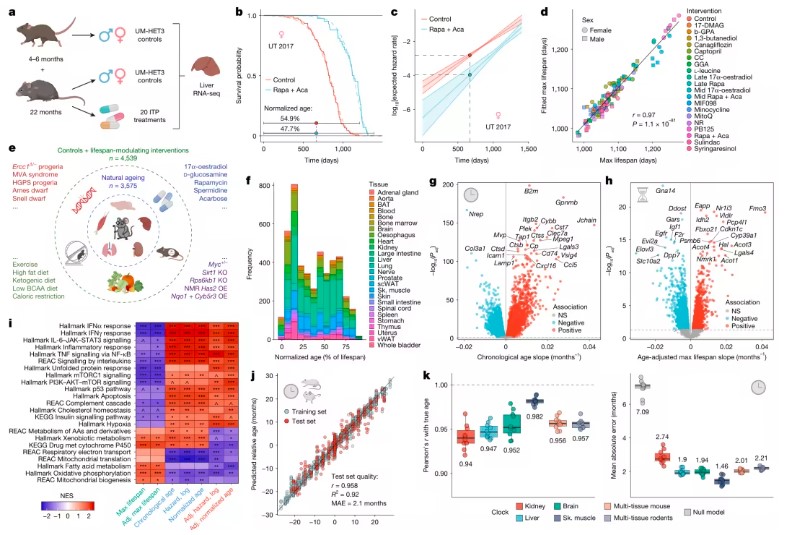
(Nature)
Multi-tissue transcriptomic clocks in rodents were able to capture molecular changes associated with aging and mortality.
“Module Clocks” Reveal Precise Targets of Interventions
By constructing “module-specific clocks” for individual functional modules, the study revealed how different interventions precisely influence distinct aspects of aging.
First, chronic diseases such as obesity and diabetes mainly accelerated aging in inflammation-related modules.
Second, lifespan-extending interventions such as caloric restriction and lifespan-shortening models such as Klotho gene knockout specifically affected mitochondrial and metabolic modules, but in opposite directions.
Third, in damage models such as replicative senescence and radiation exposure, these “mortality signatures” were intensified. In contrast, during regenerative or rejuvenation-related processes such as cellular reprogramming and embryonic development, these signatures were reversed or weakened.
Significance and Research Resources
This study systematically depicts a conserved molecular blueprint of aging and reveals that aging is modular and decomposable. It also provides powerful tools for the aging research community.
The researchers have made available an online calculator called TACO and an R software package called tAge, allowing scientists worldwide to use these transcriptomic clock tools.
These resources are expected to greatly advance the precise quantification of aging at the cellular, tissue, and organismal levels, support the evaluation of anti-aging interventions, and ultimately lay the foundation for developing “precision anti-aging” therapies that target specific aging pathways.
Related Products & Services
- Cell and Gene Therapy
- Immune Checkpoint Proteins
- ADC Target Protein
- PROTAC Targets
- Targets of CAR-T Cell Therapy
- Cancer Drug Targets
- Protein Engineering Services
- Protein Interaction Service
- Protein Expression and Purification Services
- Drug Discovery Screening
- Protein Pathway Profiling
Reference
- Tyshkovskiy, A., Kholdina, D., Davitadze, M. et al. Universal transcriptomic hallmarks of mammalian ageing and mortality. Nature 654, 173–188 (2026). https://doi.org/10.1038/s41586-026-10542-3