
Uncategorized Wednesday, 2026/03/11
Early-life healthy diets may influence brain health for a lifetime
Scientists from University College Cork in Ireland and other institutions have found that long-term consumption of high-fat and high-sugar diets early in life may leave “permanent scars” on the neural circuits that regulate feeding in the brain. Even if body weight returns to normal in adulthood, these changes can quietly influence eating behavior and food preferences throughout life.
In everyday life, many of us have experienced this: even when we are already full, we still can’t resist taking a few more bites of fried chicken or French fries. Or although we know we should eat more vegetables, our taste buds keep craving the sweetness of cake or milk tea. Before blaming yourself for having weak willpower, scientists suggest that it might not entirely be your fault—it could be the “imprint” left on your brain by your childhood diet.
Recently, a study published in the journal Nature Communications titled “Bifidobacterium longum and prebiotic interventions restore early-life high-fat/high-sugar diet-induced alterations in feeding behavior in adult mice” reported that long-term intake of high-fat, high-sugar diets during early life can leave lasting changes in the brain’s feeding-regulation circuits. Even if individuals later adopt a normal diet and regain normal body weight, these neural alterations may persist and influence eating behavior and food preferences. In other words, eating “too well” in childhood may indeed make it harder to control one’s appetite later in life.
This study comes at a particularly timely moment. Today’s children grow up surrounded by high-sugar and high-fat foods: birthday cakes, party snacks, fried chicken burgers used as rewards, and sugary beverages during holidays. These “happy foods” have become a common part of childhood. Epidemiological surveys show that the global rate of childhood overweight and obesity has increased more than tenfold over the past 40 years. In China, one in five school-age children is overweight or obese. Even more concerning is that many of these children struggle to break their dependence on high-energy foods as they grow older.
To simulate this type of “early exposure,” the researchers developed a mouse model. Young mice were fed a high-fat, high-sugar diet from birth to five weeks of age, and then switched to a normal diet in adulthood. The results showed that although their body weight eventually became similar to that of mice that had never been exposed to “junk food,” irreversible changes had already occurred in their brains—especially in the hypothalamus, the region responsible for appetite regulation and energy balance. Persistent structural and functional damage was observed there.
Specifically, early unhealthy diets significantly reduced the number of cells in the adult mouse hypothalamus expressing feeding-related markers such as POMC (proopiomelanocortin), GHSR (growth hormone secretagogue receptor), PNOC (prepronociceptin), and NOD2 (nucleotide-binding oligomerization domain 2). These cells function like the brain’s “satiety switches” and “energy sensors.” When they are disrupted, the brain becomes less sensitive to signals indicating fullness while cravings for high-calorie foods become unusually strong.
Early exposure to high-fat, high-sugar diets also had long-term effects on the abundance of Bifidobacterium, particularly Bifidobacterium longum, and on feeding behavior in adult mice, with clear sex-specific differences.
Female mice were more sensitive to early dietary damage. They showed a significant reduction in LEPR (leptin receptor)-positive cells in the hypothalamus, along with disruptions in arginine and tryptophan metabolism pathways. As adults, they not only consumed more food but also exhibited pronounced food grinding behavior (breaking food apart instead of fully eating it). Male mice, on the other hand, primarily displayed impaired peptidoglycan sensing and abnormal steroid metabolism, along with a significantly increased preference for sweetness and lower serotonin levels in the striatum. These findings may help explain why eating disorders and emotional eating are more common among women in real life, whereas men are more prone to metabolic syndrome–related problems.
Our Related Proteins

Beyond brain changes, early high-fat and high-sugar diets also disrupted the balance of the gut microbiota. Such diets during early life significantly reduced the abundance of Bifidobacterium in the gut, and this effect persisted into adulthood. Because the gut microbiota is a key link in the gut–brain axis, disturbances in microbial balance can further exacerbate abnormal eating behavior, creating a vicious cycle.
So is there any way to reverse this kind of “childhood shadow”? The answer appears to be yes, but the type of intervention matters. The research team tested two gut microbiota–targeted interventions:
- A prebiotic combination (FOS + GOS)—fructooligosaccharides and galactooligosaccharides, dietary fibers naturally found in foods such as onions, garlic, asparagus, and bananas.
- A potential probiotic strain called Bifidobacterium longum APC1472.
The results were encouraging: both approaches improved abnormal feeding behaviors in adult mice, but through different mechanisms.
The prebiotic combination triggered a large-scale “reshuffling” of the gut microbiome, significantly increasing beneficial bacteria such as Bifidobacterium. By reshaping microbial structure and metabolic functions, it repaired gut–brain signaling pathways disrupted by early unhealthy diets. It specifically restored amino acid metabolism in female mice and bile acid and steroid metabolism in male mice, bringing hypothalamic gene expression back toward normal.
In contrast, Bifidobacterium longum APC1472 showed a more targeted effect. Without significantly altering the overall gut microbial composition, it directly improved feeding behavior. It was particularly effective at reducing overeating and food grinding behavior in female mice and restored the expression of key hypothalamic genes such as POMC and LEPR. Its action appears more like directly “communicating” with the brain rather than completely restructuring the gut microbial community.
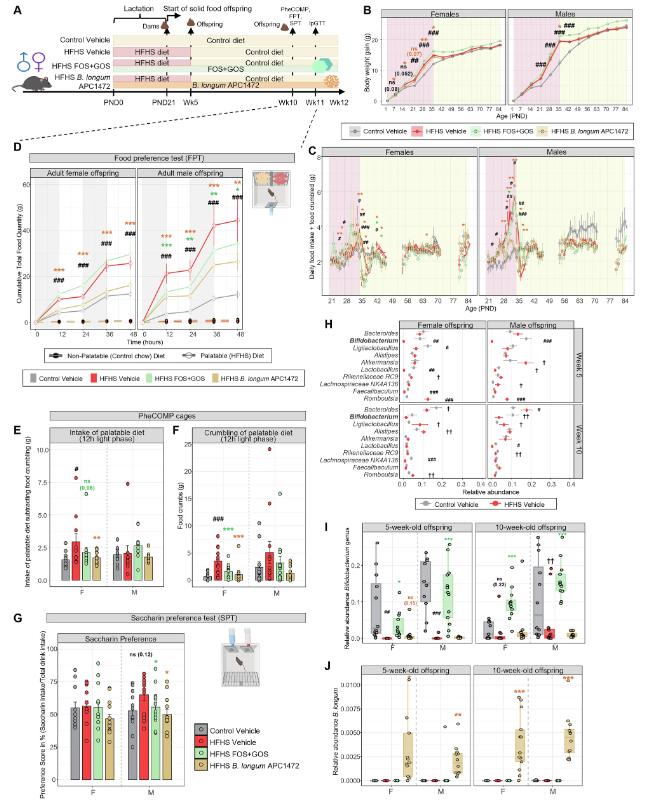
Fig1. Exposure to a high-fat/high-sugar diet during early life has long-term effects on Bifidobacterium and B. longum abundance and on feeding behavior in a sex-specific manner in adult female and male mice.
Further analysis showed that the two interventions worked through different repair pathways. Prebiotics mainly acted by regulating the production of short-chain fatty acids (such as acetate) and restoring microbial functional potential in gut–brain modules like tryptophan metabolism and dopamine degradation. Meanwhile, Bifidobacterium longum APC1472 may influence hypothalamic neuronal function by regulating tryptophan metabolites and activating AMPK-related energy homeostasis pathways, while also improving baseline blood glucose levels in adult female mice.
The study also revealed additional behavioral details. Early high-fat and high-sugar diets affected not only food preference but also specific feeding behaviors, such as faster eating speed and larger first meals. These changes persisted even after switching back to a normal diet. Both interventions were able to correct these behaviors and partially repair metabolic abnormalities. For example, prebiotics restored glucose tolerance in male mice, while Bifidobacterium longum reduced visceral fat accumulation in males.
Of course, researchers emphasize that prevention remains the best strategy. Dietary choices during childhood affect far more than just the number on the scale—they can leave lasting marks deep within the brain and the ecological system of the gut microbiota. Correcting these changes later in adulthood is possible but requires greater effort.
Nevertheless, this study also offers hope. Even if dietary “imprints” have already formed, they can still be effectively modulated through targeted gut microbiota interventions. Different approaches may suit different situations: if the gut microbiome is broadly imbalanced, prebiotics may be more appropriate; if the microbial structure is relatively stable but appetite control is difficult, Bifidobacterium longum APC1472 might be a better option.
Ultimately, the message of this research is simple: encouraging children to eat more fruits, vegetables, whole grains, and fermented foods, while reducing high-sugar and high-fat processed snacks, is not about depriving them of childhood happiness—it is about laying the foundation for healthy appetite regulation over the coming decades. After all, a truly happy childhood should not lead to an adulthood burdened by uncontrollable cravings. And for adults already affected by early dietary habits, scientifically guided supplementation with prebiotics or specific probiotics may help put the brakes on an out-of-control appetite.
Related Products & Services
- Cell and Gene Therapy
- Obesity Targets
- Metabolic Diseases Targets
- Protein Engineering Services
- Protein Interaction Service
- Protein Expression and Purification Services
- Drug Discovery Screening
- Protein Pathway Profiling
Reference
- Cuesta-Marti, C., Ponce-España, E., Uhlig, F. et al. Bifidobacterium longum and prebiotic interventions restore early-life high-fat/high-sugar diet-induced alterations in feeding behavior in adult mice. Nat Commun 17, 1653 (2026). doi:10.1038/s41467-026-68968-2