
Uncategorized Wednesday, 2026/10/21
Research Highlights
A new study published in Nature reveals an unexpected mechanism of Toll-like receptor (TLR) signaling in which inflammatory responses are sustained by mature myddosome complexes that operate independently of continued receptor association. The research identifies TRAM as a critical regulator that enables MyD88-containing signaling complexes to dissociate from activated TLRs and mature in the cytoplasm. Importantly, chemically disrupting these cytoplasmic myddosomes markedly impairs TLR-induced inflammatory responses, demonstrating their essential role in sustaining inflammatory signaling.
Rethinking the Classical Model of Toll-Like Receptor Signaling
Toll-like receptors (TLRs) serve as essential sentinels of the innate immune system, recognizing molecular signatures associated with pathogens and tissue damage.
These receptors detect a wide range of danger signals, including bacterial cell wall components, viral nucleic acids, and other pathogen-associated molecular patterns. Upon activation, TLRs initiate intracellular signaling cascades that coordinate inflammatory responses and host defense mechanisms.
According to the conventional model, activated TLRs recruit adaptor proteins such as myeloid differentiation primary response protein 88 (MyD88) through their intracellular signaling domains. This process promotes the assembly of a large multiprotein signaling complex known as the myddosome.
The myddosome subsequently recruits downstream signaling proteins and kinases, activating inflammatory transcription factors such as nuclear factor kappa B (NF-κB) and inducing the expression of immune response genes.
In this classical framework, receptor-associated complex assembly is generally considered the central organizing event in inflammatory signal transduction.
However, recent research suggests that the sequence of events is more dynamic than previously recognized.
Rather than remaining continuously associated with the receptor, MyD88-containing signaling complexes may undergo distinct stages of assembly, release, and maturation.
Nature Study Identifies TLR-Free Myddosome Signal Transduction
A research team led by Jonathan C. Kagan at Harvard Medical School published a study in Nature entitled “TRAM promotes Toll-like-receptor-free myddosome signal transduction.”
The researchers discovered that activated TLRs initially assemble a small, immature signaling complex referred to as a proto-myddosome.
This preliminary complex forms at the receptor-associated membrane signaling platform but does not represent the fully assembled, mature myddosome.
Following its initial formation, the proto-myddosome dissociates from the TLR complex and moves into the cytoplasm, where it undergoes further assembly and maturation.
The resulting cytoplasmic myddosome recruits additional downstream signaling components and becomes capable of sustaining inflammatory signaling independently of continued physical association with the activated receptor.
This finding challenges the assumption that mature myddosome signaling must remain directly coupled to TLRs.
Instead, the receptor primarily functions as an initiation platform, while the mature cytoplasmic signaling complex serves as an important driver of prolonged inflammatory responses.
This process represents a form of receptor-independent signal propagation, in which intracellular signaling continues after the signaling machinery has physically separated from the initiating receptor.
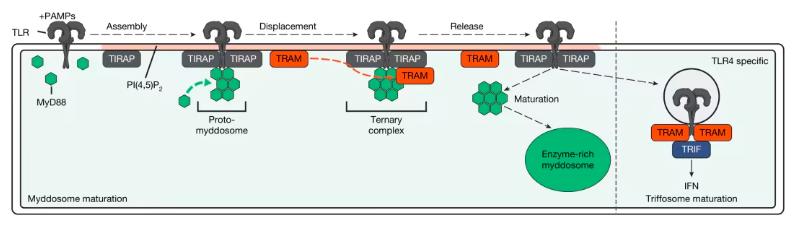
Fig 1. Proposed mechanism of TRAM-mediated, TLR-free myddosome signal transduction.
TRAM Controls the Release of MyD88 From Activated TLR Complexes
An important question raised by this discovery was how the immature signaling complex becomes detached from the activated TLR.
To identify the molecular regulator responsible for this transition, the researchers performed genetic screening experiments in macrophages.
These experiments identified TRAM, also known as TRIF-related adaptor molecule or TICAM2, as a key component of the process.
TRAM was previously recognized primarily for its involvement in the TRIF-dependent branch of TLR signaling, which operates independently of the canonical MyD88 pathway.
The new findings reveal an additional and unexpected function for TRAM in regulating MyD88-dependent signal transduction.
According to the proposed mechanism, activated TLRs first engage the adaptor protein TIRAP, which facilitates MyD88 recruitment and the formation of an initial proto-myddosome complex.
TRAM then promotes the release of MyD88-containing signaling assemblies from the TLR–TIRAP platform.
Following dissociation, these complexes undergo further maturation within the cytoplasm, allowing the recruitment and organization of downstream signaling kinases.
The mature myddosome subsequently supports sustained NF-κB activation and the expression of secondary inflammatory response genes.
In the absence of TRAM, MyD88 remains abnormally associated with the receptor signaling complex.
This impaired release disrupts the appropriate assembly and coordination of downstream signaling components, resulting in unstable signaling interactions and reduced inflammatory responses.
These findings establish TRAM as an important molecular regulator connecting receptor-dependent signal initiation with receptor-independent intracellular signaling.
Cytoplasmic Myddosomes Sustain Inflammatory Gene Expression
One of the most significant aspects of the study was the demonstration that cytoplasmic myddosomes are functionally important for sustained inflammatory signaling.
To directly test this hypothesis, the researchers used a chemical approach to disrupt mature myddosome complexes within the cytoplasm.
Following chemical disruption, TLR stimulation produced markedly impaired inflammatory responses.
This experiment provided functional evidence that mature cytoplasmic myddosomes are not merely byproducts of receptor activation.
Instead, they constitute an essential signaling platform responsible for maintaining downstream inflammatory activity.
The findings suggest that the generation of a mature cytoplasmic signaling complex allows inflammatory responses to continue beyond the initial receptor activation event.
Such spatial separation may provide cells with an additional level of control over the duration, intensity, and organization of innate immune signaling.
Importantly, this mechanism distinguishes the initial recognition of an extracellular or endosomal danger signal from the intracellular machinery that sustains the resulting inflammatory response.
Our Featured Proteins
| Cat.No. # | Product Name | Source (Host) | Species | Tag | Protein Length | Price |
|---|---|---|---|---|---|---|
| MYD88-10293M | Recombinant Mouse MYD88 Protein | Mammalian Cells | Mouse | His |

|
|
| MYD88-12080Z | Recombinant Zebrafish MYD88 | Mammalian Cells | Zebrafish | His |
|
|
| MYD88-1550H | Recombinant Human MYD88 Protein, His tagged | E.coli | Human | His | 176-280 aa |
|
| Myd88-1827M | Recombinant Mouse Myd88 protein, His-tagged | E.coli | Mouse | His | Arg32~Pro265 |
|
| TICAM2-3230H | Recombinant Human TICAM2, GST-tagged | E.coli | Human | GST | 1-235aa | |
| TICAM2-646H | Recombinant Human TICAM2 Protein, His-tagged | E.coli | Human | His | Lys34~Ile241 | |
| Ticam2-647M | Recombinant Mouse Ticam2 Protein, His/GST-tagged | E.coli | Mouse | GST&His | Ser20~Ser196 |
A New Perspective on Receptor-Independent Signal Transduction
The discovery of TLR-free myddosome signaling introduces a revised model of innate immune signal transmission.
In the conventional model, receptors are viewed as central platforms that both initiate and organize downstream signaling.
The new findings suggest that receptor activation and sustained signal propagation can be spatially separated.
TLRs initiate the formation of signaling complexes, but continued receptor association is not necessarily required for the full maturation and prolonged activity of those complexes.
This mechanism highlights the importance of intracellular protein complex organization in controlling immune responses.
It also demonstrates that signaling pathways cannot always be understood solely through the activation status of their initiating receptors.
Instead, the location, assembly state, and molecular composition of downstream signaling complexes may determine how long a signal persists and which transcriptional programs are activated.
The study therefore expands current understanding of how cells organize and maintain inflammatory signaling following pathogen recognition.
Potential Implications for Chronic Inflammation and Autoimmune Diseases
Sustained TLR signaling contributes to host defense, but excessive or persistent activation can also promote chronic inflammatory and autoimmune disorders.
Dysregulated inflammatory signaling has been implicated in numerous pathological conditions in which immune responses remain active beyond their protective functions.
The identification of TRAM-dependent myddosome maturation suggests potential new opportunities for modulating these responses.
For example, future therapeutic strategies might investigate whether targeting TRAM-mediated complex release or disrupting mature cytoplasmic myddosomes could selectively reduce prolonged inflammatory signaling.
Such approaches could theoretically interfere with downstream inflammatory amplification without directly preventing the initial recognition of microbial or danger-associated molecules by TLRs.
This distinction may be important because broad inhibition of TLR activity can compromise essential innate immune defense mechanisms.
However, the therapeutic potential of targeting TRAM or cytoplasmic myddosomes remains hypothetical.
Additional research will be required to determine whether these mechanisms can be selectively manipulated without impairing necessary immune functions.
Furthermore, the current findings are based primarily on cellular and mouse experimental systems.
The extent to which TRAM-dependent myddosome maturation varies across human immune cell populations, inflammatory conditions, and different TLR signaling pathways requires further investigation.
Conclusion: A New Framework for Understanding Innate Immune Signaling
This study reveals an unexpected mechanism by which TLR signaling can continue independently of sustained receptor association.
Rather than assembling exclusively as receptor-bound signaling platforms, MyD88-containing complexes undergo a multistep process involving initial proto-myddosome formation, TRAM-dependent release, and subsequent maturation within the cytoplasm.
The resulting mature myddosomes support prolonged NF-κB activation and inflammatory gene expression.
By demonstrating that chemical disruption of cytoplasmic myddosomes significantly impairs TLR-induced inflammatory responses, the researchers provide functional evidence for the importance of these receptor-free signaling complexes.
These findings revise the conventional understanding of TLR-mediated signal transduction and highlight a previously underappreciated role for spatial organization in innate immune signaling.
More broadly, the research suggests that intracellular signaling complexes can function as independent regulatory platforms after receptor-mediated initiation.
Although additional studies are needed to assess the clinical relevance of this mechanism, the discovery opens new avenues for investigating sustained inflammation and potentially developing more selective approaches to inflammatory disease modulation.
Related Products & Services
- Cell and Gene Therapy
- Immune Checkpoint Proteins
- ADC Target Protein
- PROTAC Targets
- Targets of CAR-T Cell Therapy
- Cancer Drug Targets
- Protein Engineering Services
- Protein Interaction Service
- Protein Expression and Purification Services
- Drug Discovery Screening
- Protein Pathway Profiling
Reference
Fisch, D., Ohri, V., Anastasakou, E. et al. TRAM promotes Toll-like-receptor-free myddosome signal transduction. Nature (2026). https://doi.org/10.1038/s41586-026-11052-y