
Uncategorized Wednesday, 2026/10/21
Research Highlights
A recent study identifies loss of TANK-binding kinase 1 (TBK1) function as an upstream driver of a caspase-8/7–gasdermin E (GSDME) pyroptotic program in motor neurons across genetically distinct forms of amyotrophic lateral sclerosis (ALS). The findings establish a mechanistic link between neuroinflammation, TDP-43 proteinopathy, and motor neuron degeneration, suggesting that the TBK1–caspase–GSDME signaling axis may represent a potential therapeutic target for modifying ALS progression.
New Study Identifies a Shared Mechanism Across ALS Genotypes
Amyotrophic lateral sclerosis (ALS) is a progressive and ultimately fatal neurodegenerative disease characterized by the degeneration of upper and lower motor neurons. Despite extensive research, it remains unclear whether different genetic risk factors converge on a common pathogenic pathway.
A research team led by Xiangjun Chen and Jixi Li from Fudan University published a study in Cell Death & Differentiation entitled “Convergent TBK1 loss of function drives gasdermin E dependent pyroptosis and motor neuron degeneration across ALS genotypes.”
The study identifies a shared molecular mechanism linking TBK1 deficiency to inflammatory cell death across genetically diverse ALS cases.
Whole-exome sequencing of eight patients with familial ALS identified pathogenic or disease-associated variants in three cases, involving TBK1 (R573H), TDP-43/TARDBP (G298V) together with GARS (I44M) and SETX (L1304W), or SOD1 (G94R) together with SQSTM1 (G262R).
Despite their distinct genetic backgrounds, patient-derived induced pluripotent stem cell (iPSC) motor neurons exhibited several common pathological features, including shortened axons and neurites, reduced TBK1 activity, increased phosphorylated TDP-43 with cytoplasmic aggregation, and co-assembly of caspase-8/7 with the pyroptotic effector gasdermin E (GSDME).
Neuroinflammatory stimulation further enhanced the cleavage of caspase-8/7 and GSDME in patient-derived motor neurons. These changes were accompanied by increased RIPK1 phosphorylation and reduced TBK1 activation.
Importantly, TBK1 knockdown in SH-SY5Y cells reproduced these pathological features, providing additional evidence that impaired TBK1 signaling contributes to activation of the inflammatory cell death pathway.
The researchers also generated humanized TBK1 R573H knock-in mice, which developed progressive motor deficits accompanied by spinal motor neuron loss, neuroinflammation, and TDP-43 pathology.
Following lipopolysaccharide (LPS) challenge, these mice exhibited increased cleavage of GSDME and caspase-7, together with markedly elevated phosphorylated TDP-43 expression in vulnerable neuronal populations.
Collectively, these findings identify TBK1 loss of function as an upstream contributor to caspase-8/7–GSDME-associated pyroptosis in motor neurons and establish a mechanistic connection between neuroinflammation, TDP-43 proteinopathy, and neurodegeneration.
The results suggest that targeting the TBK1–caspase–GSDME axis could provide a potential disease-modifying strategy for ALS, although further experimental and clinical validation is required.
Our Related Proteins
| Cat.No. # | Product Name | Source (Host) | Species | Tag | Protein Length | Price |
|---|---|---|---|---|---|---|
| TBK1-443H |
Active Recombinant Full Length Human TBK1 Proein, GST-tagged

|
Sf9 Cells | Human | GST | Full L. 1-729 a.a. | |
| TBK1-336H | Recombinant Human TBK1 protein, GST-tagged | E.coli | Human | GST | 590-729 a.a. | |
| TBK1-337H | Recombinant Human TBK1 protein, His-tagged | E.coli | Human | His | 1-729 a.a. | |
| TBK1-732H | Recombinant Human TANK-binding Kinase 1 | Sf9 Cells | Human | Non | Full L. 1-729 a.a. | |
| TBK1-657H | Recombinant Human TBK1 Protein, His-tagged | E.coli | Human | His | Trp9~Val310 | |
| CASP8-26H |
Active Recombinant Human CASP8, His-tagged

|
E.coli | Human | His | 200-496 a.a. | |
| CASP8-1146R | Recombinant Rat CASP8 Protein | Mammalian Cells | Rat | His |

|
|
| GSDME-1025H | Recombinant Human GSDME Protein, His (Fc)-Avi-tagged | HEK293 | Human | Avi&Fc&His |
|
|
| CASP7-0429H | Active Recombinant Human CASP7 Protein | E.coli | Human | Non |
|
|
| CASP7-0430H | Recombinant Human CASP7 Protein, GST-Tagged | Wheat Germ | Human | GST | 1-336 aa |
|
| OPTN-1463H | Recombinant Human OPTN, GST-tagged | E.coli | Human | GST | C-term-350aa | |
| OPTN-12178M | Recombinant Mouse OPTN Protein | Mammalian Cells | Mouse | His |
|
|
| SQSTM1-2945H | Recombinant Human SQSTM1 protein, GST-tagged | E.coli | Human | GST | 1-440 aa |
ALS: A Genetically Heterogeneous Neurodegenerative Disease
Amyotrophic lateral sclerosis is a progressive neurodegenerative disorder characterized by the degeneration of both upper and lower motor neurons.
Clinically, patients experience progressive muscle weakness, atrophy, and upper motor neuron signs, with respiratory failure representing a major cause of mortality.
Over the past decade, numerous ALS-associated genetic variants have been identified, revealing substantial differences in mutation prevalence across populations.
Hexanucleotide repeat expansions in C9orf72 are particularly prominent in Western ALS cohorts, whereas variants involving SOD1, TARDBP (encoding TDP-43), and TBK1 represent important genetic contributors among Chinese patients.
Despite this genetic heterogeneity, many ALS-associated genes participate in a relatively limited number of cellular processes, including innate immunity, autophagy, protein homeostasis, and inflammatory signaling.
These overlapping biological functions suggest that genetically distinct forms of ALS may converge on shared downstream mechanisms responsible for motor neuron vulnerability and degeneration.
Identifying such convergent pathways is particularly important for developing therapeutic strategies that could potentially benefit patients carrying different disease-associated mutations.
TBK1: A Central Regulator of Innate Immunity, Autophagy, and Neuronal Survival
Among the genes implicated in ALS, TANK-binding kinase 1 (TBK1) has emerged as a critical regulator of innate immune signaling, selective autophagy, and cellular survival.
TBK1 phosphorylates autophagy adaptor proteins, including optineurin (OPTN) and sequestosome 1 (SQSTM1/p62), helping coordinate cargo recognition with autophagosome formation.
In addition, TBK1 integrates signals initiated by pattern-recognition receptors and contributes to the regulation of interferon production and other innate immune responses.
Through these activities, TBK1 plays an important role in maintaining cellular homeostasis and regulating responses to intracellular stress.
Loss-of-function mutations in TBK1 can reduce kinase activity and have been associated with familial ALS and frontotemporal dementia (FTD), highlighting the importance of TBK1 dysfunction in neurodegenerative disease.
However, the precise mechanisms through which TBK1 deficiency leads to selective motor neuron degeneration remain incompletely understood.
Another unresolved question is whether impaired TBK1 activity represents a common pathogenic feature shared by ALS patients with different genetic mutations.
The new study addresses these questions by examining TBK1-related signaling abnormalities across patient-derived cellular models and genetically engineered mice.
Programmed Cell Death Pathways in ALS Pathogenesis
Several regulated cell death pathways have been implicated in ALS, including apoptosis, necroptosis, and pyroptosis.
Necroptosis is a regulated form of lytic cell death involving receptor-interacting protein kinase 1 (RIPK1, also known as RIP1), RIPK3, and mixed lineage kinase domain-like pseudokinase (MLKL).
Activation of this pathway has been associated with neuronal injury and neuroinflammation in ALS and other neurodegenerative disorders, including Alzheimer's disease (AD) and Parkinson's disease (PD).
Previous experimental studies have shown that genetic disruption or pharmacological inhibition of necroptosis-related components can provide neuroprotective effects in certain ALS models.
However, the failure of the RIPK1 inhibitor DNL788 to demonstrate sufficient clinical benefit in a Phase II ALS trial underscores the complexity of human disease mechanisms.
This outcome also suggests that additional or parallel regulated cell death pathways may contribute to motor neuron degeneration.
How these different pathways interact with ALS-associated genetic risk factors, particularly TBK1 dysfunction, remains an important area of investigation.
GSDME-Dependent Pyroptosis and Motor Neuron Degeneration
Pyroptosis is a form of regulated lytic cell death mediated by members of the gasdermin protein family.
Upon proteolytic activation, gasdermin proteins release pore-forming domains that disrupt cellular membranes, resulting in cell swelling, membrane rupture, and the release of intracellular contents.
Among the gasdermin family members, gasdermin E (GSDME) is broadly expressed in neurons, whereas gasdermin D (GSDMD) expression is more strongly associated with certain immune and glial cell populations.
GSDME can be cleaved by caspase-3, releasing its N-terminal pore-forming domain. This fragment oligomerizes within cellular membranes to form large pores and induce lytic cell death.
Previous ALS research has demonstrated that GSDME can contribute to mitochondrial damage, axonal degeneration, and disease progression downstream of caspase activation triggered by pathogenic protein aggregates.
In SOD1 G93A mouse models, genetic deletion of GSDME has been reported to extend survival and preserve motor function.
These observations highlight GSDME as an important executor of neuronal injury and suggest that its pathological role may differ from the inflammatory cell death functions traditionally associated with GSDMD.
Nevertheless, the upstream signals responsible for GSDME activation in human ALS have remained unclear.
In particular, whether TBK1 dysfunction, RIPK1 activation, and TDP-43 pathology converge on a shared caspase–GSDME signaling pathway has been an unresolved question.
The new study provides evidence supporting such a connection, extending current understanding of the molecular mechanisms underlying ALS-associated neuronal death.
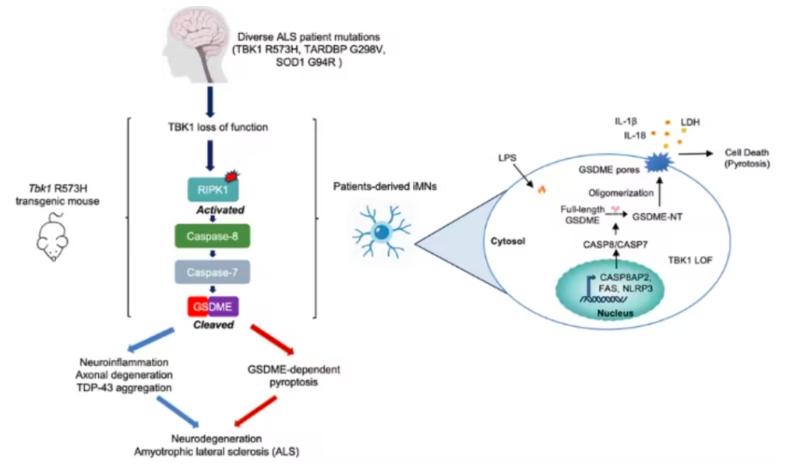
Fig 1. Proposed mechanism linking TBK1 dysfunction to GSDME-dependent pyroptosis and motor neuron degeneration across ALS genotypes.
Source: Cell Death & Differentiation.
Patient-Derived iPSC Models Reveal Convergent ALS Pathology
A major challenge in ALS research is the lack of experimental models that fully reproduce the genetic diversity and clinical heterogeneity observed in patients.
For example, the widely used SOD1 G93A mouse model typically carries multiple copies of a mutant transgene, a genetic configuration that differs from the endogenous mutations found in most patients.
Although such models have provided valuable insights into ALS pathogenesis, they only partially reflect the complexity of human disease.
Human induced pluripotent stem cell-derived motor neurons carrying patient-specific mutations offer an alternative platform for investigating disease mechanisms in a human genetic context.
Similarly, humanized knock-in mouse models that reproduce disease-associated alleles at endogenous genomic loci provide complementary opportunities for examining pathological changes in vivo.
In the present study, the researchers combined patient genetic analyses, iPSC-derived motor neuron models, and humanized genetic mouse models to investigate the relationship between TBK1 dysfunction, GSDME activation, and inflammatory neuronal death.
Despite carrying distinct ALS-associated mutations, patient-derived motor neurons exhibited a common pathological signature characterized by reduced TBK1 activity, increased TDP-43 phosphorylation and cytoplasmic aggregation, and activation of a caspase-8/7–GSDME-associated pyroptotic program.
These findings suggest that TBK1-related signaling dysfunction may represent a convergence point for multiple genetic forms of ALS.
Neuroinflammation Amplifies TBK1-Associated Neuronal Injury
The study further investigated how inflammatory stimulation influences the TBK1–caspase–GSDME pathway.
In patient-derived motor neurons, neuroinflammatory challenge enhanced the cleavage of caspase-8/7 and GSDME, indicating increased activation of the associated cell death machinery.
This response was accompanied by elevated RIPK1 phosphorylation and reduced TBK1 activation.
These observations suggest that inflammatory stress may amplify neuronal vulnerability when TBK1 signaling is already compromised.
To further investigate the contribution of TBK1 deficiency, the researchers reduced TBK1 expression in SH-SY5Y cells.
TBK1 knockdown reproduced several disease-associated molecular features, supporting a functional relationship between impaired TBK1 activity and activation of inflammatory cell death signaling.
The results suggest that TBK1 dysfunction may weaken protective cellular mechanisms while increasing susceptibility to inflammatory stress.
Humanized TBK1 R573H Knock-In Mice Develop Progressive ALS-Like Pathology
To examine the consequences of TBK1 dysfunction in vivo, the researchers generated humanized TBK1 R573H knock-in mice.
These animals developed progressive motor impairments accompanied by spinal motor neuron degeneration, neuroinflammation, and pathological changes involving TDP-43.
The findings indicate that the TBK1 R573H variant can contribute to ALS-like neurological abnormalities in a genetically engineered animal model.
When the mice were challenged with lipopolysaccharide (LPS), a widely used experimental stimulus for inducing inflammatory responses, they exhibited increased cleavage of GSDME and caspase-7.
In addition, phosphorylated TDP-43 expression was markedly elevated in vulnerable neuronal populations.
These observations suggest that systemic inflammatory challenges can exacerbate molecular abnormalities associated with TBK1 dysfunction.
The humanized knock-in model therefore provides an experimental platform for examining interactions among genetic susceptibility, neuroinflammation, regulated neuronal death, and TDP-43 pathology.
Therapeutic Implications of the TBK1–Caspase–GSDME Axis
The identification of a shared TBK1-related signaling pathway across genetically distinct ALS models has important implications for future therapeutic research.
Rather than focusing exclusively on individual disease-associated mutations, therapeutic strategies could potentially target common downstream mechanisms that contribute to motor neuron degeneration.
The TBK1–caspase–GSDME axis represents one such candidate pathway.
Potential approaches may include preserving appropriate TBK1-dependent signaling, modulating pathological caspase activation, or limiting GSDME-mediated membrane damage.
However, TBK1 performs essential functions in innate immunity and cellular homeostasis, and broad manipulation of its activity could produce unintended biological consequences.
Furthermore, the current findings are based primarily on patient-derived cellular models and experimental animals.
Additional investigations will be required to determine whether the identified pathway plays a similar role across larger ALS patient populations and whether its modulation can produce meaningful therapeutic benefits without disrupting essential physiological functions.
Conclusion
This study provides evidence that genetically distinct forms of ALS can converge on a shared pathological mechanism involving TBK1 loss of function and GSDME-dependent inflammatory cell death.
By integrating patient genetic analyses, iPSC-derived motor neurons, cellular knockdown experiments, and humanized TBK1 R573H knock-in mice, the researchers identified a molecular pathway connecting impaired TBK1 signaling, caspase-8/7–GSDME activation, TDP-43 pathology, and progressive motor neuron degeneration.
The findings also demonstrate that inflammatory stimulation can exacerbate these abnormalities, highlighting the interaction between genetic susceptibility and neuroinflammatory stress in ALS pathogenesis.
Overall, the research advances understanding of the mechanisms underlying motor neuron vulnerability and identifies the TBK1–caspase–GSDME signaling axis as a potential target for future disease-modifying therapeutic strategies.
Related Products & Services
- Cell and Gene Therapy
- Immune Checkpoint Proteins
- ADC Target Protein
- PROTAC Targets
- Targets of CAR-T Cell Therapy
- Cancer Drug Targets
- Protein Engineering Services
- Protein Interaction Service
- Protein Expression and Purification Services
- Drug Discovery Screening
- Protein Pathway Profiling
Reference
Qi, Z., Liu, X., Geng, L. et al. Convergent TBK1 loss of function drives gasdermin E dependent pyroptosis and motor neuron degeneration across ALS genotypes. Cell Death Differ (2026). https://doi.org/10.1038/s41418-026-01874-8