
Uncategorized Wednesday, 2026/10/21
Research Highlights
Cell fate is governed by complex signaling pathways involving various protein post-translational modifications. However, the mechanisms by which protein AMPylation regulates signal transduction in mammalian cells remain poorly understood.
A recent study published in Proceedings of the National Academy of Sciences (PNAS) identifies a previously uncharacterized tumor-suppressive signaling pathway mediated by the protein adenylyltransferase SELENOO (SelO). The findings demonstrate that SelO suppresses cancer cell proliferation and migration through AMPylation of CDK5 regulatory subunit-associated protein 3 (Cdk5rap3), revealing a novel connection between protein AMPylation and cancer progression.
New Study Reveals the Tumor-Suppressive Role of SelO
A research team led by Ting Wang and Yuan Fu from Tianjin Medical University published a study in PNAS entitled “SelO functions as a tumor suppressor through AMPylating Cdk5rap3.”
The study demonstrates that the protein adenylyltransferase SELENOO (SelO) is induced by chemotherapy and exhibits clinical relevance in cancer.
In mouse models, SelO knockout promoted primary tumor development and metastasis. In cancer cells, the cytoplasmic pool of SelO inhibited cell proliferation and migration.
Mechanistically, SelO catalyzes the AMPylation of Cdk5rap3 at threonine 328 (T328), enhancing its interaction with the tumor suppressor ARF.
This enhanced interaction competitively reduces the binding of ARF to the SUMO-conjugating enzyme UBC9, thereby decreasing ARF-mediated SUMO1 modification of Mdm2 and Slug.
Meanwhile, the increased affinity between Cdk5rap3 and ARF reduces the association of Cdk5rap3 with the phosphatase PPM1D, impairing PPM1D-mediated dephosphorylation of Mdm2.
Together, these molecular changes destabilize Mdm2 and Slug proteins, suppressing downstream signaling pathways involved in cell proliferation and TGF-β-mediated migration.
These findings establish an important role for protein AMPylation in mammalian cell signaling and cancer progression.
Protein AMPylation: An Underexplored Post-Translational Modification in Mammalian Cells
Cancer arises from uncontrolled cellular proliferation and the acquisition of invasive and migratory capabilities. These biological processes are regulated by intricate signaling networks involving protein post-translational modifications (PTMs). Dysregulation of these modifications plays a critical role in cancer development and progression.
Although protein kinases are well-established targets in cancer therapy, ATP (adenosine triphosphate) also serves as a substrate for protein adenylyltransferases. These enzymes transfer an adenosine monophosphate (AMP) moiety to specific serine, threonine, or tyrosine residues on target proteins through a process known as AMPylation, also referred to as adenylylation.
Despite growing interest in this modification, its functions in mammalian cellular signaling remain incompletely characterized.
Much of the early research on protein AMPylation focused on prokaryotic organisms. Although AMPylation has also been detected in mammalian cells, most investigations have concentrated on its role in protein folding and quality control within the endoplasmic reticulum (ER).
In addition, certain pathogenic bacteria exploit AMPylating enzymes to modify host signaling proteins after entering mammalian cells, thereby manipulating host cellular processes.
More recently, studies have reported that the 5′–3′ exonuclease phospholipase D3 (PLD3) is regulated through AMPylation mediated by FIC domain-containing protein (FICD), directly influencing Toll-like receptor signaling.
These observations suggest that AMPylation may have broader regulatory functions in mammalian cells than previously recognized.
Our Featured Proteins
| Cat.No. # | Product Name | Source (Host) | Species | Tag | Protein Length | Price |
|---|---|---|---|---|---|---|
| CDK5RAP3-1027H | Recombinant Human CDK5RAP3 Protein, GST-Tagged | Wheat Germ | Human | GST |

|
|
| CDK5RAP3-1308R | Recombinant Rat CDK5RAP3 Protein | Mammalian Cells | Rat | His |
|
|
| CDK5RAP3-3227C | Recombinant Chicken CDK5RAP3 | Mammalian Cells | Chicken | His |
|
|
| CDK5RAP3-335Z | Recombinant Zebrafish CDK5RAP3 | Mammalian Cells | Zebrafish | His |
|
|
| CDK5RAP3-50H | Recombinant Human CDK5RAP3, His-tagged | E.coli | Human | His |
|
|
| MDM2-2320H |
Active Recombinant Human MDM2, GST-tagged

|
E.coli | Human | GST | ||
| MDM2-350H |
Recombinant human MDM2, His-tagged

|
E.coli | Human | His | 1-118 a.a. | |
| MDM2-568H | Active Recombinant Human MDM2 protein, His-tagged | E.coli | Human | His | 1-218 aa | |
| PLD3-1771H | Recombinant Human PLD3, GST-tagged | E.coli | Human | GST | 144-490aa | |
| FICD-12894H | Recombinant Human FICD, GST-tagged | E.coli | Human | GST | C-term-300a.a. | |
| UBC9-3524H | Recombinant Human UBC9, GST-tagged | E.coli | Human | GST | 0-184AA | |
| UBC9-3407H | Recombinant Human UBC9 protein, His-tagged | E.coli | Human | His | 1-184 aa |
SELENOO (SelO): A Protein Adenylyltransferase With Distinct Isoforms
SELENOO (SelO) is a protein adenylyltransferase with a conserved C-terminal region containing an unusual selenocysteine residue at position 667.
Previous research has suggested that this selenocysteine residue can suppress the AMPylation activity of SelO.
During selenoprotein translation, the UGA codon, which normally functions as a translation termination signal, can also encode selenocysteine under specific cellular conditions.
Consequently, cells can produce two SelO isoforms, one containing selenocysteine and the other lacking this residue. Their relative abundance depends on intracellular selenium availability and the efficiency of selenocysteine incorporation.
Recent research has demonstrated that the selenocysteine residue is essential for SelO-mediated mitochondrial homeostasis through a mechanism dependent on NADase activity.
However, the functional significance of AMPylation mediated by the non-selenocysteine-containing SelO isoform in mammalian cells has remained largely unexplored.
The new study addresses this knowledge gap by investigating the role of SelO-dependent AMPylation in cancer-associated signaling pathways.
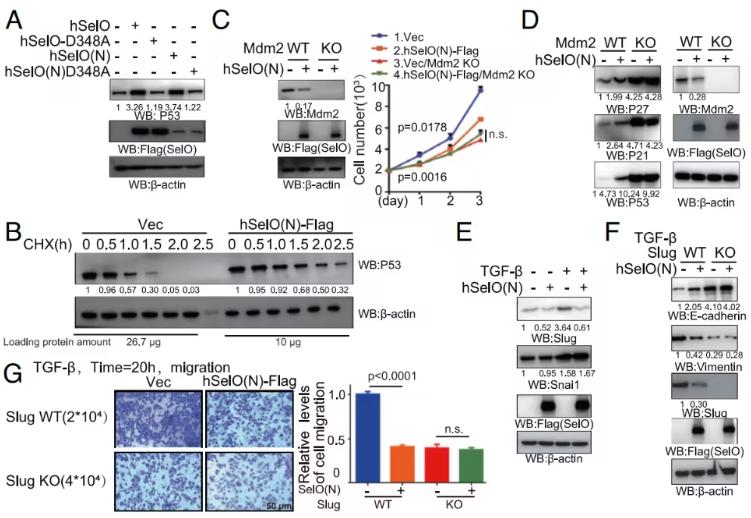
Fig 1. SelO reduces Mdm2 and Slug protein levels in an AMPylation activity-dependent manner.
Cdk5rap3: A Multifunctional Regulator of Cellular Signaling
CDK5 regulatory subunit-associated protein 3 (Cdk5rap3) is a highly conserved multifunctional protein found in various multicellular organisms.
Loss of Cdk5rap3 function can lead to severe developmental abnormalities and lethal phenotypes, reflecting its essential role in maintaining cellular and organismal homeostasis.
Cdk5rap3 participates in signaling pathways that regulate a wide range of biological processes, including:
- Endoplasmic reticulum stress responses
- Autophagy
- Apoptosis
- Cell cycle progression
- Cell adhesion
- Cell migration and invasion
Cdk5rap3 mediates these diverse functions through interactions with multiple regulatory proteins.
Among its important binding partners are the tumor suppressor alternative reading frame protein (ARF), also known as p14ARF in humans and encoded by the CDKN2A locus, and the oncogenic phosphatase PPM1D.
Notably, previous research has revealed seemingly contradictory roles for Cdk5rap3 in cancer. Depending on the biological context, Cdk5rap3 can function either as a tumor suppressor or as a promoter of oncogenic signaling.
This functional duality highlights the importance of understanding how specific molecular interactions and post-translational modifications determine its activity in different cellular environments.
SelO-Mediated AMPylation of Cdk5rap3 Regulates Tumor-Suppressive Signaling
The current study identifies an AMPylation-dependent signaling pathway that controls cell proliferation and migration in mammalian cells, with SelO acting as a central regulatory component.
SelO exerts its tumor-suppressive function by catalyzing AMPylation of Cdk5rap3 at threonine 328.
This post-translational modification alters the interaction dynamics of Cdk5rap3 with two important regulatory proteins: ARF and PPM1D.
AMPylation enhances the binding affinity between Cdk5rap3 and ARF, thereby reducing the availability of ARF for interaction with the SUMO-conjugating enzyme UBC9.
Consequently, ARF-mediated SUMO1 modification of Mdm2 and Slug is reduced.
At the same time, the enhanced Cdk5rap3–ARF interaction limits the association between Cdk5rap3 and PPM1D, impairing the ability of PPM1D to dephosphorylate Mdm2.
Through these interconnected mechanisms, SelO promotes the destabilization of Mdm2 and Slug.
Mdm2 is an E3 ubiquitin-protein ligase that plays a central role in regulating cell proliferation, particularly through its involvement in p53-associated signaling.
Slug, also known as the zinc finger transcription factor SNAI2, contributes to epithelial–mesenchymal transition, cell migration, and invasive behavior.
By reducing the stability of these proteins, SelO suppresses signaling programs associated with cancer cell proliferation and TGF-β-mediated migration.
This mechanism provides a molecular explanation for how SelO-dependent AMPylation contributes to tumor suppression.
Conclusion: A New Connection Between Protein AMPylation and Cancer Progression
This study uncovers a previously underexplored AMPylation-mediated signaling pathway that regulates cancer cell proliferation and migration.
By modifying Cdk5rap3 at threonine 328, SelO changes the interactions of Cdk5rap3 with ARF and PPM1D, leading to reduced stability of the oncogenic regulators Mdm2 and Slug.
These findings expand the known biological functions of protein AMPylation beyond protein quality control and establish its importance in mammalian signaling networks involved in tumor development.
The identification of SelO as a tumor suppressor also provides a new perspective on the context-dependent functions of Cdk5rap3 and highlights the potential relevance of AMPylation-associated pathways in cancer research.
Although further investigation is required to evaluate the therapeutic implications of these findings, the study offers a molecular foundation for exploring SelO-dependent signaling as a potential target for future anticancer strategies.
Related Products & Services
- Cell and Gene Therapy
- Immune Checkpoint Proteins
- ADC Target Protein
- PROTAC Targets
- Targets of CAR-T Cell Therapy
- Cancer Drug Targets
- Protein Engineering Services
- Protein Interaction Service
- Protein Expression and Purification Services
- Drug Discovery Screening
- Protein Pathway Profiling
Reference
L. Wu, J. Wu, W. Xie, X. Lu, C. Chen, T. Zhang, J. Shen, Y. Zhao, L. Chen, Y. Li, Q. Yu, Y. Fu, & T. Wang, SelO functions as a tumor suppressor through AMPylating Cdk5rap3, Proc. Natl. Acad. Sci. U.S.A. 123 (38) e2617361123, https://doi.org/10.1073/pnas.2617361123 (2026).