

Enzyme/Antibody conjugation
Creative BioMart offers comprehensive Enzyme/Antibody Conjugation Services designed to support a broad spectrum of research, diagnostic, and assay-development applications. With extensive expertise in high-quality protein modification and a commitment to customized solutions, we deliver enzyme-labeled antibodies and protein conjugates with exceptional stability, activity, and reproducibility. Our platform features one of the industry’s largest selections of enzyme conjugates—including HRP, AP, β-galactosidase, and β-lactamase—supported by optimized conjugation chemistries and stringent quality control. Each project is tailored to meet the client’s scientific objectives, ensuring the highest level of specificity, performance, and reliability for downstream analytical and detection workflows.
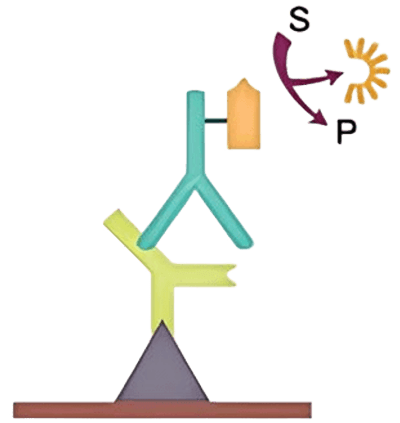
Introduction to Enzyme/Antibody Conjugation
Enzyme/antibody conjugation is a foundational tool in immunology, diagnostics, molecular biology, and biochemical assay development. By chemically coupling enzymes to antibodies or other proteins, researchers create highly sensitive detection reagents capable of signal amplification, visualization, or substrate conversion in a wide range of analytical platforms.
Commonly used enzymes—such as horseradish peroxidase (HRP), alkaline phosphatase (AP), β-galactosidase, and β-lactamase —enable colorimetric, fluorometric, and chemiluminescent readouts, making them indispensable in ELISAs, Western blots, immunohistochemistry, and hybridization assays. Despite their utility, successful conjugation requires careful control to maintain the bioactivity of both the enzyme and the antibody/protein carrier. Variables such as coupling chemistry, reaction stoichiometry, buffer composition, and purification strategies can significantly influence the final product’s specificity, sensitivity, and shelf-life.
Creative BioMart has established a dedicated enzyme conjugation platform engineered to overcome the challenges inherent to producing reproducible, high-performance conjugates. Our experienced team has spent years refining conjugation strategies, implementing quality control pipelines, and developing proprietary methods that allow us to achieve near-optimal 1:1 enzyme-to-antibody/protein ratios while preserving functional integrity on both sides of the conjugate.
Whether clients require standardized HRP- antibody conjugates for routine immunoassays, specialized β-galactosidase constructs for reporter detection, or custom-designed multi-step coupling strategies for complex biomolecules, Creative BioMart provides a reliable and cost-effective solution tailored to their research needs.
Enzyme/Antibody Conjugation: What We Offer
Service Workflow

Service Features
-
Extensive Enzyme Options
We offer one of the largest selections of enzyme conjugates available commercially, including:
- Horseradish peroxidase (HRP): Ideal for chemiluminescent, colorimetric, and electrochemical detection
- Alkaline phosphatase (AP): Preferred for substrates requiring low background and high amplification
- β-Galactosidase: Widely used in colorimetric assays and reporter detection systems
- β-Lactamase: Suitable for advanced detection strategies and high-sensitivity assays
Other enzymes may also be available upon request. Our team routinely accommodates custom enzyme selections based on project needs.
-
Supported Conjugation Methods
Depending on the antibody composition, enzyme characteristics, and desired conjugate properties, we select from a range of coupling chemistries such as:
- Amine-reactive crosslinking
- Thiol-reactive chemistries
- Carboxyl-activated coupling
- Heterobifunctional linkers
- Site-directed or orientation-specific conjugation strategies
Our team ensures that the method minimizes structural disruption to both components.
-
Conjugation Process
Using our in-house optimized techniques, antibody/protein and enzyme molecules are reacted under controlled conditions. Our platform ensures:
- Consistent stoichiometry
- Protection of functional residues
- Minimal aggregation
- Optimal enzyme coating and orientation
-
Broad Application Coverage
Our conjugates are suitable for a wide range of research and diagnostic applications, including:
- ELISAs (direct, indirect, and sandwich formats)
- Western blotting and dot blotting
- In situ hybridization (ISH)
- Immunocytochemistry (ICC)
- Immunohistochemistry (IHC)
- Flow cytometry (enzyme-assisted detection formats)
- Reporter-based assays
- High-sensitivity diagnostic kit development
-
Custom and Client-Driven Conjugation
Every conjugation is designed specifically for each client. We work closely with customers to understand:
- The nature and function of their target antibody or protein
- The desired application and detection modality
- Required stability, sensitivity, and kinetic performance
- Potential concerns regarding steric hindrance or antigen binding sites
- Buffer and formulation preferences
This collaborative approach ensures maximal activity, specificity, and experimental compatibility.
-
Performance Features
- High turnover rate enzymes ensuring strong signal amplification
- Stable conjugates with long shelf-life and minimal loss of activity
- Low cost relative to comparable commercial conjugation services
- Optimized conditions for sensitive antibodies or proteins that may be prone to denaturation
- Compatibility with various assay formats, including low-volume platforms, automation, and kit development
What Sets Us Apart
- Extensive Enzyme Selection: With one of the widest arrays of available enzymes—HRP, AP, β-galactosidase, β-lactamase, and more—we provide unmatched flexibility in designing detection reagents tailored to your research or diagnostic platform.
- Customized, Client-Focused Solutions: Every conjugation is performed specifically for each customer. We take the time to fully understand your project’s complexities and ensure the final product integrates seamlessly into downstream workflows.
- Optimized Conjugation Chemistry: Our proprietary techniques deliver stable, reproducible conjugates with ideal stoichiometry and preserved bioactivity—critical for sensitive detection assays.
- Superior Quality Control: Each batch undergoes stringent QC testing to ensure enzyme activity, antibody specificity, and long-term stability meet or exceed industry standards.
- Highly Cost-Effective Services: We combine premium quality with competitive pricing, making our custom conjugation platform one of the most cost-effective commercial solutions available.
- Experienced Scientific Team: Our specialists bring years of expertise in enzyme chemistry, protein engineering, assay design, and antibody development. Clients rely on us not just for conjugation, but for scientific partnership.
Enzyme/Antibody Conjugation: Case Studies
Case 1: Improving functional properties of pea protein through "green" modifications using enzymes
Shen et al., 2022. doi:10.1016/j.foodchem.2022.132687
In this study, pea protein functionality was enhanced through enzymatic crosslinking and conjugation-based modification. Transglutaminase-treated proteins exhibited nearly double the water-holding capacity of untreated pea protein, while guar gum–conjugated samples demonstrated exceptional emulsifying capacity and stability. Sequential modification—crosslinking followed by conjugation—produced synergistic improvements across multiple properties, including water and oil retention, emulsification, and gelation. Molecular analyses confirmed structural changes underlying these enhancements, and the modified proteins maintained sensory qualities comparable to the control. These findings highlight the potential of protein–enzyme and protein–polysaccharide conjugation strategies to significantly improve plant protein performance in food applications.
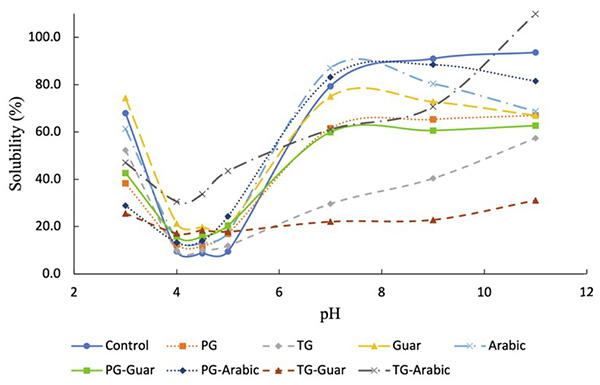
Figure 1. Solubility of pea and modified pea proteins. The pea protein deamidated by glutaminase (PG), crosslinked by transglutaminase (TG), and conjugated with guar gum (Guar) or gum Arabic (Arabic). (Shen et al., 2022)
Case 2: A β-galactosidase-activated fluorogenic reporter for the detection of gastric cancer in vivo and in urine
Yu et al., 2024. doi:10.1021/acs.analchem.4c00429
Gastric cancer remains difficult to diagnose due to invasive procedures and low-sensitivity assays. To address this, researchers developed a fluorescent gastric cancer reporter (FGCR) that produces activatable near-infrared fluorescence in response to tumor-associated β-galactosidase. In a murine model, FGCR enabled real-time in vivo imaging and highly sensitive remote urinalysis, aided by its exceptional renal-clearance efficiency (~95% ID). The probe allowed detection of tumors as small as ~2.1 mm and supported prognosis assessment following oxaliplatin chemotherapy. This work introduces a promising noninvasive strategy for gastric cancer diagnosis and monitoring, while providing design guidance for future fluorescence-based diagnostic probes.
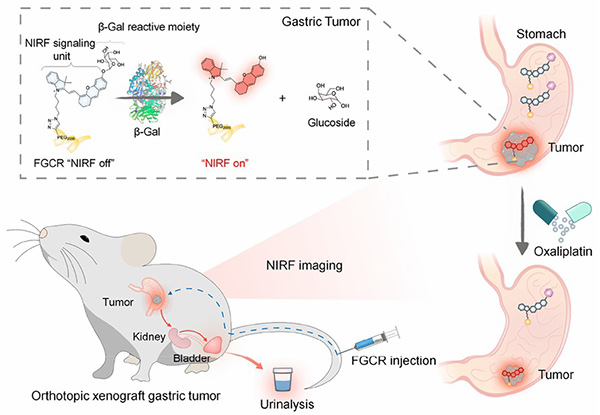
Figure 2. Design and mechanism of FGCR for real-time NIRF imaging and urinary detection of orthotopic GC in living mice. (Yu et al., 2024)
Enzyme/Antibody Conjugation: Customer Feedback
“We collaborated with Creative BioMart to produce HRP-conjugated antibodies for a high-throughput ELISA platform targeting inflammatory biomarkers. Their team carefully optimized the conjugation chemistry to maintain antibody affinity while ensuring maximum enzymatic activity. The conjugates consistently delivered high signal-to-noise ratios, allowing our assay to reach the sensitivity levels required for preclinical validation. Their scientific insight and responsiveness made the project seamless.”
— Director of Immunoassay Development | Global Pharmaceutical Company
“Our lab needed AP-conjugated proteins for in situ hybridization experiments on tissue sections. Creative BioMart customized the conjugation protocol to preserve both protein structure and enzymatic function. The resulting conjugates produced highly specific staining with minimal background, dramatically improving the clarity and reproducibility of our imaging data. Their attention to detail and clear communication throughout the project exceeded our expectations.”
— Principal Investigator, Molecular Pathology | University Research Institute
“We requested β-galactosidase-labeled antibodies to support a reporter-based drug screening assay. Creative BioMart’s team designed a tailored conjugation workflow that optimized enzyme-to-antibody ratios while protecting binding activity. The conjugates performed flawlessly across hundreds of plates, significantly reducing variability and enhancing our throughput. Their combination of technical expertise and fast turnaround was a key factor in meeting our tight project deadlines.”
— Senior Scientist, High-Throughput Screening | Biotechnology Company
“For a novel diagnostic kit, we required β-lactamase conjugates with precise orientation and high enzymatic activity. Creative BioMart developed a custom conjugation strategy that preserved antibody specificity and yielded robust signal amplification. The quality and consistency of the conjugates gave us confidence for regulatory submission and early clinical testing. Their proactive troubleshooting and thorough documentation were invaluable.”
— R&D Director, Diagnostics Division | Emerging Medical Technology Company
Enzyme/Antibody Conjugation: Frequently Asked Questions
-
Q: What types of enzyme conjugates do you offer?
A: We provide one of the industry’s largest selections of enzyme conjugates, including horseradish peroxidase (HRP), alkaline phosphatase (AP), β-galactosidase, and β-lactamase. If your project requires a different enzyme, we can typically accommodate custom requests. Our team will recommend the optimal enzyme based on your assay format and sensitivity requirements. -
Q: How do you ensure the conjugates retain both enzyme and antibody/protein activity?
A: Using our proprietary conjugation techniques, we maintain near 1:1 enzyme-to-antibody/protein ratios. Reactions are optimized to protect structural integrity, functional binding sites, and enzymatic activity. Each conjugate undergoes rigorous quality control, including activity assays and specificity tests, to ensure reliable performance in your applications. -
Q: What applications are your enzyme conjugates suitable for?
A: Our conjugates are compatible with a wide range of research and diagnostic techniques, including ELISAs (direct, indirect and sandwich formats), Western blotting, dot blotting, immunohistochemistry (IHC), immunocytochemistry (ICC), in situ hybridization (ISH) and reporter assays and high-throughput screening. We can advise on the most suitable enzyme for your specific application to maximize sensitivity and signal quality. -
Q: Can you provide custom conjugation solutions?
A: Yes. Every conjugation is tailored to the client’s requirements. We work closely to understand your target protein, antibody, assay conditions, and desired performance. Customizations can include:- Alternative enzyme selection
- Orientation-specific conjugation
- Optimized buffer systems
- Special stoichiometry for sensitive proteins
-
Q: How is the quality of conjugates verified?
A: Each batch undergoes comprehensive quality control, including SDS-PAGE or size-exclusion chromatography to assess purity, enzyme activity assays, and antibody/protein binding and stability testing. We provide full QC documentation to give you confidence in the performance of your conjugates.
Other Resources
Related Services
- Protein Labeling
- Stable Isotope Labeling
- Protein Biotinylation
- Fluorescent Labeling in Vitro
- Fluorescent Tagged Protein in Vivo
- Site-Specific and Custom Labeling
- Protein Bioconjugation Services
Related Products
References:
- Shen Y, Hong S, Singh G, Koppel K, Li Y. Improving functional properties of pea protein through “green” modifications using enzymes and polysaccharides. Food Chemistry. 2022;385:132687. doi:10.1016/j.foodchem.2022.132687
- Yu M, Meng Z, Yi S, et al. A β-galactosidase-activated fluorogenic reporter for the detection of gastric cancer in vivo and in urine. Anal Chem. 2024;96(16):6390-6397. doi:10.1021/acs.analchem.4c00429

Contact us or send an email at for project quotations and more detailed information.
Quick Links
-

Papers’ PMID to Obtain Coupon
Submit Now -

Refer Friends & New Lab Start-up Promotions