

MNP Characterization Toolkit - Comprehensive Analysis from Physical Properties to Protein Conformation
Membrane Protein Nanoparticles (MNPs), which are nanoparticles coated with natural cell membranes and embedded with membrane proteins, represent a revolutionary platform technology. By providing a biomimetic microenvironment for transmembrane proteins, MNPs enhance stability and enable functional studies. To ensure consistent preparation quality and functional reproducibility, establishing a systematic, multi-dimensional characterization framework is essential. This guide synthesizes industry consensus and research best practices into four core characterization modules—physical properties, protein integration quality, lipid composition, and advanced conformational analysis—offering researchers a complete technical pathway from basic characterization to in-depth mechanistic exploration.
Explore MNPs Products
Learn More
1. Physical Characterization of Nanoparticles
1.1 Particle Size Distribution: DLS and Nanoparticle Tracking Analysis (NTA)
Dynamic Light Scattering (DLS) and Nanoparticle Tracking Analysis (NTA) are complementary techniques for assessing MNP size distribution. DLS calculates particle size based on light intensity fluctuations, making it ideal for rapid determination of the mean population diameter (typically 50–200 nm) and polydispersity index (PDI), with an ideal PDI of <0.2. NTA tracks individual particle Brownian motion to directly count particles and provide absolute concentration (particles/mL), which is particularly valuable for detecting aggregates or empty nanoparticles. For initial characterization, both methods should be used in tandem: DLS for batch-to-batch stability monitoring, and NTA to verify whether protein loading alters size distribution. If NTA reveals a bimodal distribution, this suggests the presence of uncoated bare cores or excessive aggregation, requiring optimization of sonication or extrusion protocols.
1.2 Morphology: Cryo-EM for Visualizing Membrane Layer Structure
While negative-stain EM is convenient, it cannot preserve the hydrated state and structural authenticity of the MNP membrane. Cryogenic Electron Microscopy (Cryo-EM) images samples in vitreous ice, clearly revealing whether a lipid bilayer (~4–5 nm thickness) completely encapsulates the nanoparticle core. High-resolution Cryo-EM can discern protrusion orientation of membrane proteins within the lipid layer, and combined with antibody labeling, enables preliminary determination of protein topology. We recommend imaging at least 100 particles per batch to statistically assess membrane coverage. Discontinuous or "patchy" membrane structures indicate improper lipid-to-core ratios or insufficient extrusion pressure. For GPCRs and other 7-transmembrane proteins, Cryo-EM can visualize two-leaflet density features, validating proper folding.
Explore GPCRs Proteins
Learn More
1.3 Concentration Quantification: Conversion Between Nanoparticle and Protein Concentrations
MNP studies require distinction between two critical parameters: particle concentration (particles/mL) and protein concentration (µg/mL). Particle concentration is measured directly via NTA or Resistive Pulse Sensing (RPS), which determines the actual functional units in cellular assays. Protein concentration is typically determined by BCA assay or micro-volume UV-Vis (280 nm). The conversion formula is: Protein copies per particle = (Total protein mass / Molecular weight) / (Particle concentration × Avogadro's constant). In practice, we recommend standardizing to "micrograms of protein per 10⁹ particles (µg/10⁹ particles)". If protein concentration is disproportionately high without a corresponding size increase, this suggests free protein that failed to integrate, necessitating additional wash steps. Establish a standard curve using lipid-only controls with known protein amounts to correct for background interference.
2. Assessment of Membrane Protein Integration Quality
2.1 Protein Orientation: Protease Protection Assay (Detecting Extracellular/Intracellular Domains)
The topological orientation of membrane proteins in MNPs directly impacts functionality. Protease protection assays exploit the inability of proteases (e.g., Proteinase K) to penetrate intact lipid membranes: if a target protein's extracellular domain (ECD) is correctly oriented outward, it will be digested while the intracellular domain (ICD) remains protected. Experimental workflow: incubate MNPs with protease, then analyze by SDS-PAGE for full-length and truncated bands; confirm domain identity via Western blot using domain-specific antibodies. For example, if GPRC5B's ECD antibody signal disappears while ICD signal persists, it indicates >90% of proteins are correctly inserted in the "outside-in" orientation. If both signals vanish, membrane integrity is compromised or proteins are mis-inserted. Include a detergent control (e.g., Triton X-100) to validate digestion specificity. Quantify orientation uniformity via ImageJ densitometry to calculate percentage consistency.
2.2 Oligomeric State Analysis: Native-PAGE and Cross-linking Mass Spectrometry
Membrane protein function often depends on dimers or higher-order oligomers. Native-PAGE separates MNPs without disrupting the membrane environment; staining with Coomassie blue or silver reveals bands. If monomers are ~150 kDa, dimers should appear as a distinct band at ~300 kDa. However, Native-PAGE has limited resolution and cannot distinguish non-specific aggregates.
Cross-linking Mass Spectrometry (XL-MS) provides precise oligomeric state information: use membrane-permeable cross-linkers (e.g., DSS, BS³) to covalently link spatially adjacent lysine residues. After enzymatic digestion, LC-MS/MS identifies cross-linked peptides. Detection of inter-subunit K–K connections confirms oligomer presence. For GPCRs, TM5–TM5 cross-links indicate a stable dimer interface. Optimize cross-linker arm length (11–30 Å) and concentration to avoid over-crosslinking artifacts. We recommend stoichiometric calculations: if cross-linked peptide abundance exceeds monomer peptide abundance by a >1:5 ratio, the oligomer is the predominant species.
2.3 Mobility: FRAP (Fluorescence Recovery After Photobleaching) for Measuring Diffusion Coefficients
Lateral mobility of membrane proteins is a critical indicator of functional dynamics. Fluorescence Recovery After Photobleaching (FRAP) is performed on a confocal microscope: locally photobleach fluorescently labeled proteins (e.g., GFP-tagged) on the MNP surface with high-intensity laser, then monitor fluorescence recovery kinetics. The diffusion coefficient D is calculated by D = (0.88 × ω²)/(4τ₁/₂), where ω is the bleach radius and τ₁/₂ is the half-recovery time. Functional MNPs exhibit D values of 0.1–1 µm²/s, approaching native cellular membranes (~0.5 µm²/s). Low D values (<0.05 µm²/s) suggest excessive membrane rigidity or protein immobilization, possibly due to high cholesterol content or protein–matrix interactions. Co-label membranes with lipophilic dyes like DiD to verify whether lipid and protein mobility are synchronized. Analyze at least 30–50 particles per sample to ensure statistical significance.
3. Lipid Composition Analysis
3.1 Mass Spectrometry-Based Identification of MNP Membrane Lipid Composition
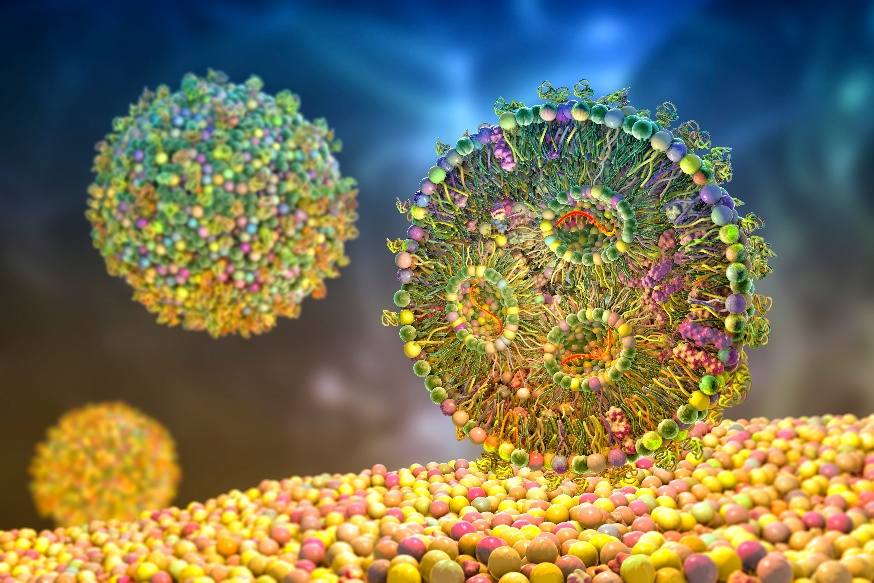
MNP functionality critically depends on faithful preservation of source cell membrane lipids. Lipidomics employs Liquid Chromatography-Tandem Mass Spectrometry (LC-MS/MS): extract lipids via chloroform/methanol, separate with C30 reverse-phase chromatography, and scan in positive/negative ESI modes. Matching against the LIPID MAPS database enables quantitative profiling of >200 lipid species, including phosphatidylcholine (PC), phosphatidylethanolamine (PE), phosphatidylserine (PS), sphingomyelin (SM), and cholesterol. Critical quality controls include: using isotope internal standards (e.g., d₇-cholesterol) to correct extraction efficiency; comparing lipid molar ratios between MNPs and source membranes, with PC/PE ratio deviation <15%. PS enrichment suggests loss of membrane asymmetry due to apoptosis. Report both relative percentages and absolute molar concentrations (mol/particle) per lipid class, and calculate the Double Bond Index (DBI) to assess membrane fluidity.
3.2 Impact of Cholesterol Content on GPCR Functionality
As a membrane fluidity modulator, cholesterol directly influences GPCR conformation and signal transduction. After LC-MS quantification, establish a functional dose-response curve. For example, incrementally increase cholesterol molar ratio in MNPs (20%–50%) and measure ligand binding affinity (Kd) and G protein coupling efficiency (GTPγS binding assay). Typically, GPCR Bmax peaks at 30–40% cholesterol; higher ratios form rigid rafts that restrict receptor conformational flexibility. Curvature-sensitive MS can reveal cholesterol distribution heterogeneity on the MNP surface. Enhanced co-localization signals of cholesterol and GPCR suggest direct molecular interactions. Complement with molecular dynamics simulations to observe cholesterol binding hotspots (e.g., GPCR TM1–TM7 cleft). Functional validation via β-arrestin recruitment assays: insufficient cholesterol reduces recruitment rate constants by >50%.
3.3 Influence of Lipid Raft Microdomains on Protein Aggregation States
Lipid microdomains (rafts) in MNPs can induce receptor nanoclustering and modulate signal transduction. Use Förster Resonance Energy Transfer (FRET) to detect co-localization of raft markers (e.g., glycosylphosphatidylinositol-GFP) with membrane proteins (e.g., mCherry-GPCR). High FRET efficiency (>0.3) indicates co-partitioning. For deeper insights, time-resolved FRET (trFRET) quantifies protein clustering: donor lifetime shortening >30% suggests nanoclusters of >5 proteins. MS coupling: use raft-specific mild detergents (e.g., CHAPS) to extract MNPs and compare protein composition between raft-enriched and soluble fractions. If GPCR is only detected in raft fractions, its function depends on ordered lipid environments. For mechanistic studies, add raft-disrupting agents (e.g., methyl-β-cyclodextrin) and observe whether oligomers dissociate into monomers. Such analysis is particularly critical for understanding receptor tyrosine kinase (RTK) dimerization activation mechanisms.
4. Advanced Conformational Analysis
4.1 Circular Dichroism (CD) for Secondary Structure Integrity
The far-UV CD spectrum (190–250 nm) is sensitive to α-helices and β-sheets. Optimize MNP samples to ~10¹³ particles/mL and use a 0.1 cm cuvette to minimize scattering artifacts. Typical GPCR-MNPs should exhibit α-helical double negative peaks at 208 nm and 222 nm, with a [θ]₂₂₂/[θ]₂₀₈ ratio >1.0 indicating stable transmembrane helices. Thermal denaturation experiments monitor peak intensity changes with temperature, with Tm >55°C as a robustness indicator. If transmembrane helix content (calculated via SELCON3 algorithm) is <40%, protein denaturation during coating is likely. Recommended controls: acquire CD spectra of detergent-solubilized free protein; the difference should be <10%. Synchrotron Radiation CD (SRCD) improves signal-to-noise for micro-volume samples. Data analysis requires subtraction of liposome-only blanks and baseline drift correction for light scattering.
4.2 Hydrogen-Deuterium Exchange Mass Spectrometry (HDX-MS) for Dynamic Conformations
HDX-MS reveals solvent accessibility and conformational flexibility of membrane proteins within MNPs. Protocol: Resuspend MNPs in D₂O buffer, quench at time points from 0 to 240 minutes, digest with pepsin at low temperature, and measure peptide deuterium incorporation via LC-MS. Exchange rates of backbone amide hydrogens reflect hydrogen bond strength and exposure. The key metric is deuterium protection: if ligand-binding domain peptides show >80% protection, they are likely membrane-embedded or structurally rigid; if G protein-binding interface peptides show <20% protection, they are highly dynamic. Compare apo vs. ligand-bound states via differential HDX-MS (ΔHDX); regions with ΔHDX >5% are identified as allosteric sites. Technical challenges: lipids interfere with ionization and require online reverse-phase lipid removal; deuterium back-exchange must be precisely controlled. We recommend the Waters HDX platform with acquisition rates >10 Hz for peptide-level resolution. Visualize results by mapping ΔHDX onto protein structures using PyMOL plugins.
4.3 Antibody Epitope Mapping (MNP-Based Peptide Competition Assays)
Precise epitope mapping is crucial for therapeutic antibody development. Traditional ELISA using linear peptides fails to capture conformational epitopes. MNP-peptide competition assays exploit intact membrane protein conformations: synthesize biotinylated 15-mer overlapping peptides covering the entire protein sequence (offset 5 aa). Pre-incubate MNPs with constant-concentration antibody, add peptide titrations, and detect antibody binding inhibition via ELISA or FACS. Peptides with lowest IC₅₀ values identify core epitopes. If multiple non-adjacent peptides compete, the epitope is likely conformational and composed of discontinuous sequences.
Advanced strategies employ HDX-MS competition: Antibody binding significantly reduces deuterium incorporation in epitope regions; comparing HDX with/without antibody localizes epitopes to single-residue resolution. For MNPs, ensure antibodies do not disrupt lipid membranes—pre-validate by confirming no significant mobility changes via FRAP post-binding. Final epitope data can guide antibody humanization to avoid targeting critical functional domains.
Conclusion and Best Practice Recommendations
When building an MNP quality evaluation system, we recommend a Tiered Validation Strategy:
- Tier 1 (Essential QC): DLS, NTA, BCA protein quantification—release criteria for every batch.
- Tier 2 (Quality Confirmation): Cryo-EM morphology, protease protection assay, Native-PAGE—perform for first production batch and key subsequent batches.
- Tier 3 (Deep Characterization): FRAP, lipidomics, HDX-MS—reserved for mechanistic studies and patent applications.
For data integration, establish multi-parameter correlation matrices: e.g., increased particle size (>250 nm) often correlates with PDI >0.3 and decreased FRAP diffusion coefficients, indicating process optimization needs. Include source cell membrane controls and empty nanoparticle negative controls in all experiments to ensure data interpretability. As technology advances, AI-assisted integrated analysis (e.g., machine learning to predict optimal lipid formulations) will further enhance MNP characterization efficiency and standardization.
Related Products and Services
Resource
-
Unlocking Drug Targets with Membrane Protein Nanoparticles!
-
Membrane Protein Platforms: 6-Way Showdown!
-
Mastering Membrane Protein Platforms in 3 Minutes!

Contact us or send an email at for project quotations and more detailed information.
Quick Links
-

Papers’ PMID to Obtain Coupon
Submit Now -

Refer Friends & New Lab Start-up Promotions