

Membrane Protein Platforms: A Comprehensive Selection Resource for Drug Discovery and Biopharma R&D
Membrane proteins represent over 60% of all FDA-approved drug targets, yet their study outside native cellular environments remains one of biopharma's most persistent technical challenges. When removed from the lipid bilayer, these complex receptors, transporters, and ion channels rapidly denature, aggregate, or lose functional activity—directly contributing to the 90% attrition rate in preclinical drug development.
The Core Challenge: Why Membrane Protein Isolation Is Critical
Membrane proteins are not merely soluble proteins with a hydrophobic patch. Their function depends intimately on:
- Transmembrane domain stabilization by specific lipid compositions
- Lateral pressure and membrane curvature
- Interactions with scaffolding proteins and co-receptors
- Native post-translational modifications (glycosylation, palmitoylation)
Traditional detergent-based methods often compromise these factors, leading to mischaracterized lead compounds that fail in late-stage development. The global market for reliable membrane protein platforms is projected to grow at 12.3% CAGR through 2028, driven by ADC therapeutics, CAR-T target validation, and GPCR-targeted drugs.
The Primary Technology Platforms: Deep Dive
1. Detergent Micelles: The Legacy Workhorse
Technical Principle: Detergents like DDM (n-Dodecyl-β-D-Maltoside) or LMNG (Lauryl Maltose Neopentyl Glycol) solubilize membrane proteins by forming ~5 nm micelles that shield the hydrophobic transmembrane regions.
Advantages:
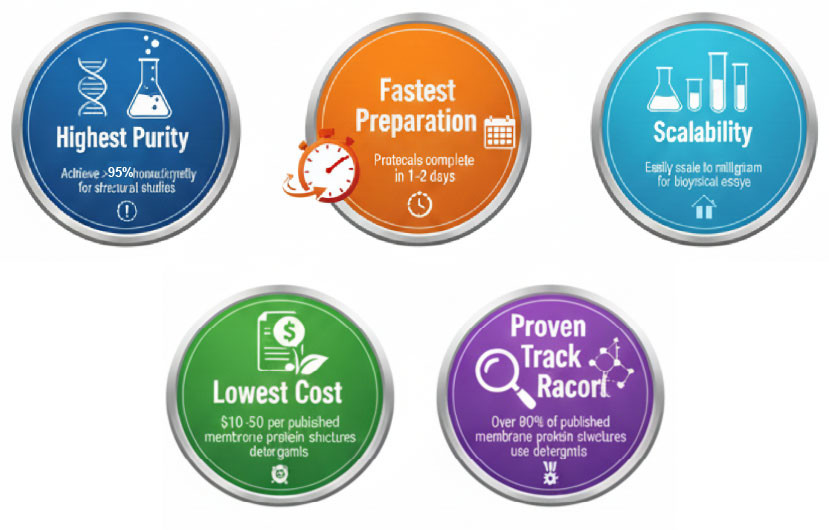
- Highest purity: Achieve >95% homogeneity for structural studies
- Fastest preparation: Protocols complete in 1-2 days
- Lowest cost: $10-50 per gram of protein produced
- Proven track record: Over 80% of published membrane protein structures use detergents
- Scalability: Easily scale to milligram quantities for biophysical assays
Disadvantages:
- Strips native lipids: Detergents remove essential phospholipids and cholesterol, destabilizing some proteins
- Functional artifacts: Can alter protein conformation and create non-physiological oligomerization states
- Assay interference: Detergents suppress immune responses and interfere with SPR, ELISA, and BLI
- Limited stability: Proteins often aggregate within days at 4°C
Best Applications:
- X-ray crystallography and Cryo-EM (when lipid environment is not critical)
- Surface Plasmon Resonance (SPR) binding studies
- High-throughput screening campaigns requiring mg-scale protein
Cost-Benefit Analysis:
Lowest upfront cost, but hidden costs from frequent protein re-preparation and failed functional assays can accumulate.
2. Nanodiscs: Controlled Membrane Mimicry
Technical Principle: Membrane Scaffold Proteins (MSPs) or synthetic polymers encircle a lipid bilayer patch (~10-20 nm diameter), creating a soluble disc that maintains native protein orientation.
Advantages:
- Tunable lipid environment: Incorporate specific phospholipids, cholesterol, or native lipid extracts
- Excellent for Cryo-EM: Enabled structures of GPCRs, transporters, and ion channels at near-atomic resolution
- No detergents: Eliminates assay interference while maintaining solubility
- Customizable size: MSP1D1 (9.7 nm) to MSP1E3D1 (12.9 nm) accommodate different protein sizes
Disadvantages:
- Optimization-intensive: Each protein requires screening of MSP:lipid:protein ratios (2-4 weeks development)
- Scaffold protein contamination: MSP bands can complicate SDS-PAGE analysis
- Not fully native: Artificial bilayer curvature may not replicate membrane microdomains
- Limited scalability: Production costs rise significantly above 10 mg quantities
Best Applications:
- Single-particle Cryo-EM and NMR spectroscopy
- Functional reconstitution of ion channels with defined lipid composition
- Kinetic assays where specific lipids modulate activity
Emerging Variants:
- Copolymer nanodiscs: SMA (styrene-maleic acid) polymers extract proteins directly from membranes without detergents, preserving native lipids
- Saposin-based discs: Smaller, more stable for challenging proteins
Cost-Benefit Analysis:
Moderate cost ($500-2,000 per prep), but high labor investment in optimization.
3. Virus-Like Particles (VLPs): Immunogenic Powerhouses
Technical Principle: Self-assembling protein cages (e.g., Qβ, AP205, HBcAg) display membrane proteins on their surface in dense, repetitive arrays (~100-150 nm particles).
Advantages:
- Exceptional stability: Shelf-stable for months at 4°C; withstands lyophilization
- Potent immunogenicity: Repetitive display elicits strong B-cell activation and durable antibody responses
- High density: Can present 100-200 membrane protein trimers per particle
- Proven manufacturing: Established GMP production pathways for vaccines
Disadvantages:
- Heterogeneous display: Variable protein insertion rates; some particles lack target protein
- Scaffold immunogenicity: Anti-VLP antibodies can confound immune readouts
- Size limitations: Large VLPs may not enter certain tissues or cells
- Limited lipid environment: Proteins displayed without native bilayer context
Best Applications:
- Vaccine development and immunotherapy targets
- Production of conformation-specific antibodies against membrane proteins
- Long-term stability studies
Cost-Benefit Analysis:
Moderate-high cost ($2,000-5,000 per gram), but superior for immune applications where stability justifies expense.
4. Vesicles: Native Membrane Fragments
Technical Principle: Direct purification of plasma membrane fragments (50-500 nm) containing target proteins in their endogenous lipid environment.
Advantages:
- Fully native: Preserve post-translational modifications, lipid microdomains, and multi-protein complexes
- No genetic engineering: Can isolate from primary cells or tissues
- Functional complexes: Maintain receptor-co-receptor interactions (e.g., GPCR-G protein complexes)
Disadvantages:
- Extreme heterogeneity: Broad size distribution and variable protein composition
- Poor purity: Contaminated with cytosolic proteins and organelle membranes
- Low yield: Requires 10^8-10^9 cells per preparation
- Assay variability: Batch-to-batch consistency is challenging
Best Applications:
- Functional assays requiring native signaling complexes
- Drug candidate validation in physiologically relevant systems
- Large protein complexes that cannot be reconstituted
Cost-Benefit Analysis:
High cost ($3,000-8,000 per prep) due to cell requirements and extensive purification; best for late-stage validation.
5. Exosomes: Natural Nanocarriers
Technical Principle: Secreted extracellular vesicles (30-150 nm) of endosomal origin, carrying membrane proteins in native orientation plus RNA and protein cargo.
Advantages:
- Clinically relevant: Naturally secreted by cells, offering biomarker potential
- High stability: Resistant to proteases and harsh conditions
- Native cargo: Preserve endogenous protein and nucleic acid content
- Cellular uptake: Efficiently enter recipient cells via endocytosis
Disadvantages:
- Isolation complexity: Contamination with microvesicles and apoptotic bodies
- Low yield: Require conditioned media from 10^8 cells over 48-72 hours
- Standardization issues: Lack of validated isolation protocols across labs
- Functional ambiguity: Cargo may not reflect current cell state
Purification Methods Comparison:
| Method | Purity | Yield | Time | Cost | Best For |
|---|---|---|---|---|---|
| Ultracentrifugation | ⭐⭐⭐ | ⭐⭐⭐⭐ | 8-12h | $ | Gold standard, scalable |
| SEC | ⭐⭐⭐⭐ | ⭐⭐ | 2-4h | $$ | High purity, removes proteins |
| Immunoaffinity | ⭐⭐⭐⭐⭐ | ⭐ | 4-6h | $$$$ | Specific subpopulations |
| Microfluidics | ⭐⭐⭐⭐ | ⭐⭐ | 1-2h | $$$ | Rapid, low sample volume |
Best Applications:
- Liquid biopsy biomarker discovery
- Cell-cell communication studies
- Therapeutic delivery vehicle development
Cost-Benefit Analysis:
Highest cost ($5,000-15,000 per prep); reserved for clinical research.
6. Membrane Protein Nanoparticles (MNPs): Intact Biocompatibility
Technical Principle: Direct stabilization of intact membrane fragments (50-200 nm) with native protein orientation and surrounding lipids, optimized for in vivo applications.
Advantages:
- Maximum biocompatibility: No artificial scaffolds; proteins in native membrane context
- Ideal for drug delivery: Can be functionalized with targeting ligands; excellent PK profile
- Preserves protein-protein interactions: Native complex stoichiometry maintained
- Scalable production: Adaptable to bioreactor systems
Disadvantages:
- Least defined composition: Contains entire membrane proteome, not isolated target
- Batch variability: Membrane composition varies with cell culture conditions
- Characterization challenges: Difficult to quantify target protein per particle
- Limited structural studies: Too heterogeneous for Cryo-EM or crystallography
Best Applications:
- Preclinical ADC and CAR-T target validation
- In vivo drug delivery and targeting studies
- Cell therapy potency assays
Cost-Benefit Analysis:
High cost ($4,000-10,000 per prep) but unmatched for translational research.
Comprehensive Platform Comparison Tables
Table 1: Quick Reference Selection Guide
| Research Goal | Primary Choice | Backup Option | Avoid | Key Consideration |
|---|---|---|---|---|
| Atomic Structure | Detergent/Nanodiscs | SMALPs | Vesicles/Exosomes | Need monodisperse samples |
| HTS Campaign | Nanodiscs | Detergent | VLPs, MNPs | Cost and scalability |
| Vaccine Development | VLPs | Nanodiscs | Detergent | Immunogenicity critical |
| Functional Pharmacology | Vesicles | MNPs | Detergent | Native environment essential |
| Clinical Biomarkers | Exosomes | Vesicles | Detergent | Clinical relevance paramount |
| In Vivo Delivery | MNPs | Exosomes | Nanodiscs | Biocompatibility key |
| Antibody Generation | VLPs > Nanodiscs | Vesicles | Detergent | Epitope conformation |
| Ion Channel Studies | Nanodiscs | SMALPs | Detergent | Lipid-dependent gating |
Table 2: Cost, Timeline & Resource Requirements
| Platform | Material Cost* | Labor Time | Total Timeline | Protein Yield | Scalability |
|---|---|---|---|---|---|
| Detergent | $10-50/mg | 1 day | 1-2 days | 1-10 mg | ⭐⭐⭐⭐⭐ |
| Nanodiscs | $500-2,000/mg | 1-2 weeks | 2-4 weeks | 0.5-5 mg | ⭐⭐⭐ |
| VLPs | $2,000-5,000/mg | 3-5 days | 1 week | 5-20 mg | ⭐⭐⭐⭐ |
| Vesicles | $3,000-8,000/prep | 2-3 days | 3-4 days | 0.1-1 mg | ⭐⭐ |
| Exosomes | $5,000-15,000/prep | 3-5 days | 4-7 days | 0.01-0.5 mg | ⭐ |
| MNPs | $4,000-10,000/prep | 2-3 days | 3-4 days | 0.5-2 mg | ⭐⭐ |
*Per preparation cost based on HEK293 cell expression
Table 3: Downstream Assay Compatibility Matrix
| Platform | SPR/BLI | ELISA | Cryo-EM | Immunization | Cell-Based | MS |
|---|---|---|---|---|---|---|
| Detergent | ⚠️ Interferes | ⚠️ Interferes | ✅ Excellent | ❌ Suppresses | ⚠️ Cytotoxic | ✅ Good |
| Nanodiscs | ✅ Good | ✅ Good | ✅ Excellent | ⚠️ Scaffold issues | ✅ Good | ⚠️ Scaffold peaks |
| VLPs | ⚠️ Non-specific | ✅ Excellent | ⚠️ Too large | ✅ Excellent | ✅ Good | ⚠️ Dense bands |
| Vesicles | ⚠️ Variable | ✅ Good | ❌ Heterogeneous | ✅ Good | ✅ Excellent | ⚠️ Contamination |
| Exosomes | ✅ Good | ✅ Good | ❌ Heterogeneous | ✅ Good | ✅ Excellent | ⚠️ Contamination |
| MNPs | ✅ Good | ✅ Good | ❌ Heterogeneous | ✅ Excellent | ✅ Excellent | ⚠️ Complex |
Table 4: Protein Stability & Complexity Considerations
| Protein Type | Detergent | Nanodiscs | VLPs | Vesicles | Exosomes | MNPs |
|---|---|---|---|---|---|---|
| Stable GPCR | ✅ | ✅ | ✅ | ⚠️ Overkill | ❌ | ❌ |
| Fragile Complex | ❌ | ✅ | ⚠️ | ✅ | ✅ | ✅ |
| Ion Channel | ⚠️ | ✅ | ❌ | ✅ | ⚠️ | ✅ |
| Large Complex (>500 kDa) | ❌ | ⚠️ | ❌ | ✅ | ⚠️ | ✅ |
| Multipass MP | ⚠️ | ✅ | ❌ | ✅ | ⚠️ | ✅ |
| Post-translational mod critical | ❌ | ⚠️ | ❌ | ✅ | ✅ | ✅ |
Table 5: Commercial Availability & Vendor Landscape
| Platform | Commercial Kits | Custom Services | DIY Complexity | Key Vendors |
|---|---|---|---|---|
| Detergent | ✅ Extensive | ✅ | ⭐ Easy | Anatrace, Avanti, Thermo |
| Nanodiscs | ✅ Growing | ✅ | ⭐⭐ Moderate | Cube Biotech, Sigma |
| VLPs | ⚠️ Limited | ✅ | ⭐⭐⭐ Hard | Medicago, CPI |
| Vesicles | ❌ Rare | ✅ | ⭐⭐⭐ Hard | Custom academic labs |
| Exosomes | ✅ Kits for isolation | ✅ | ⭐⭐⭐ Hard | SBI, ExoFlux, Thermo |
| MNPs | ❌ Rare | ✅ | ⭐⭐⭐ Hard | Emerging biotechs |
Emerging & Complementary Technologies
7. SMALPs (Styrene-Maleic Acid Lipid Particles)
Directly extract membrane proteins from cells without detergents, preserving native lipids. Ideal for structural biology but limited commercial availability.
8. Bicelles: Hybrid Membrane Models
Disk-like structures with a lipid bilayer core and detergent rim. Offer intermediate complexity between micelles and nanodiscs. Excellent for NMR studies but unstable long-term.
9. Cell-Free Expression Systems
Enable production of toxic membrane proteins without cell viability constraints. Can incorporate labeled amino acids for biophysical studies. High cost and low yield limit scale-up.
10. Affinity-Based Purification Kits
Commercial kits offer rapid, standardized protocols for specific applications. While convenient, they may compromise purity or native state compared to custom methods.
Decision Framework: The 5-Step Selection Process
Step 1: Define Your Assay Endpoint
- Structural biology → Detergent or Nanodiscs
- Immunology/Vaccines → VLPs
- Functional pharmacology → Vesicles or MNPs
- Clinical biomarkers → Exosomes
Step 2: Assess Protein Stability
- Robust proteins: Detergent acceptable
- Fragile/complex: Nanodiscs or native platforms
- Unknown: Run parallel stability tests in 2-3 systems
Step 3: Evaluate Resource Constraints
- Budget < $1k, <1 week → Detergent
- Budget $2-5k, 2-4 weeks → Nanodiscs or VLPs
- Budget >$5k, timeline flexible → Vesicles/Exosomes/MNPs
Step 4: Consider Downstream Compatibility
- SPR/BLI: Avoid detergents; use nanodiscs or VLPs
- Immunization: VLPs > MNPs > Vesicles
- Cryo-EM: Nanodiscs preferred
- In vivo: MNPs or Exosomes
Step 5: Validate Functional Relevance
Regardless of platform, confirm:
- Ligand binding affinity matches native cell data
- Signaling activity is preserved
- Conformational epitopes are intact
Practical Case Studies
- Case 1: GPCR Small-Molecule Screening
- Challenge: Need mg-scale protein for HTS
- Selection: Nanodiscs with defined cholesterol content
- Rationale: Detergent would distort allosteric site; vesicles too variable; nanodiscs balance scale and native environment
- Outcome: 85% hit overlap with cell-based assays
- Case 2: ADC Target Validation
- Challenge: Confirm tumor-specific epitope exposure
- Selection: MNPs from patient-derived tumor cells
- Rationale: Native glycosylation and lipid environment critical for ADC binding and internalization
- Outcome: Identified false positive from detergent prep, saving $2M in lead optimization
- Case 3: Vaccine Development
- Challenge: Generate neutralizing antibodies against viral membrane protein
- Selection: VLP display
- Rationale: Repetitive epitope presentation elicits high-affinity B cell responses
- Outcome: 10x higher neutralizing titers vs. soluble protein
Common Pitfalls & Best Practices
1
Pitfall 1: Platform-Centric Thinking
Labs often default to their most familiar technology. This leads to mismatched assays and failed programs. Solution: Create a platform selection SOP based on decision tree above.
2
Pitfall 2: Ignoring Lipid Context
Over 40% of membrane proteins require specific lipids for activity. Solution: Always test activity in native lipid-containing platforms (nanodiscs, vesicles, MNPs) alongside detergents.
3
Pitfall 3: Under-Characterizing Preparations
Heterogeneity is often underestimated. Solution: Use orthogonal characterization: SEC-MALS, DLS, negative stain EM, and functional assays for every batch.
4
Pitfall 4: Scaling Too Early
Optimizing in detergents then transferring to native platforms often fails. Solution: Lock final platform before lead optimization begins.
Conclusion: Strategic Platform Selection as Competitive Advantage
In modern drug discovery, platform selection is no longer a technical detail—it's a strategic decision impacting program success, timeline, and budget. No universal solution exists; each platform represents a deliberate trade-off between purity, native environment, stability, and cost.
Key Takeaways:
- Detergents: Fast, pure, but artificial—use for early structural work only
- Nanodiscs: The versatile middle ground—best for most discovery programs
- VLPs: Immunology specialty tool—unmatched for vaccines
- Vesicles & MNPs: Native function champions—essential for translational studies
- Exosomes: Clinical niche player—powerful but expensive for biomarkers
Our labs operate a platform portfolio, maintaining capability across 3-4 systems and selecting based on protein-specific requirements. As therapeutic modalities advance—particularly in ADC, cell therapy, and mRNA spaces—the ability to preserve native membrane protein context will separate leading innovators from followers.
Your Complete Membrane Protein Solution Partner: Creative BioMart
Now that you understand the critical differences between membrane protein platforms, where can you source high-quality proteins in each format? Creative BioMart provides a comprehensive portfolio of 750+ transmembrane proteins spanning 20+ species, produced using multiple presentation technologies to match your exact research needs.
Why Creative BioMart Stands Apart:
| Advantage | Creative BioMart Capability |
|---|---|
| Coverage | 750+ transmembrane proteins (GPCRs, ion channels, transporters, immunoglobulins) |
| Formats | Traditional recombinant, VLPs, Nanodiscs, MNPs—all platforms covered |
| Host Systems | E. coli (342 proteins), HEK293 (283 proteins), Insect Cells, CHO, Wheat Germ |
| Tags | His (392), SUMO (51), Flag (33), Myc (21), GFP, Strep, Biotin, Avi |
| Species | Human (462), Mouse (52), Rat (27), Cynomolgus (8), plus viral/bacterial proteins |
| Quality | <0.1 EU/μg endotoxin, validated bioactivity via functional ELISA |
| Speed | 4-6 weeks turnaround for custom projects |
| Price | Competitive |
Featured Products by Platform:
-
Detergent-Based Recombinant Proteins
- KCNE2-240H: Human KCNE2 (full-length, His-tagged) expressed in E. coli—ideal for structural studies
-
VLP-Displayed Proteins (Best for vaccines & antibody generation)
- CLDN6-8614H: Active Human CLDN6 in VLPs, biotinylated—perfect for ADC validation
- ADORA2A-0978H: Human ADORA2A in VLP format—for immunogenicity studies
-
Nanodisc-Embedded Proteins (Best for Cryo-EM & functional assays)
- TLR4-40689H: Human TLR4 full-length in Nanodiscs—preserves native signaling
- TLR9-0183H: Human TLR9 in Nanodiscs—ideal for ligand binding studies
- ADORA2A-3958H: Human ADORA2A in Nanodiscs—conformationally intact
- AGTR1-983H: Human AGTR1 in Synthetic Nanodiscs with MBP-Flag tags—customizable lipid environment
-
MNP (Membrane Nanoparticle) Formats (Best for in vivo & cell therapy)
- ADORA2A-3959H: Human ADORA2A in MNPs—fully native membrane context for drug delivery studies
- CB1-395H: Human CB1 in MNPs—preserves endocannabinoid signaling complex
-
Multi-Format Options for Key Targets Creative BioMart uniquely offers the same target in multiple formats—compare ADORA2A in VLPs, Nanodiscs, and MNPs side-by-side to select the optimal platform for your application.
Get Started Today:
Browse 750+ ready-to-ship membrane proteins
Learn More
For Custom Projects: Our expert team delivers full-length, active transmembrane proteins in your choice of format (VLPs, Nanodiscs, MNPs, or traditional) with 4-6 week turnaround.
Request a FREE Consultation: Contact our membrane protein specialists to match the right platform to your research goals.
Platform Selection = Question First, Technology Second. Let Creative Biomart provide the right protein in the right format for your answer.
Related Products and Services
Resource
-
Unlocking Drug Targets with Membrane Protein Nanoparticles!
-
Membrane Protein Platforms: 6-Way Showdown!
-
Mastering Membrane Protein Platforms in 3 Minutes!

Contact us or send an email at for project quotations and more detailed information.
Quick Links
-

Papers’ PMID to Obtain Coupon
Submit Now -

Refer Friends & New Lab Start-up Promotions