

Active Recombinant Human CD96 protein, His-tagged
| Cat.No. : | CD96-3887H |
| Product Overview : | Active Recombinant Human CD96 protein(P40200-2)(Val22-Met503) is expressed from HEK293 with His tag at the C-Terminus. |
| Availability | October 05, 2026 |
| Unit | |
| Price | |
| Qty |
- Specification
- Gene Information
- Related Products
- Case Study
- Application
- Download
| Species : | Human |
| Source : | HEK293 |
| Tag : | His |
| Protein Length : | 22-503 aa |
| Form : | Lyophilized from 0.22μm filtered solution in PBS (pH 7.4). |
| Bio-activity : | Immobilized Anti-CD96 Antibody, hFc Tag at 1μg/ml (100μl/well) on the plate. Dose response curve for Human CD96, His Tag with the EC50 of 28.8ng/ml determined by ELISA. |
| Molecular Mass : | The protein has a predicted MW of 54.7 kDa. Due to glycosylation, the protein migrates to 115-130 kDa based on Bis-Tris PAGE result. |
| Endotoxin : | Less than 1 EU per ug by the LAL method. |
| Purity : | > 95% as determined by Bis-Tris PAGE |
| Storage : | Store at -20 to -80°C for 12 months as supplied from date of receipt. -80°C for 3 months after reconstitution. Recommend to aliquot the protein into smaller quantities for optimal storage. Please minimize freeze-thaw cycles. |
| Reconstitution : | Dissolve the lyophilized protein in distilled water. |
| protein Refseq-Weblink : | http://www.ncbi.nlm.nih.gov/protein/NP_005807.1 |
| Unit ID : | P40200 |
| Unit ID-Weblink : | https://www.uniprot.org/uniprotkb/P40200 |
| Gene Name | CD96 CD96 molecule [ Homo sapiens ] |
| Official Symbol | CD96 |
| Synonyms | CD96; CD96 molecule; CD96 antigen; T-cell surface protein tactile; TACTILE; cell surface antigen CD96; T cell activation, increased late expression; t cell-activated increased late expression protein; MGC22596; DKFZp667E2122; |
| Gene ID | 10225 |
| mRNA Refseq | NM_005816 |
| protein Refseq | NP_005807 |
| MIM | 606037 |
| ◆ Recombinant Proteins | ||
| CD96-151H | Recombinant Human CD96 Protein, His-tagged | +Inquiry |
| CD96-358H | Recombinant Human CD96(Val22-Met503) Protein, C-Fc-tagged | +Inquiry |
| CD96-1124HFL | Recombinant Full Length Human CD96 Protein, C-Flag-tagged | +Inquiry |
| CD96-0887H | Recombinant Human CD96 Protein, GST-Tagged | +Inquiry |
| CD96-925R | Recombinant Rat CD96 Protein, His (Fc)-Avi-tagged | +Inquiry |

| ◆ Cell & Tissue Lysates | ||
| CD96-1723MCL | Recombinant Mouse CD96 cell lysate | +Inquiry |
| CD96-1976HCL | Recombinant Human CD96 cell lysate | +Inquiry |
Case 1: Wang CQ, et al. Cells. 2023
Immune checkpoint blockade (ICB) therapy aims to boost T cell responses against tumors, but not all patients respond well, suggesting other checkpoints matter. CD96, a potential check, can suppress natural killer cells but its impact on T cells is debated. Our study reveals that CRISPR/Cas9 removing CD96 enhances T cell attack on leukemia cells. Moreover, T cells engineered with CD96-based CARs perform worse against HER2 tumors compared to those without CD96. This indicates CD96 may reduce T cell effectiveness, supporting the idea of using multiple checkpoint targets in therapy.
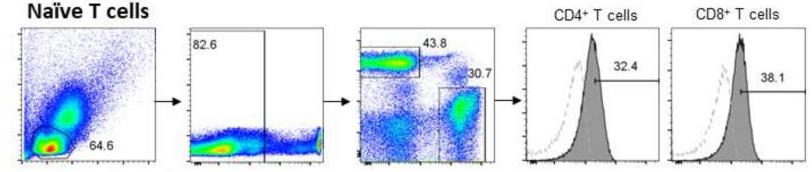
Fig1. Expression of CD96 in naïve CD4+ and CD8+ T cells at day 0.
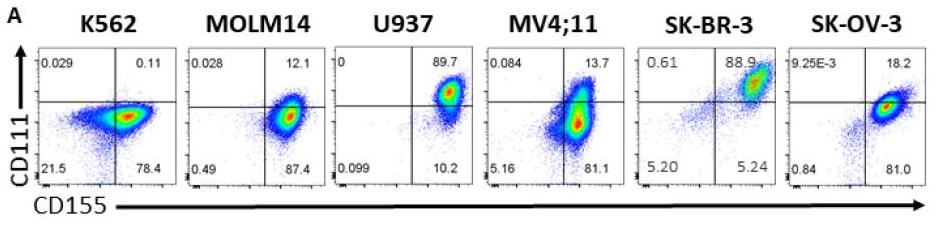
Fig2. Expression of CD96 ligands, CD155 and CD111, on K562, MOLM14, U937, MV4
Case 2: Li J, et al. Adv Sci (Weinh). 2023
Targeting CD96 in immune cells has shown promise for cancer treatment, but its role in solid tumor cells was unclear until now. We've discovered CD96 is often found in breast cancer cells and links to worse prognosis. These CD96-positive cancer cells appear to have both stem cell-like qualities and resistance to chemotherapy. Blocking CD96 in these cells boosts chemo effectiveness in tumor models. It seems CD96 promotes chemoresistance by enhancing mitochondrial function through a specific pathway. This unveils a new role for CD96 inside tumor cells, pointing to it as a potential target to improve chemotherapy responses.
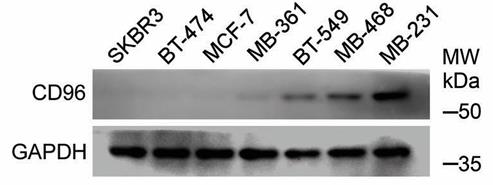
Fig1. CD96 expression was evaluated by western blotting.
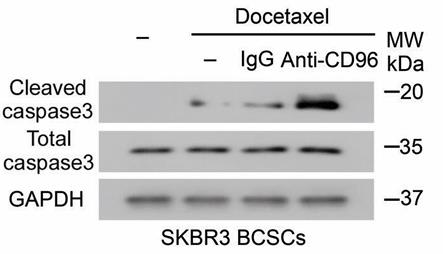
Fig2. SKBR3 BCSCs were treated with docetaxel in the presence and absence of CD96 blocking antibody, the expression of cleaved/total caspase3 was checked by western blot in 3 independent experiments.
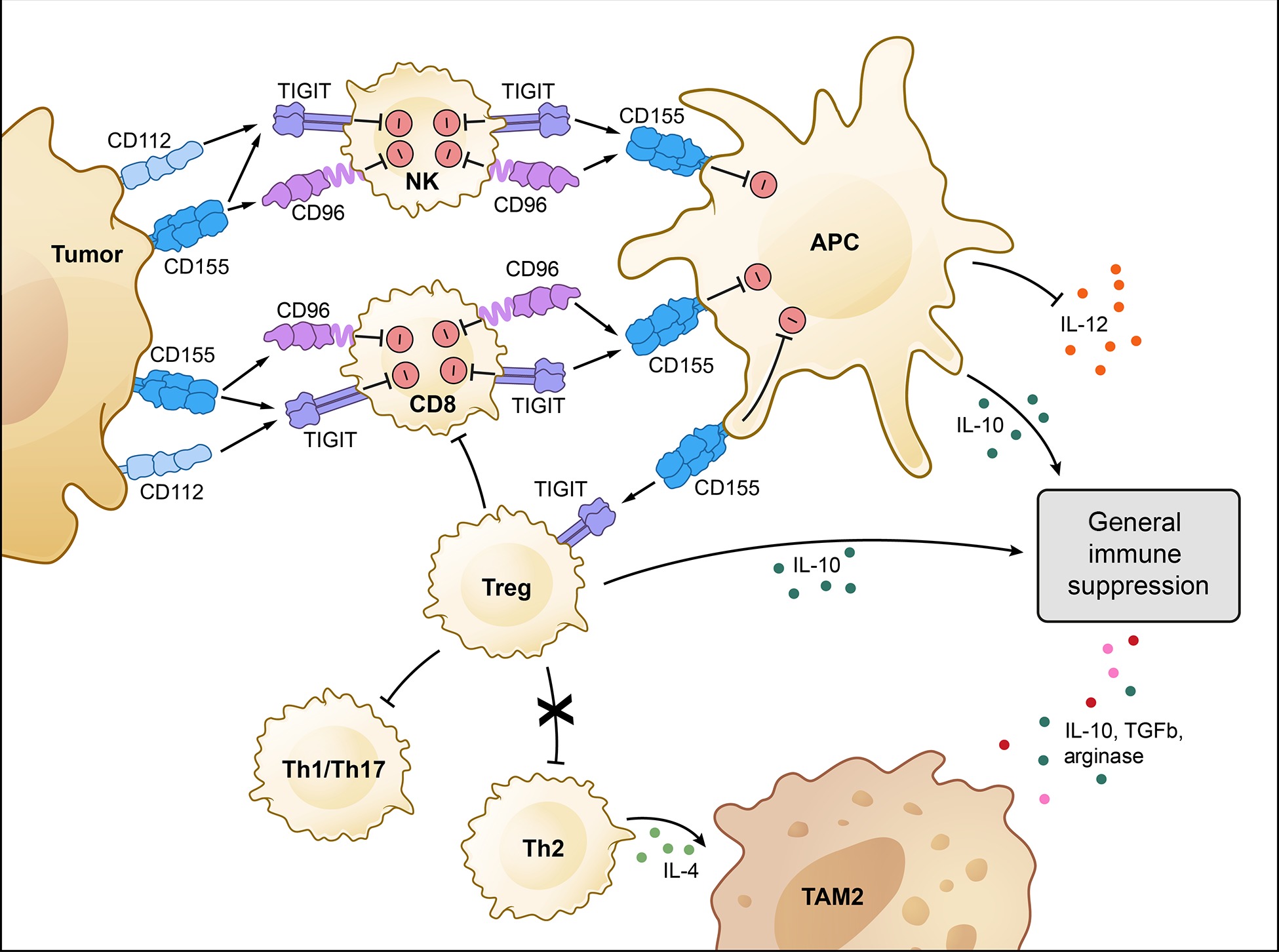
Fig1. TIGIT and CD96-mediated inhibition in cancer. (William C Dougall, 2017)

Not For Human Consumption!
Inquiry
- Reviews (0)
- Q&As (0)


Ask a Question for All CD96 Products
Required fields are marked with *
My Review for All CD96 Products
Required fields are marked with *
Recently Viewed