

From COVID-19 to Nipah: Antigen Design Considerations for mRNA-LNP Vaccine Delivery
Introduction
The successful application of mRNA vaccine technology during the COVID-19 pandemic has provided a replicable technical paradigm for addressing other emerging pathogens. Nipah virus (NiV), designated as a priority pathogen by the World Health Organization (WHO), carries a case fatality rate of 40%-75%, with no approved vaccines or therapeutics currently available. Moderna's mRNA-1215 vaccine has entered Phase I clinical trials, marking the formal extension of mRNA platforms into Nipah virus vaccine development. This article systematically discusses the key technical considerations in transitioning antigen design experience from SARS-CoV-2 Spike protein to Nipah virus F/G glycoproteins.
Technology Transfer: Structural Similarities and Differences Between SARS-CoV-2 Spike Protein and NiV F/G Proteins
Both SARS-CoV-2 Spike protein and Nipah virus F (Fusion) and G (Attachment) glycoproteins belong to Class I viral fusion proteins and play central roles in mediating virus-host cell membrane fusion. However, significant differences exist in their structural characteristics and activation mechanisms:
Table 1. Comparison of Structural Features Between SARS-CoV-2 Spike and NiV F/G Proteins
| Feature | SARS-CoV-2 Spike | NiV F Protein | NiV G Protein |
|---|---|---|---|
| Protein Class | Class I fusion protein (homotrimer) | Class I fusion protein (heterodimer F1+F2) | Type II membrane protein (homotetramer) |
| Molecular Weight | ~180 kDa (monomer) | ~61 kDa (F0 precursor) | ~74 kDa (monomer) |
| Cleavage Site | Furin polybasic site (RRAR↓) | Single basic site (GDV↓R/K) | None (non-fusion protein) |
| Activating Protease | Furin (Golgi apparatus) | Cathepsin L/B (endosome) | Not applicable |
| Key Neutralizing Epitopes | RBD (Receptor Binding Domain) | Pre-F conformation | G protein head domain |
| Glycosylation Sites | 22-35 N-glycosylation sites | 5 N-glycosylation sites | 4 N-glycosylation sites |
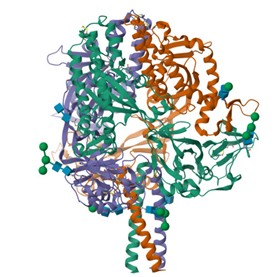 Fig 1. Crystal Structure of Nipah Virus F Protein in Prefusion Conformation (PDB: 5EVM): Crystal structure of Nipah virus F protein in prefusion conformation, showing its homotrimeric configuration and distribution of key antigenic epitopes. This structure provides the molecular foundation for structure-based vaccine design.
Unlike SARS-CoV-2 Spike protein, which is cleaved by Furin protease in the Golgi apparatus, Nipah virus F protein employs a unique activation mechanism: its F0 precursor is expressed on the cell surface, then internalized into endosomes through endocytosis, where it is cleaved by Cathepsin L or B under acidic conditions to form the fusion-active F1+F2 heterodimer. This difference has important implications for cleavage site engineering in antigen design.
Explore SARS-CoV-2 Proteins and Their Target Protein
Learn More
Key Points for Sequence Optimization
Impact of Transmembrane (TM) and Cytoplasmic Tail (CT) Domain Retention or Truncation on Surface Display
The membrane anchoring strategy for mRNA vaccine antigens directly affects protein cell surface display efficiency and immunogenicity:
Transmembrane (TM) Domain Retention Strategies:
- Full-length retention: Preserving native TM and CT domains ensures proper orientation and stable display of antigens on the cell membrane, facilitating the induction of antibodies against native conformations. For Nipah virus G protein, the CT contains endocytic signals crucial for protein recycling and antigen presentation.
- Truncation strategy: Removing CT or both TM and CT produces soluble antigens (such as sG or sF), facilitating secretory expression and purification. However, soluble antigens may not effectively mimic native conformations on the viral surface, potentially compromising neutralizing antibody induction efficiency.
Table 2. Comparison of Membrane Anchoring Strategies for Nipah Virus Antigens
| Strategy | Structural Composition | Advantages | Limitations | Application Scenarios |
|---|---|---|---|---|
| Full-length membrane anchoring | Full-length F/G (with TM+CT) | Native conformation display; induces conformation-dependent neutralizing antibodies | Expression may be limited; protein stability challenges | mRNA-LNP vaccines (intracellular expression) |
| TM retention/CT truncation | TM only | Enhanced surface display; reduced endocytosis | May lose certain epitopes | Surface display validation |
| Soluble ectodomain | Ectodomain only | High expression levels; easy QC detection | Conformation may be non-native; requires oligomerization scaffold | Recombinant protein subunit vaccines |
| Nanoparticle display | G head domain + LS scaffold | 60-valent display; enhanced immunogenicity | High structural complexity | mRNA-NP vaccines (e.g., Phylex design) |
Studies have shown that for Nipah virus mRNA vaccines, retaining the complete TM domain ensures effective antigen display on the host cell surface, thereby inducing robust CD8+ T cell responses through the MHC Class I pathway.
Explore Nipah Virus Proteins
Learn More
Processing of the Furin Cleavage Site
The cleavage activation mechanism of Nipah virus F protein differs fundamentally from that of SARS-CoV-2:
Key Differences Analysis:
- SARS-CoV-2 Spike relies on Furin cleavage at a polybasic cleavage site (RRAR↓), whose presence is essential for viral infectivity.
- Nipah virus F protein possesses a single basic cleavage site (GDV↓R), and its cleavage is mediated by Cathepsin L/B in endosomes, not Furin.
Antigen Design Considerations:
- Avoid introducing Furin sites: Introducing Furin consensus sequences (R-X-R/K-R) into Nipah virus F protein does not enhance cleavage efficiency and may instead cause protein misfolding or non-specific cleavage. Research has shown that NiV F protein carrying Furin site mutations (such as SRRHKR) is almost completely uncleavable.
- Pre-F conformation stabilization: Drawing on the 2P/6P mutation strategies used in SARS-CoV-2 vaccines, stabilizing the prefusion (pre-F) conformation of Nipah virus F protein through disulfide bonds or proline mutations can significantly enhance its immunogenicity. Loomis et al. demonstrated that pre-F conformation-induced serum neutralizing activity is significantly higher than that of post-F conformation.
- Cleavage site engineering: For mRNA vaccine applications, maintaining the natural single basic cleavage site is sufficient without additional engineering. The critical factor is ensuring that after mRNA expression in host cells, the F protein can undergo the normal endocytosis-cleavage-recycling pathway.
In Vitro Validation Tools
Application of Recombinant Proteins as Standards
In mRNA vaccine development, high-quality recombinant protein standards play irreplaceable roles in the following aspects:
Western Blot Validation Workflow:
- Expression validation: After mRNA transfection into HEK293T or Vero cells, detect protein expression at the expected molecular weight using anti-NiV F/G specific antibodies via Western Blot.
- Glycosylation modification analysis: Confirm correct N-glycosylation modification through molecular weight changes before and after PNGase F treatment. The 5 N-glycosylation sites of Nipah virus F protein are crucial for its conformational stability and antigenicity.
- Cleavage efficiency assessment: Detect the cleavage efficiency of F0 precursor to F1+F2 using F1 subunit-specific antibodies to evaluate the effectiveness of antigen design.
Table 3. Applications of Recombinant Protein Standards in mRNA Vaccine QC
| Detection Item | Role of Recombinant Protein Standards | Technical Methods |
|---|---|---|
| Expression quantification | Establish standard curves | ELISA/Western Blot |
| Glycosylation validation | Glycoform controls | Lectin blotting/Mass spectrometry |
| Conformation confirmation | Neutralizing antibody binding controls | Competitive ELISA/SPR |
| Stability assessment | Accelerated degradation references | Differential Scanning Fluorimetry (DSF) |
| Batch consistency | Positive controls | Multi-batch parallel validation |
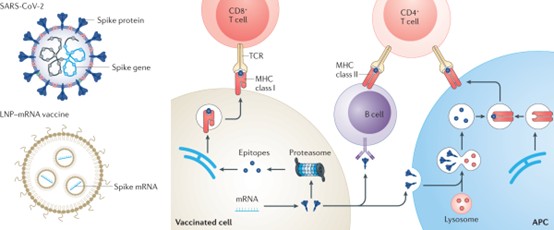 Fig 2. Schematic Diagram of mRNA-LNP Vaccine Mechanism of Action and Antigen Presentation Process.
Lipid nanoparticle (LNP)-mediated mRNA delivery and intracellular antigen expression and presentation process. LNPs enter cells through endocytosis, mRNA is translated into antigen proteins in the cytoplasm, and subsequently presented through MHC Class I/II pathways to induce humoral and cellular immune responses.
Conclusion
The technology transfer from COVID-19 to Nipah virus mRNA vaccines requires full consideration of structural differences between the two viruses in antigen design. The unique Cathepsin-dependent activation mechanism of Nipah virus F protein, the tetrameric structure characteristics of G protein, and their distinct glycosylation patterns all demand targeted sequence optimization strategies.
Summary of Key Design Principles:
- Conformation-first: Through structure biology-guided antigen design, stabilize the pre-F conformation and native tetrameric structure of G protein to maximize neutralizing antibody induction.
- Respect natural cleavage mechanisms: Avoid introducing heterologous Furin sites into Nipah virus F protein; maintain its natural activation pathway dependent on Cathepsin L/B.
- Optimize membrane anchoring strategies: Select appropriate TM/CT retention strategies based on vaccine platform characteristics (mRNA-LNP vs. protein subunit).
- Quality control systems: Establish complete QC processes using high-quality recombinant proteins as standards to ensure batch-to-batch consistency and stability of mRNA vaccines.
High-quality recombinant proteins hold irreplaceable value in mRNA vaccine development, serving not only as structural templates for antigen design but also as critical tools throughout the entire process of process development, quality control, and immunological evaluation. As candidate vaccines such as Moderna's mRNA-1215 enter clinical trials, structure-based rational antigen design combined with mRNA-LNP delivery platforms will provide rapid, scalable vaccine solutions for addressing Nipah virus and other emerging pathogens.
About Creative BioMart
Creative BioMart is committed to providing high-quality recombinant proteins, antibodies, and customized biological reagent services for global vaccine research and development. Our Nipah virus F protein and G protein product series undergo rigorous structural validation and activity testing, providing reliable tools for antigen design, QC validation, and immunological evaluation of mRNA vaccines. For more information, please feel free to contact us.
Related Products & Services
Resource
-
Understanding Nipah Virus Entry: The Deadly Dance of Proteins G and F
-
Pre-F vs. Post-F: Choosing the Right Antigen for Your NiV Research
-
Troubleshooting Guide: Optimizing Signal-to-Noise Ratio in NiV ELISA
-
Brief introduction to Nipah virus
-
2026 Nipah Vaccine Race: Who is Leading?
References
- Loomis, R. J., et al. (2020). Structure-based design of Nipah Virus vaccines: a generalizable approach to paramyxovirus immunogen development. Frontiers in Immunology, 11, 842.
- Loomis, R. J., et al. (2021). Chimeric Fusion (F) and Attachment (G) glycoprotein antigen delivery by mRNA as a candidate Nipah Vaccine. Frontiers in Immunology, 12, 772864.
- Corbett, K. S., et al. (2020). SARS-CoV-2 mRNA vaccine design enabled by prototype pathogen preparedness. Nature, 586(7830), 567-571.
- Diederich, S., Dietzel, E., & Maisner, A. (2009). Nipah virus fusion protein: influence of cleavage site mutations on the cleavability by cathepsin L, trypsin and furin. Virus Research, 145(2), 300-306.
- Moll, M., et al. (2004). A mature and fusogenic form of the Nipah virus fusion protein requires proteolytic processing by cathepsin L. Virology, 330(1), 251-257.
- Pager, C. T., & Dutch, R. E. (2005). Cathepsin L is involved in proteolytic processing of the Hendra virus fusion protein. Journal of Virology, 79(20), 12714-12720.
- Wang, L. F., et al. (2001). Molecular biology of Hendra and Nipah viruses. Microbes and Infection, 3(4), 279-287.
- Amaya, M., & Broder, C. C. (2020). Vaccines to emerging viruses: Nipah and Hendra. Annual Review of Virology, 7, 447-473.
- Wang, Q., et al. (2022). Advances in COVID-19 mRNA vaccine development. Signal Transduction and Targeted Therapy, 7(1), 1-15.
- Brandys, P., et al. (2025). A mRNA vaccine encoding for a 60-mer Nipah virus G glycoprotein nanoparticle elicits a robust neutralizing antibodies response against the Nipah virus. Vaccine, 43(1), 126456.

Contact us or send an email at for project quotations and more detailed information.
Quick Links
-

Papers’ PMID to Obtain Coupon
Submit Now -

Refer Friends & New Lab Start-up Promotions