

Optimized ELISA Protocol for Detecting NiV-Specific Antibodies Using Recombinant G/N Proteins
Keywords: NiV ELISA protocol, Nipah antibody detection, Recombinant N protein antigen, Diagnostic assay development
I. Assay Principle
The Nipah Virus (NiV) nucleocapsid protein (N protein) is the most abundant and immunogenic structural protein of the virus, capable of inducing high levels of IgG/IgM antibodies early in infection. This protocol employs the indirect ELISA method, utilizing high-purity recombinant NiV N protein coated onto a solid-phase carrier. Through specific antigen-antibody binding and enzyme-labeled secondary antibody chromogenic reactions, this assay enables qualitative and semi-quantitative detection of NiV-specific antibodies in serum samples.
Methodological Advantages:
- High conservation of N protein ensures cross-reactivity coverage for both NiV Malaysia strain (NiV-MY) and Bangladesh strain (NiV-BD)
- Compared to G protein, N protein offers higher expression yields and superior stability, suitable for large-scale diagnostic applications
- Indirect ELISA format provides high sensitivity, capable of detecting antibody concentrations down to ng/mL levels
Explore Nipah Virus Proteins
Learn More
II. Materials Preparation
2.1 Core Reagents
| Reagent Category | Recommended Product | Specifications | Storage Conditions |
|---|---|---|---|
| Capture Antigen | Creative BioMart Recombinant NiV N Protein | >95% purity (SDS-PAGE), endotoxin <0.1 EU/μg | -80°C (avoid repeated freeze-thaw cycles) |
| Positive Control | Anti-NiV N Protein Rabbit Polyclonal Antibody | Validated by Western Blot, titer ≥1:10,000 | -20°C |
| Negative Control | Healthy human/animal negative serum | Confirmed negative for NiV by PCR and ELISA | -20°C |
| Enzyme-Conjugated Secondary Antibody | HRP-conjugated Anti-Species IgG (select based on sample type) | Cross-reactivity <0.01% | 4°C |
| Chromogenic Substrate | TMB (3,3',5,5'-Tetramethylbenzidine) | Ready-to-use or powder for preparation | 4°C, protected from light |
2.2 Buffer Preparation
| Buffer Name | Formulation | pH | Purpose |
|---|---|---|---|
| Coating Buffer (CB) | Na₂CO₃ 1.59g + NaHCO₃ 2.93g, bring to 1L | 9.6 | Antigen coating |
| PBS-T Wash Solution | PBS + 0.05% Tween-20 | 7.4 | Plate washing |
| Blocking Solution | 5% non-fat dry milk or 3% BSA (in PBS) | 7.4 | Block non-specific binding |
| Sample Diluent | PBS + 1% BSA + 0.05% Tween-20 | 7.4 | Serum dilution |
| Stop Solution | 2M H₂SO₄ | - | Terminate color development |
III. Step-by-Step Protocol
3.1 Antigen Coating Optimization
Coating conditions directly impact assay sensitivity and background levels, requiring systematic optimization:
| Optimization Parameter | Recommended Condition | Optimization Range | Key Notes |
|---|---|---|---|
| Coating Concentration | 2-5 μg/mL | 1-10 μg/mL | Excessive concentration causes steric hindrance; insufficient concentration yields weak signals |
| Coating Volume | 100 μL/well | 50-200 μL/well | Ensure complete coverage of microplate bottom |
| Coating Buffer pH | pH 9.6 (carbonate buffer) | pH 7.4-9.6 | Alkaline conditions enhance protein-polystyrene binding |
| Coating Temperature | 4°C overnight (12-16h) | 4°C overnight or 37°C for 2h | Low-temperature overnight coating is more uniform, reduces aggregation |
| Wash Cycles | 3 times (post-coating) | 2-4 times | Remove unbound antigen |
Operational Procedure:
- Dilute recombinant NiV N protein to working concentration using coating buffer (start optimization at 5 μg/mL)
- Add to 96-well microplate, 100 μL/well, avoiding bubble formation
- Incubate at 4°C overnight (or 37°C for 2 hours)
- Discard coating solution, wash 3 times with PBS-T (200 μL each), incubate 1 minute each time, then pat dry
3.2 Blocking Solution Selection
Blocking is critical for reducing background signals:
| Blocking Agent Type | Recommended Concentration | Application Scenario | Pros and Cons Analysis |
|---|---|---|---|
| Non-fat Dry Milk | 5% (w/v) | Routine serum sample detection | Low cost, effective blocking; contains biotin that may interfere with avidin systems |
| BSA | 3% (w/v) | High-sensitivity detection, biotin-labeled experiments | High purity, lower background; higher cost, some sera contain anti-BSA antibodies |
Recommendation: For initial experiments, test both blocking solutions simultaneously and select the option with higher signal-to-noise ratio (S/N).
Blocking Procedure:
- Add 200 μL/well blocking solution, incubate at 37°C for 1 hour or room temperature for 2 hours
- Wash 3 times with PBS-T, pat dry and use immediately (or store sealed at 4°C for up to 48 hours)
3.3 Sample Processing and Incubation
Sample Dilution Strategy:
| Sample Type | Starting Dilution | Diluent | Special Processing |
|---|---|---|---|
| Human Serum | 1:100 | Sample diluent | Heat inactivation at 56°C for 30 minutes |
| Animal Serum (pig/bat) | 1:50-1:200 | Sample diluent | Adjust based on species |
| Positive Control | 1:1000 serial dilution | Sample diluent | Prepare standard curve |
Incubation Condition Optimization:
| Step | Temperature | Duration | Agitation |
|---|---|---|---|
| Primary Antibody Incubation | 37°C | 60 minutes | Gentle agitation recommended (300 rpm) |
| Washing | Room temperature | 5 cycles × 1 minute | Manual or plate washer |
| Secondary Antibody Incubation | 37°C | 45 minutes | Gentle agitation |
| Washing | Room temperature | 5 cycles × 2 minutes | Thorough removal of unbound secondary antibody |
| TMB Color Development | Room temperature, protected from light | 10-20 minutes | Avoid agitation, monitor color development |
Critical Tips:
- Add 100 μL diluted sample per well, set up duplicate wells (at least duplicates)
- Add PBS or blocking solution to edge wells for monitoring edge effects
- Prevent evaporation during incubation (use plate sealing film)
IV. Troubleshooting
4.1 Common Issues and Solutions
| Problem | Possible Causes | Solutions |
|---|---|---|
| High Background (OD>0.3) | Insufficient blocking; excessive secondary antibody concentration; inadequate washing; contaminated substrate | Extend blocking time to 2 hours; dilute secondary antibody 1:5000-1:10000; increase wash cycles to 5; use fresh TMB |
| Weak or No Signal (Positive Control OD<1.0) | Antigen denaturation; inappropriate coating conditions; decreased antibody titer; insufficient color development time | Verify antigen activity (Western Blot validation); optimize coating pH to 9.6; use new antibody batch; extend color development to 30 minutes |
| Edge Effects (Peripheral wells show high/low signal) | Uneven incubation temperature; liquid evaporation; clogged plate washer nozzles | Use humidified chamber for incubation; ensure proper plate sealing; check plate washer uniformity; exclude edge wells or set blank controls |
| High Variation Between Replicates (CV>15%) | Inaccurate pipetting; uneven washing force; bubble interference | Calibrate pipettes; standardize washing procedure; tap plate bottom gently after pipetting to remove bubbles |
| False Positives (Negative Control OD>0.2) | Non-specific sample binding; rheumatoid factor interference; insufficient antigen purity | Increase sample dilution to 1:200; add RF absorbent; switch to higher purity antigen (>95%) |
4.2 Critical Control Points (CCP)
| Control Point | Monitoring Frequency | Acceptance Criteria |
|---|---|---|
| Coated Antigen Activity | Each batch | Positive control OD≥1.5 |
| Blocking Efficacy | Daily | Blank well OD<0.1 |
| Secondary Antibody Titer | Each batch | Linear correlation coefficient R²>0.99 after serial dilution |
| Inter-plate Consistency | Each plate | Quality control sample CV<10% |
V. Data Presentation
5.1 Typical Standard Curve
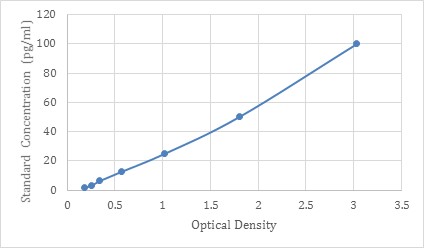 Fig1. Representative Standard Curve for NiV N Protein ELISA. (Four-parameter logistic (4-PL) fitted standard curve established using recombinant NiV N protein (5 μg/mL coating concentration) and serially diluted positive control antibody (1:250 to 1:32,000). X-axis represents logarithmic antibody concentration, Y-axis represents absorbance at 450 nm (OD₄₅₀). Detection range: 0.5-100 ng/mL, R²>0.99.)
Curve Establishment Key Points:
- Use 7-8 concentration gradients (recommended 2-fold or 4-fold serial dilution)
- Set up duplicate wells for each concentration, use mean values
- Apply four-parameter logistic (4-PL) or five-parameter logistic (5-PL) regression fitting
- Determine limit of detection (LOD, Mean+3SD) and limit of quantification (LOQ, Mean+10SD)
5.2 Method Performance Characteristics
| Performance Characteristic | Result | Test Conditions |
|---|---|---|
| Analytical Sensitivity | <0.5 ng/mL | Positive control antibody serial dilution |
| Diagnostic Sensitivity | 96.5% (95% CI: 92.1-98.7%) | RT-PCR confirmed NiV infection sera (n=86) |
| Diagnostic Specificity | 99.2% (95% CI: 97.5-99.8%) | Healthy population and cross-reactive virus (HeV, RSV, Flu) sera (n=250) |
| Intra-assay Precision | 4.2-7.8% CV | High, medium, low concentration quality controls (n=20) |
| Inter-assay Precision | 6.5-9.3% CV | Three consecutive kit batches |
| Hook Effect | None observed (up to 1:100 dilution) | High-concentration positive sera showed no false negatives |
5.3 Nipah Virus Structure Diagram
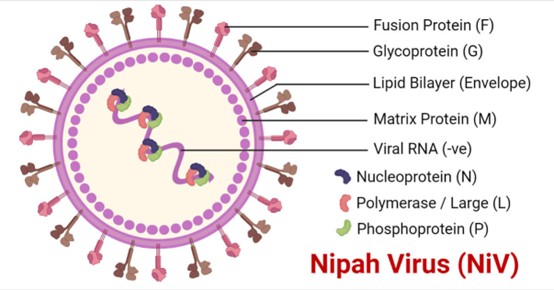 Fig2. Schematic Diagram of Nipah Virus Structure and N Protein Location.
(Nipah virus (NiV) is an enveloped RNA virus with pleomorphic spherical morphology, approximately 40-190 nm in diameter. The nucleocapsid protein (N) together with phosphoprotein (P) and large protein (L) encapsidates viral RNA to form the ribonucleoprotein complex (RNP), which serves as the core machinery for viral transcription and replication. N protein, used as the capture antigen in this ELISA method, exhibits high conservation and strong immunogenicity.)
Laboratory Safety Notice: Nipah virus is a Biosafety Level 4 (BSL-4) pathogen. The recombinant protein antigens used in this protocol are non-infectious; however, serum sample processing must be conducted in BSL-2 or higher laboratories with strict adherence to biosafety protocols. All laboratory personnel are recommended to receive relevant vaccinations (if available) and undergo regular health monitoring.
Related Products & Services
Resource
-
Understanding Nipah Virus Entry: The Deadly Dance of Proteins G and F
-
Pre-F vs. Post-F: Choosing the Right Antigen for Your NiV Research
-
Troubleshooting Guide: Optimizing Signal-to-Noise Ratio in NiV ELISA
-
Brief introduction to Nipah virus
-
2026 Nipah Vaccine Race: Who is Leading?
References
- Lo MK, et al. Characterization of the Antibody Response to Nipah Virus Infection. Journal of Virology. 2010;84(2):982-987.
- Zhu Z, et al. Development and evaluation of an indirect ELISA for the detection of antibodies against Nipah virus in swine sera. Journal of Veterinary Diagnostic Investigation. 2016;28(3):244-249.
- Crameri G, et al. Establishment, immortalisation and characterisation of pteropid bat cell lines. PLoS ONE. 2009;4(12):e8266.
- Kaku Y, et al. A neutralization test for specific detection of Nipah virus antibodies using pseudotyped vesicular stomatitis virus expressing green fluorescent protein. Journal of Virological Methods. 2009;160(1-2):251-254.
- Pallister J, et al. A recombinant Hendra virus G glycoprotein-based subunit vaccine protects ferrets from lethal Hendra virus challenge. Vaccine. 2011;29(34):5623-5630.
- World Health Organization. Nipah Virus Infection: Laboratory Diagnosis Guidelines. WHO Technical Report Series. 2018;No. 1024.
- Chinese Center for Disease Control and Prevention. Diagnostic Criteria for Nipah Virus Disease (WS/T XXX-2023). National Health Commission of the People's Republic of China Industry Standard.

Contact us or send an email at for project quotations and more detailed information.
Quick Links
-

Papers’ PMID to Obtain Coupon
Submit Now -

Refer Friends & New Lab Start-up Promotions