

Recombinant Human CTNNB1 protein, His&GST-tagged
| Cat.No. : | CTNNB1-3891H |
| Product Overview : | Recombinant Human CTNNB1 protein(P35222-1) (Met 1-Leu 781) was expressed in Insect Cells, fused with the N-terminal polyhistidine-tagged GST tag at the N-terminus. |
| Availability | October 24, 2026 |
| Unit | |
| Price | |
| Qty |
- Specification
- Gene Information
- Related Products
- Case Study
- Application
- Download
| Species : | Human |
| Source : | Insect Cells |
| Tag : | GST&His |
| Protein Length : | 1-781 aa |
| Form : | Lyophilized from sterile 50mM Tris, 100mM NaCl, 2mM GSH, 10% gly, pH 8.0. |
| Bio-activity : | Measured by its ability to bind biotinylated mouse ERBB2 in a functional ELISA. |
| Molecular Mass : | The recombinant human CTNNB1/GST chimera consists of 1018 amino acids and has a calculated molecular mass of 113 kDa. It migrates as an approximately 116 kDa band in SDS-PAGE under reducing conditions. |
| Endotoxin : | < 1.0 EU per μg of the protein as determined by the LAL method. |
| Purity : | > 87 % as determined by SDS-PAGE |
| Storage : | Store it under sterile conditions at -20°C to -80°C upon receiving. Recommend to aliquot the protein into smaller quantities for optimal storage. Avoid repeated freeze-thaw cycles. |
| Reconstitution : | It is recommended that sterile water be added to the vial to prepare a stock solution of 0.2 ug/ul. Centrifuge the vial at 4°C before opening to recover the entire contents. |
| Gene Name | CTNNB1 catenin (cadherin-associated protein), beta 1, 88kDa [ Homo sapiens ] |
| Official Symbol | CTNNB1 |
| Synonyms | CTNNB1; catenin (cadherin-associated protein), beta 1, 88kDa; catenin (cadherin associated protein), beta 1 (88kD), CTNNB; catenin beta-1; beta catenin; CTNNB; FLJ25606; FLJ37923; DKFZp686D02253; |
| Gene ID | 1499 |
| mRNA Refseq | NM_001098209 |
| Protein Refseq | NP_001091679 |
| MIM | 116806 |
| UniProt ID | P35222 |
| ◆ Recombinant Proteins | ||
| CTNNB1-01H | Recombinant Dog catenin beta 1 Protein, His-tagged | +Inquiry |
| CTNNB1-905R | Recombinant Rhesus Macaque CTNNB1 Protein, His (Fc)-Avi-tagged | +Inquiry |
| CTNNB1-1441H | Recombinant Human CTNNB1,GST-tagged | +Inquiry |
| CTNNB1-2514H | Recombinant Human CTNNB1 Protein (2-781 aa), His-tagged | +Inquiry |
| CTNNB1-1657R | Recombinant Rat CTNNB1 Protein | +Inquiry |

| ◆ Cell & Tissue Lysates | ||
| CTNNB1-563HCL | Recombinant Human CTNNB1 cell lysate | +Inquiry |
| CTNNB1-001MCL | Recombinant Mouse CTNNB1 cell lysate | +Inquiry |
Case 1: Dantzer C, et al. Elife. 2024
β-catenin-mutated tumors resist immunotherapy by disrupting exosome-mediated immune crosstalk. In hepatocellular carcinoma (HCC), oncogenic β-catenin suppresses exosome biogenesis genes SDC4 and RAB27A, reducing exosome secretion (validated via nanoparticle tracking and 3D models), thereby limiting immune infiltration. This study uncovers β-catenin’s role in tumor microenvironment remodeling through exosomal pathway regulation, offering mechanistic insights into immunotherapy resistance. Targeting β-catenin-driven exosome defects could enhance immune checkpoint inhibitor efficacy in HCC.
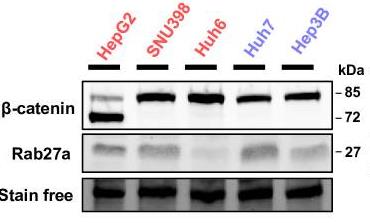
Fig1. Basal expression of ß-catenin and Rab27a in liver cancer cell lines mutated (HepG2, SNU398, Huh6) or not (Huh7, Hep3B) for ß-catenin.
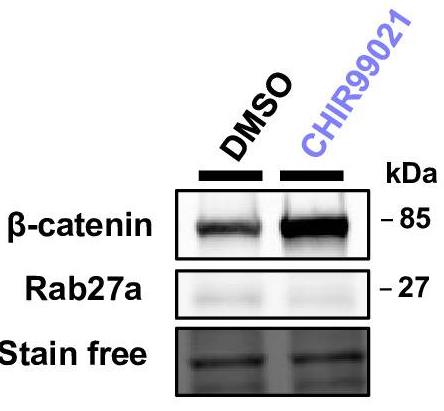
Fig2. ß-catenin and Rab27a expressions were analyzed by western-blot in Huh7 spheroids treated with DMSO or CHIR99021.
Case 2: Ilhan M, et al. Int J Mol Sci. 2024
Elevated β-catenin in breast cancer links to poor prognosis, yet targeted therapies remain suboptimal. Reduced BMP2/BMP6 expression in tumors correlates with β-catenin accumulation via SMAD4-dependent phosphorylation, lowering its stability and nuclear translocation in MCF7/T47D cells. However, MDA-MB-231/468 cells show no response, suggesting SMAD4 insufficiency. These findings highlight BMP signaling’s role in β-catenin regulation and its potential as a prognostic marker for tumor microenvironment modulation.
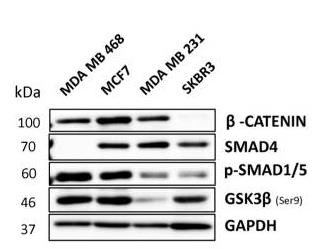
Fig1. Endogenous protein expression level of total β-CATENIN, SMAD4, phosphorylated SMAD1/5 and GSK3β (Ser9) in human breast cancer cell line panel.
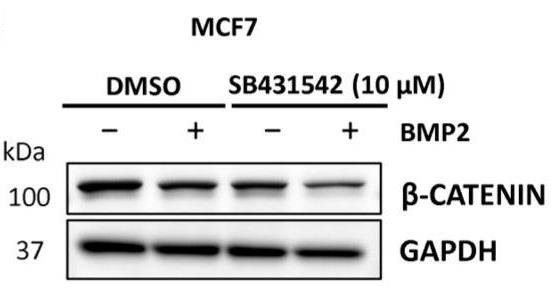
Fig2. Representative Western blot images and densitometric analysis showing the change in total β-CATENIN protein level.
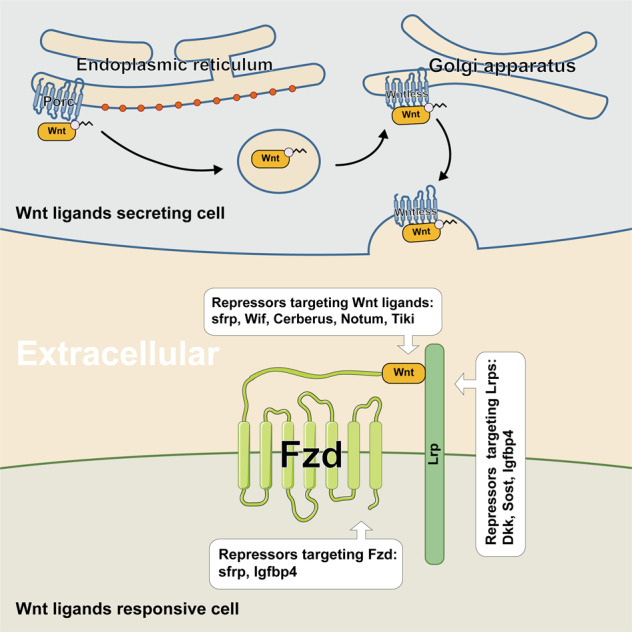
Fig1. The extracellular components and signaling transduction of Wnt/β-catenin signaling. (Fanyuan Yu, 2021)

Not For Human Consumption!
Inquiry
- Reviews (0)
- Q&As (0)


Ask a Question for All CTNNB1 Products
Required fields are marked with *
My Review for All CTNNB1 Products
Required fields are marked with *
Recently Viewed