

Active Recombinant Human CD274 protein, His-tagged
| Cat.No. : | CD274-592H |
| Product Overview : | Active Recombinant Human CD274 protein(Q9NZQ7) is produced by our Mammalian expression system and the target gene encoding Phe19-Thr239 is expressed with a 6His tag at the C-terminus. |
| Availability | September 24, 2026 |
| Unit | |
| Price | |
| Qty |
- Specification
- Gene Information
- Related Products
- Case Study
- Application
- Download
| Species : | Human |
| Source : | HEK293 |
| Tag : | His |
| Protein Length : | 19-239 aa |
| Form : | Lyophilized from a 0.2 μm filtered solution of 20mM PB, 4% Mannitol, 0.02% Tween 80, pH7.4. |
| Bio-activity : | Immobilized Anti-Human PDL1 mAb at 2μg/ml (100 μl/well)can bind Human PD-L1-His. The ED50 of Human PD-L1-6His is 5.57 ng/ml. |
| Molecular Mass : | 26.33 KDa |
| Endotoxin : | < 1 EU/µg as determined by LAL test. |
| Purity : | Greater than 95% as determined by reducing SDS-PAGE. |
| Storage : | Lyophilized protein should be stored at ≤ -20°C, stable for one year after receipt. Reconstituted protein solution can be stored at 2-8°C for 2-7 days. Aliquots of reconstituted samples are stable at ≤ -20°C for 3 months. |
| Reconstitution : | Always centrifuge tubes before opening.Do not mix by vortex or pipetting. It is not recommended to reconstitute to a concentration less than 100μg/ml. Dissolve the lyophilized protein in distilled water. Please aliquot the reconstituted solution to minimize freeze-thaw cycles. |
| Gene Name | CD274 CD274 molecule [ Homo sapiens ] |
| Official Symbol | CD274 |
| Synonyms | CD274; CD274 molecule; CD274 antigen , PDCD1LG1, programmed cell death 1 ligand 1; programmed cell death 1 ligand 1; B7 homolog 1; B7 H; B7 H1; B7H1; PD L1; PDL1; CD274 antigen; PDCD1 ligand 1; programmed death ligand 1; B7-H; PD-L1; PDCD1L1; PDCD1LG1; MGC142294; MGC142296; |
| Gene ID | 29126 |
| mRNA Refseq | NM_014143 |
| Protein Refseq | NP_054862 |
| MIM | 605402 |
| UniProt ID | Q9NZQ7 |
| ◆ Recombinant Proteins | ||
| CD274-020HA | Recombinant Human CD274 protein, HIgG1 Fc-tagged, APC labeled | +Inquiry |
| CD274-1058CA | Recombinant Canine CD274 protein, Fc-tagged, APC labeled | +Inquiry |
| CD274-713M | Recombinant Mouse CD274 Protein, Fc-tagged | +Inquiry |
| CD274-0625H | Active Recombinant Human CD274 protein, Twin-Strep-tagged | +Inquiry |
| CD274-8230H | Active Recombinant Human CD274 protein, His/Fc-tagged, Biotinylated | +Inquiry |

| ◆ Cell & Tissue Lysates | ||
| CD274-2735HCL | Recombinant Human CD274 cell lysate | +Inquiry |
| CD274-914CCL | Recombinant Cynomolgus CD274 cell lysate | +Inquiry |
| CD274-002RCL | Recombinant Rat CD274 cell lysate | +Inquiry |
| CD274-2642MCL | Recombinant Mouse CD274 cell lysate | +Inquiry |
Case 1: Li H, et al. J Transl Med. 2024
In gastric cancer, myeloid-derived suppressor cells (MDSCs) significantly assist tumors in dodging the immune system. A study involving 90 patients found that those with higher levels of exosomal PD-L1 had worse survival rates, as these levels boost the number of MDSCs. This increase happens because exosomal PD-L1 activates the IL-6/STAT3 pathway, leading to more MDSC proliferation. Tests confirmed that these exosomes support tumor growth and immune evasion by boosting MDSCs.
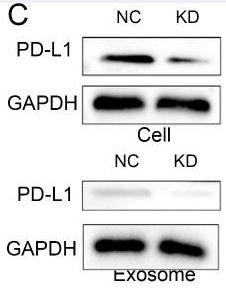
Fig1. Western blotting analysis of the PD-L1 content in GC cells and exosome from the culture supernatant of GC cells.
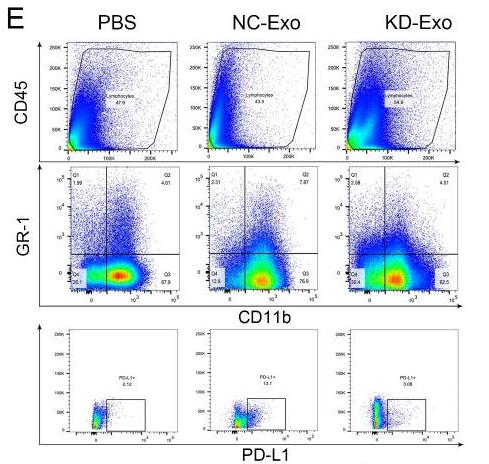
Fig2. Percentages of MDSCs (CD45 + CD11b + Gr1+) and PD-L1 + MDSCs in tumors determined via flow cytometry.
Case 2: Agborbesong E, et al. Cells. 2024
The primary cilium, a sensory structure on most cells, is linked to diseases if defective. While related to immune synapses, the role of immune components in cilia formation isn't well-known. This study reveals that PD-L1, a protein usually involved in immune function, also affects ciliogenesis. It's present in crucial cell areas and, when depleted, enhances cilia growth and the presence of essential cilia proteins. PD-L1 interacts with proteins like BBS5 and PC-2, playing a role in sensory signaling.
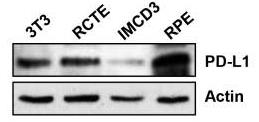
Fig1. Western blot analysis indicating the differential expression of PD-L1 in fibroblast and epithelial cells.
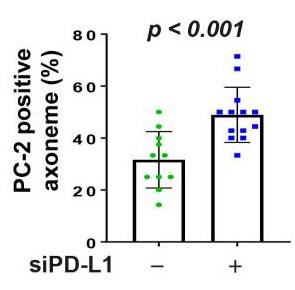
Fig2. Quantitative data of PC-2-positive cilia in PD-L1 siRNA knockdown NIH3T3 cells compared to control siRNA cells.
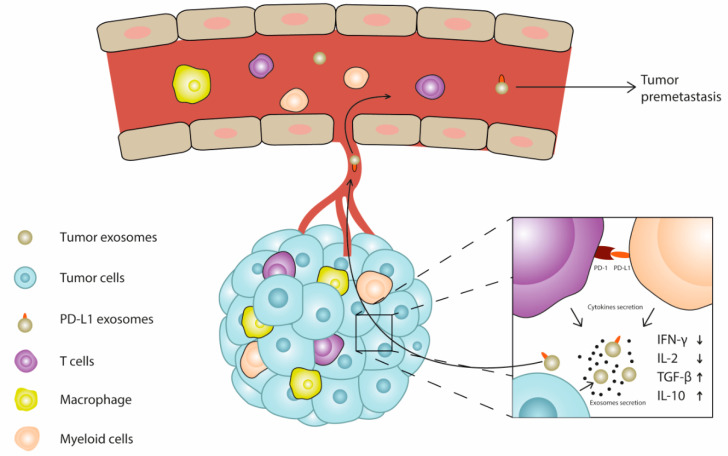
Fig1. Schematic diagram of the effect of exosomal PD-L1 on tumor microenvironment. (Lingxiao Ye, 2021)

Not For Human Consumption!
Inquiry
- Reviews (0)
- Q&As (0)


Ask a Question for All CD274 Products
Required fields are marked with *
My Review for All CD274 Products
Required fields are marked with *
Recently Viewed