

CD55 and CD59: Complement Regulation in Cancer and Antibody Research
Table of Contents
- Why Cells Need Complement Regulation
- Complement Activation at the Cell Surface
- CD55 and Convertase Regulation
- CD59 and Membrane Attack Complex Inhibition
- CD55/CD59 Expression in Cancer
- Complement-Dependent Cytotoxicity in Antibody Research
- Why CDC Varies Between Antibodies
- Strategies to Overcome Complement Resistance
- Assays for CD55 and CD59
- Recombinant CD55/CD59 Proteins
Why Cells Need Complement Regulation
The complement system is a major component of innate immunity.
It can recognize pathogens or antibody-coated targets, amplify inflammatory signals, deposit opsonins and generate the membrane attack complex.
This powerful system must be tightly regulated.
Without protective mechanisms, complement could damage healthy host cells.
CD55 and CD59 are two important complement-regulatory CD antigens.
They act at different stages.
CD55 limits formation and persistence of complement convertases.
CD59 acts later, inhibiting membrane attack complex assembly.
Explore Our CD Antigen Products
Learn More
Complement Activation at the Cell Surface
The classical complement pathway can be initiated when C1q recognizes appropriately organized antibody Fc domains.
A simplified sequence is:
antibody binding → C1q recruitment → C4/C2 activation → C3 convertase → C5 convertase → C5b-9 membrane attack complex
Amplification occurs as the cascade proceeds.
Because this process can become powerful rapidly, membrane regulators are essential.
CD55 and Convertase Regulation
CD55 is also called decay-accelerating factor.
It accelerates dissociation of complement convertase complexes.
This reduces downstream complement amplification.
By acting at the convertase stage, CD55 can decrease:
- C3 cleavage;
- opsonin deposition;
- C5 activation;
- terminal-pathway initiation.
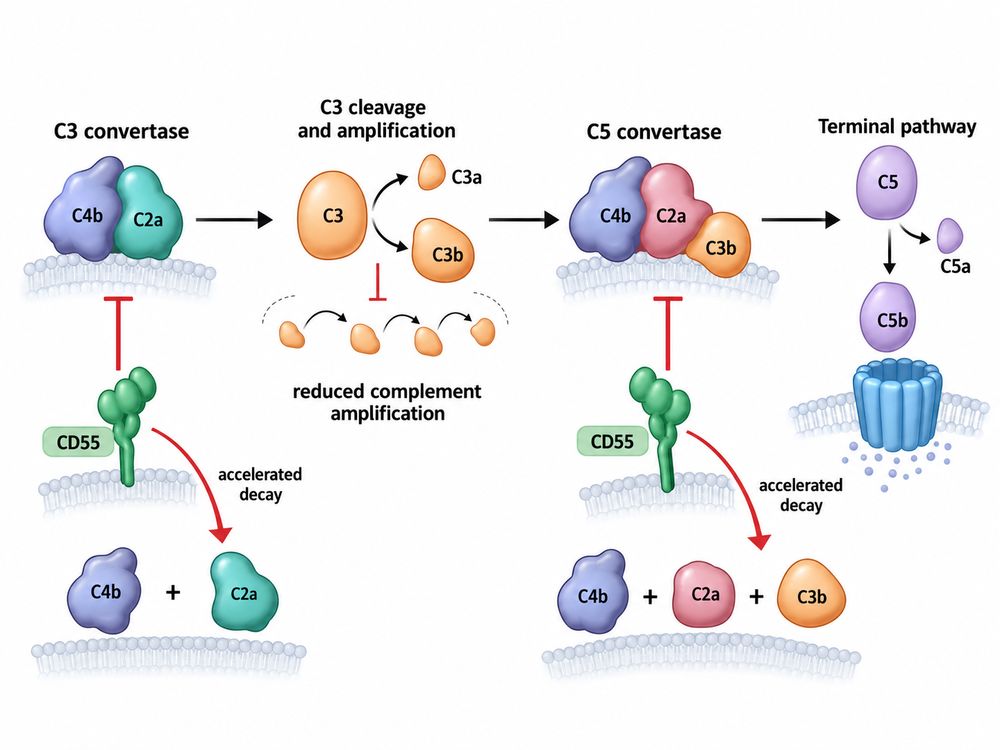 Fig 1. CD55 in the Complement Cascade
CD59 and Membrane Attack Complex Inhibition
CD59 acts near the end of the pathway.
It interferes with assembly of the terminal complement complex, particularly membrane incorporation/polymerization of C9.
As a result, CD59 helps prevent formation of functional membrane pores.
The complementary roles of CD55 and CD59 mean a cell can resist complement at multiple stages.
| Protein | Main Site of Regulation | Result |
|---|---|---|
| CD55 | C3/C5 convertases | Reduced cascade amplification |
| CD59 | Terminal C5b-9 complex | Reduced membrane pore formation |
CD55/CD59 Expression in Cancer
Tumor cells may express high levels of complement regulators.
From the tumor's perspective, this can be advantageous because it may protect the cell from complement-mediated injury.
This becomes particularly relevant when therapeutic antibodies rely partly on complement-dependent cytotoxicity.
However, complement biology in cancer is complicated.
Complement can support antitumor immune mechanisms but can also contribute to inflammation and tumor-promoting microenvironments.
Therefore, the goal is not simply to maximize complement activation in every context.
Complement-Dependent Cytotoxicity in Antibody Research
CDC begins when antibodies bind a target antigen in a geometry favorable for complement recruitment.
C1q recognition can then initiate the classical pathway.
If activation proceeds efficiently, terminal complement complexes can damage the target cell membrane.
CD55 and CD59 can reduce this activity.
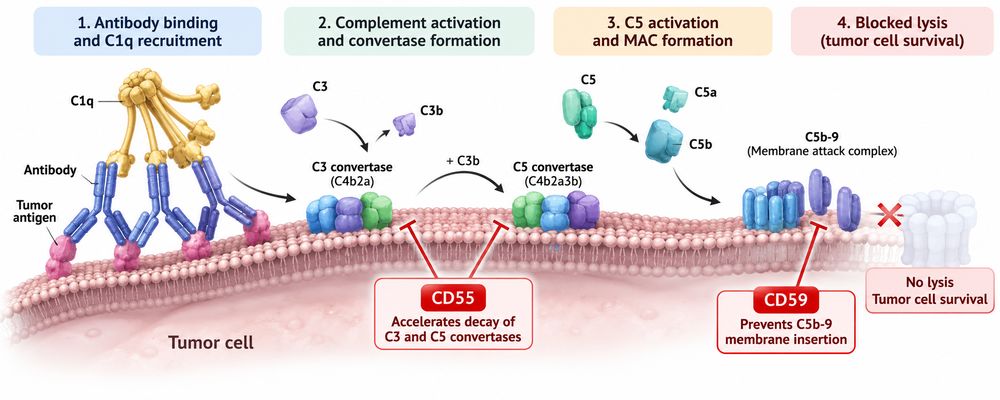 Fig 2. Antibody-Mediated CDC and CD55/CD59
Why CDC Varies Between Antibodies
Antibody affinity alone does not predict CDC.
Important factors include:
Antigen Density
High surface density can support effective antibody clustering.
Epitope Location
The distance between antibody Fc regions and the membrane can influence complement activation.
Antibody Isotype
Different IgG subclasses differ in their ability to engage C1q.
Fc Geometry
C1q recruitment depends on the organization of target-bound Fc regions.
CD55/CD59 Levels
Complement-regulator abundance can limit the cascade.
Complement Availability
Serum source and complement concentration affect assay outcomes.
This explains why two antibodies with similar binding affinity can produce very different CDC.
Explore Our CD Antigen Products
Learn More
Strategies to Overcome Complement Resistance
Experimental strategies include:
- antibodies engineered for enhanced C1q recruitment;
- combinations targeting complement regulators;
- bispecific molecules;
- tumor-targeted complement modulation.
Targeted strategies are preferable to nonspecific systemic complement activation because normal tissues depend on regulatory proteins for protection.
Assays for CD55 and CD59
| Assay | Question |
|---|---|
| Flow cytometry | How much CD55/CD59 is on the cell surface? |
| ELISA | Does the antibody bind recombinant target? |
| Blocking assay | Does inhibition increase complement activity? |
| C3 deposition | Is upstream complement activation occurring? |
| C5b-9 deposition | Is terminal complement forming? |
| CDC assay | Are target cells lysed? |
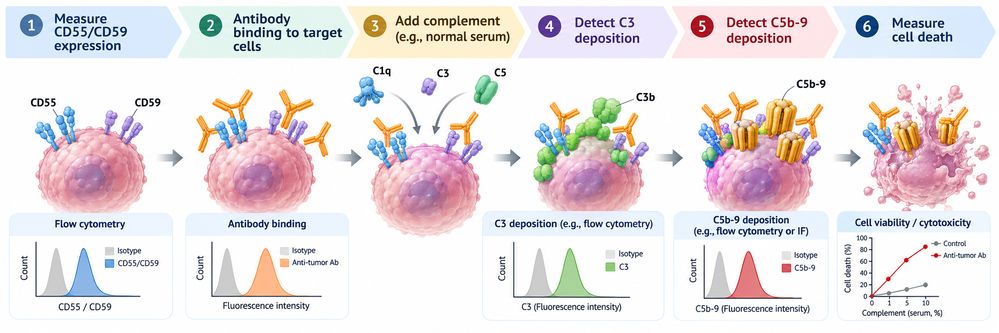 Fig 3. CD55/CD59 Functional Study Design
Recombinant CD55/CD59 Proteins
Purified CD antigen proteins can support antibody screening and biochemical characterization.
However, both proteins are naturally membrane-associated.
This means purified protein assays cannot fully reproduce local membrane density and spatial regulation.
A strong program therefore combines:
- recombinant-protein binding;
- native cell-surface binding;
- complement deposition;
- functional CDC.
When selecting recombinant CD antigens, extracellular-domain design and glycosylation should be considered.
What is the difference between CD55 and CD59?
CD55 acts earlier in the complement cascade by destabilizing C3 and C5 convertases, whereas CD59 acts later by preventing formation of the terminal membrane attack complex. Tumor cells expressing both regulators may therefore resist complement-mediated cytotoxicity at multiple stages.
Resource
-
From CD Markers to Immune Maps: A New Era in Immunology
-
The CD Map Is Still Growing: New CD Molecules and HLDA11
-
Antigen Density: Beyond CD-Positive
-
Spatial CD Biology: Why Location Matters in the Tumor Microenvironment
-
Logic-Gated CAR-T: Revolutionizing Cancer Therapy
-
Cluster of Differentiation
References
- Saxena R, Gottlin EB, Campa MJ, He YW, Patz EF Jr. Complement Regulators as Novel Targets for Anti-Cancer Therapy: A Comprehensive Review. Semin Immunol. 2025;77:101931. doi:10.1016/j.smim.2025.101931.
- Derer S, Beurskens FJ, Rösner T, Peipp M, Valerius T. Complement in Antibody-Based Tumor Therapy. Crit Rev Immunol. 2014;34(3):199–214. doi:10.1615/CritRevImmunol.2014009761.
- Fishelson Z, Donin N, Zell S, Schultz S, Kirschfink M. Obstacles to Cancer Immunotherapy: Expression of Membrane Complement Regulatory Proteins. Mol Immunol. 2003;40(2-4):109–123. doi:10.1016/S0161-5890(03)00112-3.

Contact us or send an email at for project quotations and more detailed information.
Quick Links
-

Papers’ PMID to Obtain Coupon
Submit Now -

Refer Friends & New Lab Start-up Promotions