
CD80 and CD86: CD28/CTLA-4 Costimulatory Signaling in Immune Research
Table of Contents
What Are CD80 and CD86?
CD80, also known as B7-1, and CD86, also known as B7-2, are related cell-surface costimulatory ligands expressed mainly by professional antigen-presenting cells.
Both interact with CD28 and CTLA-4.
That simple statement hides a complex regulatory system.
CD28 is generally associated with positive costimulation, whereas CTLA-4 acts as a major negative regulator of T-cell activation.
CD80 and CD86 therefore sit at the center of a molecular competition that determines whether antigen recognition is supported by strong costimulation or restrained by inhibitory pathways.
These two molecules are among the most widely studied immunological CD antigens.
Explore Our CD Antigen Products
Learn More
CD80 Versus CD86
Although CD80 and CD86 share receptors, they are not biologically identical.
| Characteristic | CD80 | CD86 |
|---|---|---|
| Alternative name | B7-1 | B7-2 |
| Main receptors | CD28, CTLA-4 | CD28, CTLA-4 |
| Expression pattern | Often later or activation-associated | Often more rapidly inducible |
| Structural behavior | Can form dimers in some contexts | Primarily monomeric |
| Research role | Costimulation and CTLA-4 biology | Early costimulation and CTLA-4 biology |
Their expression kinetics differ among APC types and activation conditions.
Therefore, a study that measures only CD80 may miss early costimulatory changes dominated by CD86, while a study measuring only CD86 may miss later changes in CD80.
CD28-Mediated Costimulation
TCR recognition of peptide-MHC provides antigen specificity but is not always sufficient for full naïve T-cell activation.
CD28 provides a major costimulatory signal.
When CD28 binds CD80 or CD86, downstream signaling can support:
- IL-2 production;
- proliferation;
- metabolic reprogramming;
- survival;
- differentiation.
This classical "signal 1 plus signal 2" framework remains valuable, although modern immunology recognizes that T-cell fate is shaped by many additional costimulatory and inhibitory receptors.
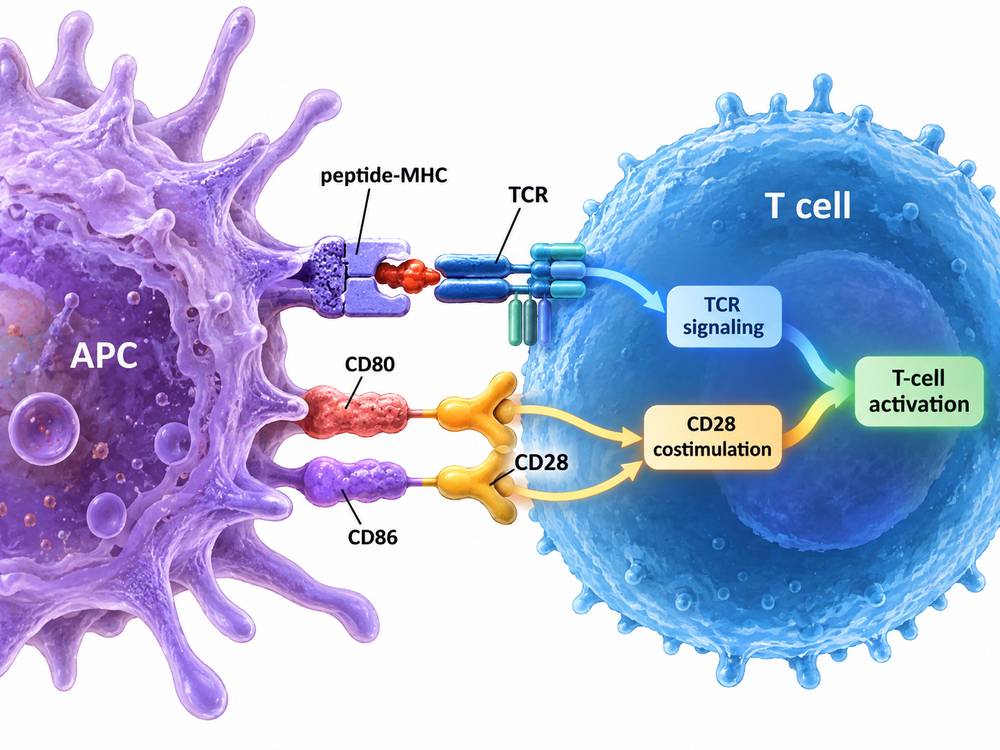 Fig 1. CD28 Costimulation by CD80 and CD86
CTLA-4-Mediated Immune Regulation
CTLA-4 is a homolog of CD28 but has a fundamentally different immunological role.
It binds CD80 and CD86 and can limit the availability of these ligands for CD28.
CTLA-4 is induced after conventional T-cell activation and is constitutively important in regulatory T cells.
The balance can be conceptualized as:
CD28 + CD80/CD86 → supports activation
CTLA-4 + CD80/CD86 → limits costimulation
However, CTLA-4 biology extends beyond simple competition.
Trans-Endocytosis of CD80 and CD86
A landmark study demonstrated that CTLA-4 can physically capture CD80 and CD86 from opposing antigen-presenting cells.
The ligand-receptor complex is internalized into the CTLA-4-expressing cell, reducing the amount of costimulatory ligand available on the APC surface.
This mechanism is called trans-endocytosis.
It provides a powerful explanation for how CTLA-4-expressing regulatory cells can suppress costimulation in a cell-extrinsic manner.
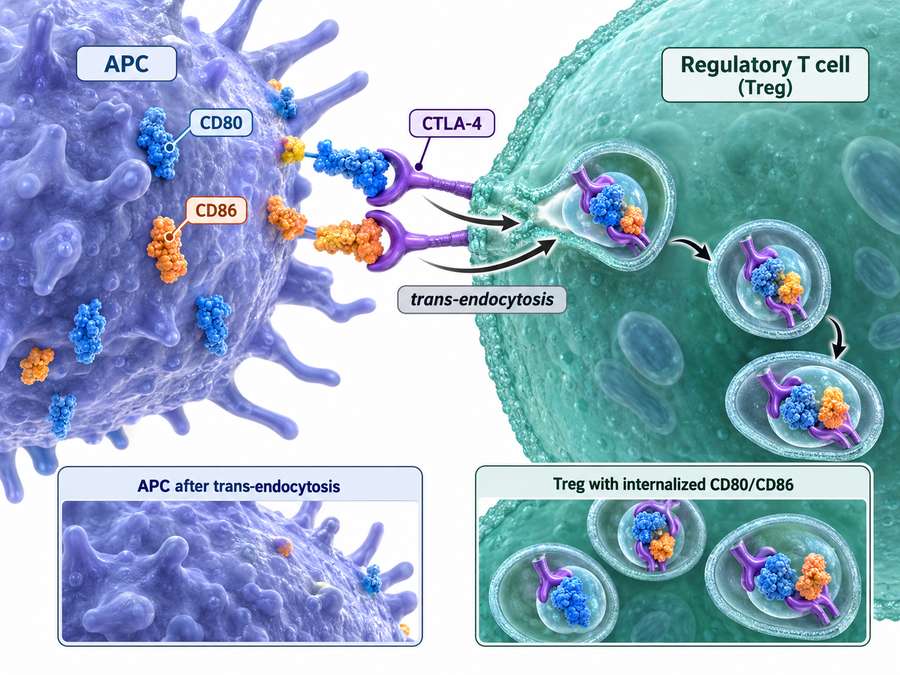 Fig 2. CTLA-4-Mediated Trans-Endocytosis
Expression on Antigen-Presenting Cells
Dendritic cells, B cells and monocytes can express CD80 and CD86.
Expression generally increases in response to activation or maturation signals, but exact kinetics depend on:
- Toll-like receptor stimulation;
- cytokines;
- tissue environment;
- cell type;
- differentiation state.
Therefore, measuring CD80 and CD86 is useful for assessing APC activation but cannot alone define functional competence.
A mature dendritic cell may express strong CD80/CD86 yet still be influenced by inhibitory cytokines, metabolic constraints or other checkpoints.
CD80/CD86 in Cancer and Immunotherapy Research
The pathway is closely linked to cancer immunotherapy because CTLA-4-directed therapies modify a system in which CD80 and CD86 are essential ligands.
CD28 signaling can also be important for effective T-cell responses during checkpoint modulation.
In tumors, relevant variables include:
- abundance of antigen-presenting cells;
- CD80/CD86 expression;
- regulatory T-cell activity;
- CTLA-4 expression;
- localization within tumor versus draining lymph node.
CD80 and CD86 are additionally used experimentally to engineer artificial antigen-presenting cells or costimulatory surfaces.
These systems help researchers study receptor activation under controlled conditions.
Assays for CD80/CD86 Biology
| Assay | Main Purpose |
|---|---|
| CD80-CD28 binding | Measure costimulatory receptor interaction |
| CD86-CD28 binding | Compare ligand-specific interaction |
| CD80-CTLA-4 binding | Characterize inhibitory receptor affinity |
| CD86-CTLA-4 binding | Compare receptor-ligand kinetics |
| Competition assay | Test blockade by antibodies or biologics |
| T-cell reporter assay | Measure functional signaling |
| APC/T-cell coculture | Evaluate integrated immune response |
SPR and BLI can reveal kinetic differences between receptor-ligand pairs.
However, ligand valency and surface density can significantly alter apparent affinity.
Therefore, results obtained with an Fc-fusion dimer should not automatically be compared with a monomeric protein.
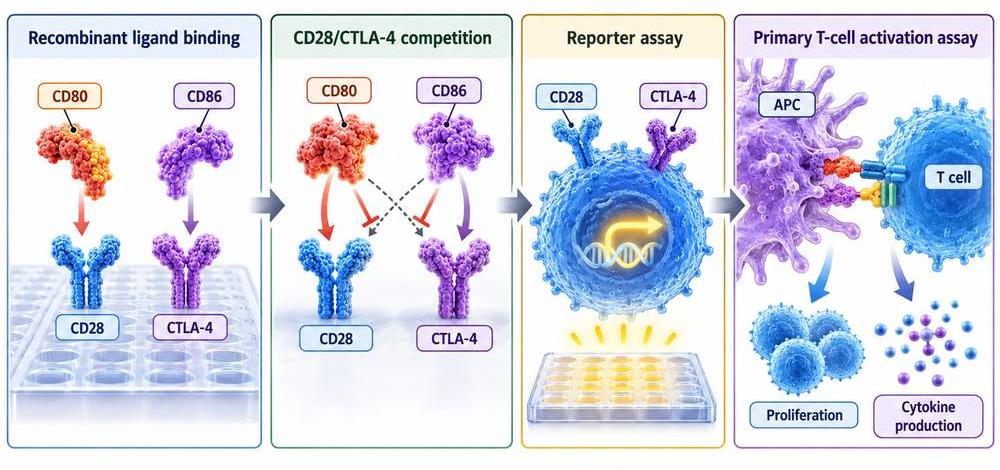 Fig 3. CD80/CD86 Experimental Workflow
Selecting Recombinant CD80 and CD86
Matched recombinant CD antigens are useful when directly comparing CD80 and CD86.
Researchers should ideally keep the following variables consistent:
- species;
- extracellular-domain boundaries;
- tag;
- expression system;
- immobilization format.
Explore Our CD Antigen Products
Learn More
Fc-Tagged Proteins
Useful for capture assays and multivalent presentation.
Potential limitation: avidity.
His-Tagged Proteins
Useful for ELISA and many quantitative biochemical assays.
Avi-Tagged/Biotinylated Proteins
Useful for oriented streptavidin immobilization.
Mammalian Expression
Often preferred when extracellular glycosylation and native-like folding are important.
For translational work, human and animal orthologs of these CD antigen proteins can also support cross-species characterization.
What is the difference between CD80 and CD86?
Both are B7-family ligands that bind CD28 and CTLA-4, but they differ in expression kinetics, structural behavior and interaction properties. CD86 is often induced earlier after APC activation, whereas CD80 may become more prominent later. Their shared but non-identical biology makes simultaneous measurement more informative than evaluating either ligand alone.
Resource
-
From CD Markers to Immune Maps: A New Era in Immunology
-
The CD Map Is Still Growing: New CD Molecules and HLDA11
-
Antigen Density: Beyond CD-Positive
-
Spatial CD Biology: Why Location Matters in the Tumor Microenvironment
-
Logic-Gated CAR-T: Revolutionizing Cancer Therapy
-
Cluster of Differentiation

References
- Sansom DM, Manzotti CN, Zheng Y. What's the Difference Between CD80 and CD86? Trends Immunol. 2003;24(6):314–319. doi:10.1016/S1471-4906(03)00111-X.
- Qureshi OS, Zheng Y, Nakamura K, et al. Trans-Endocytosis of CD80 and CD86: A Molecular Basis for the Cell-Extrinsic Function of CTLA-4. Science. 2011;332(6029):600–603. doi:10.1126/science.1202947.
- Slavik JM, Hutchcroft JE, Bierer BE. CD28/CTLA-4 and CD80/CD86 Families: Signaling and Function. Immunol Res. 1999;19(1):1–24. doi:10.1007/BF02786473.
- Walker LSK, Sansom DM. Confusing Signals: Recent Progress in CTLA-4 Biology. Trends Immunol. 2015;36(2):63–70. doi:10.1016/j.it.2014.12.001.

Contact us or send an email at for project quotations and more detailed information.
Quick Links
-

Papers’ PMID to Obtain Coupon
Submit Now -

Refer Friends & New Lab Start-up Promotions