

How to Select Recombinant CD Antigens for Your Assay
Table of Contents
- Why Recombinant CD Antigen Selection Matters
- Start With the Experimental Question
- Selecting the Correct Species
- Choosing an Expression System
- Extracellular Domain vs Full-Length Protein
- His, Fc, Avi and Tag-Free Formats
- Protein Valency and Oligomerization
- Selecting Proteins for ELISA
- Selecting Proteins for SPR and BLI
- Antibody Screening and Validation
- Purity, Activity, Endotoxin and Aggregation
- Troubleshooting Unexpected Results
- CD Antigen Selection Checklist
Why Recombinant CD Antigen Selection Matters
Choosing a recombinant protein only by target name can lead to misleading experimental results.
Two products labeled "CD47," "CD80" or "CD70" may differ in:
- species;
- sequence boundaries;
- expression host;
- glycosylation;
- oligomeric state;
- tag;
- biotinylation;
- biological activity.
Therefore, the best recombinant CD antigen is not simply the protein with the highest purity.
It is the reagent whose format matches the assay.
Explore Our CD Antigen Products
Learn More
Start With the Experimental Question
Before comparing products, define what the experiment measures.
Antibody Binding
A soluble extracellular domain may be sufficient.
Quantitative Affinity
Controlled valency and immobilization become critical.
Receptor-Ligand Interaction
Native-like folding and activity matter.
Cell-Based Function
A soluble protein may be insufficient if membrane organization is essential.
Enzyme Inhibition
Catalytic activity must be demonstrated.
Species Cross-Reactivity
Matched human and animal orthologs are needed.
This application-first approach prevents many downstream problems.
Selecting the Correct Species
For a human therapeutic program, the human target is usually the primary reagent.
However, preclinical development may also require:
- mouse;
- rat;
- cynomolgus monkey;
- other orthologs.
| Development Question | Recommended Protein Set |
|---|---|
| Human lead binding | Human target |
| Mouse efficacy model | Human + mouse |
| NHP toxicology | Human + cynomolgus |
| Cross-species mechanism | Multi-species matched panel |
Do not rely solely on sequence identity.
An antibody epitope may contain only a few residues, and one substitution can substantially reduce binding.
Choosing an Expression System
Mammalian Expression
Mammalian cells can provide:
- disulfide bond formation;
- glycosylation;
- complex folding;
- secretory processing.
For many extracellular immune receptors, this improves native-like structure.
E. coli Expression
Advantages include:
- rapid production;
- high yield;
- low cost;
- simple scale-up.
However, E. coli cannot provide mammalian N-linked glycosylation.
Proteins containing multiple disulfide bonds may also require specialized folding strategies.
Insect Cells
Insect expression can produce many complex extracellular proteins but glycosylation differs from mammalian cells.
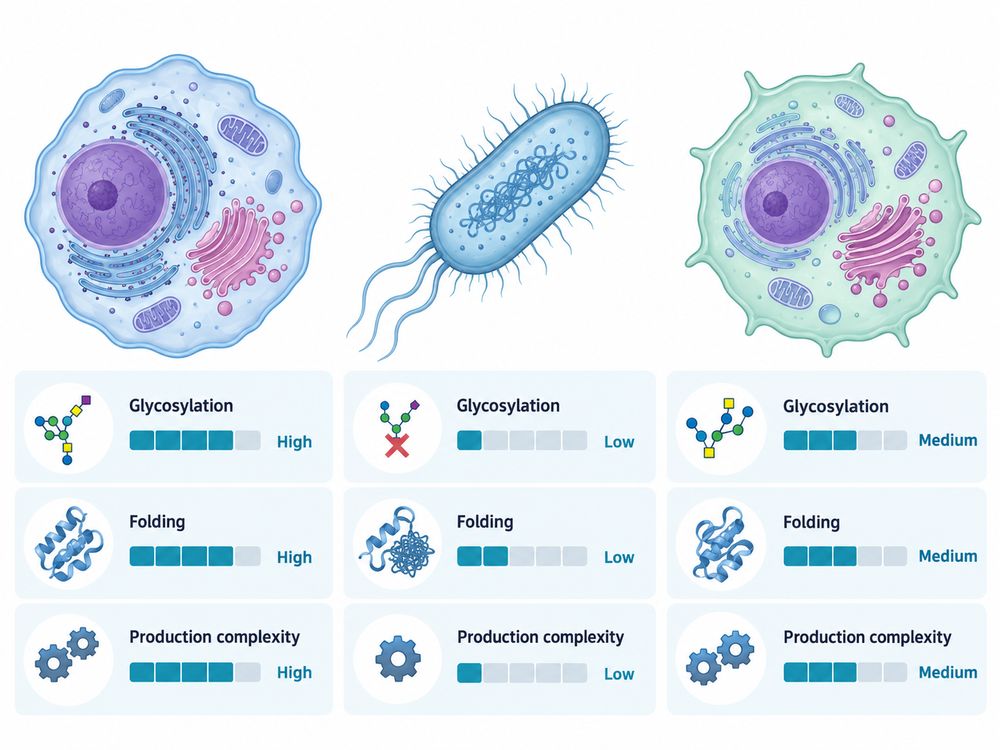 Fig 1. Expression-System Comparison
Illustration brief: Mammalian, bacterial and insect-cell icons with relative features for glycosylation, folding and production complexity.
Extracellular Domain vs Full-Length Protein
Most CD molecules are transmembrane proteins.
For ELISA or SPR, researchers often use the extracellular domain because it is soluble and easier to purify.
This works well for many single-pass receptors.
However, soluble constructs can lose membrane-dependent structure.
Multipass proteins present a greater challenge.
CD9, CD63 and CD81 are examples of four-pass tetraspanins. A small soluble extracellular loop does not reproduce the full protein architecture.
For such targets, alternatives can include:
- cell-surface expression;
- membrane preparations;
- virus-like particles;
- nanodiscs;
- liposomes.
Explore Our CD Antigen Products
Learn More
His, Fc, Avi and Tag-Free Formats
His Tag
Advantages:
- small size;
- convenient purification;
- broad compatibility.
Limitations:
- random immobilization depending on assay;
- possible accessibility issues.
Fc Fusion
Advantages:
- improved stability;
- easy Protein A/G capture;
- often increased solubility.
Limitations:
- dimerization;
- avidity effects;
- Fc-receptor interactions.
Avi Tag
The Avi sequence can be enzymatically biotinylated at a defined lysine.
Advantages:
- controlled biotinylation;
- oriented streptavidin capture;
- useful for SPR/BLI.
Tag-Free Protein
Advantages:
- avoids tag interference.
Limitations:
- fewer convenient capture options.
| Format | Best Used For | Main Caveat |
|---|---|---|
| His | ELISA, biochemical binding | Immobilization orientation |
| Fc | Capture, multivalent binding | Avidity/Fc receptor effects |
| Avi-biotin | SPR/BLI | Biotinylation quality |
| Tag-free | Mechanistic studies | Harder immobilization |
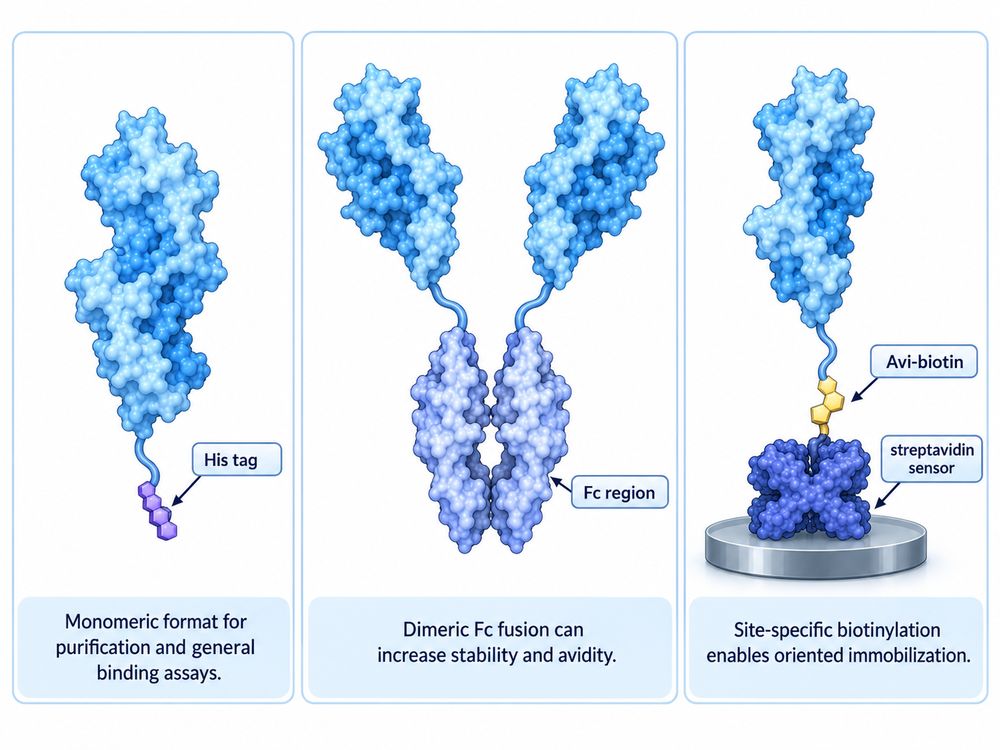 Fig 2. His-, Fc- and Avi-Tagged CD Proteins
Protein Valency and Oligomerization
Valency can change apparent binding dramatically.
For example, a monomeric receptor may show modest affinity.
If the same receptor is fused to Fc, dimerization can create avidity and produce much stronger apparent binding.
This is not necessarily wrong.
It simply answers a different question.
Researchers should distinguish:
intrinsic affinity from multivalent apparent avidity.
For quantitative comparison, assay formats should remain consistent.
Selecting Proteins for ELISA
ELISA is comparatively tolerant of protein format.
Useful priorities include:
- stability;
- reproducible coating;
- correct epitope exposure.
His- and Fc-tagged proteins are both widely used.
However, if the detection antibody recognizes Fc or reacts nonspecifically with the tag, matched tag controls are essential.
Selecting Proteins for SPR and BLI
SPR and BLI are more sensitive to immobilization artifacts.
Important issues include:
Surface Density
High ligand density can create rebinding.
Valency
Dimeric analytes can produce complex kinetics.
Orientation
Random amine coupling may expose molecules differently.
Mass Transport
Very high binding rates can become diffusion-limited.
Site-specific biotinylated CD antigen proteins can provide controlled orientation on streptavidin sensors.
For affinity measurements, low surface density and monomeric analyte are often preferable.
Antibody Screening and Validation
Recombinant proteins are extremely useful in antibody discovery.
However, purified antigen should not be the only validation system.
An antibody may bind:
- a denatured epitope;
- a tag-dependent epitope;
- an artificial recombinant conformation.
Therefore, final validation should include native target on cells whenever possible.
A strong screening workflow uses:
recombinant antigen → target-positive cells → target-negative cells → functional assay
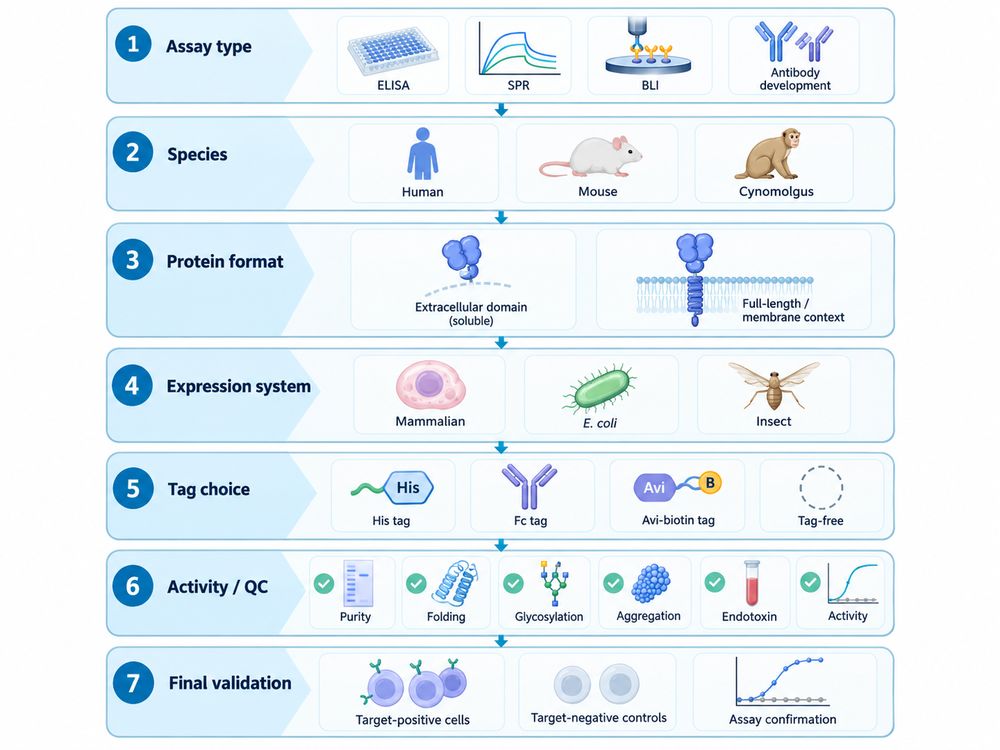 Fig 3. Recombinant CD Antigen Selection Workflow
Purity, Activity, Endotoxin and Aggregation
Purity
High purity reduces interference, but purity alone does not prove correct folding.
Activity
For receptor ligands and enzymes, activity should be directly measured.
Endotoxin
This is critical for immune-cell experiments.
A highly pure protein can still contain enough endotoxin to activate monocytes or dendritic cells.
Aggregation
Aggregates can create artificially strong antibody binding through multivalent interactions.
SEC or other aggregation analysis can be particularly valuable for quantitative assays.
Lot Consistency
Long-term screening programs may require comparable performance between lots.
Explore Our CD Antigen Products
Learn More
Troubleshooting Unexpected Results
Strong ELISA Binding but No Cell Binding
Possible causes:
- recombinant-specific epitope;
- incorrect conformation;
- tag recognition;
- epitope inaccessible on cells.
Different Affinity Between His and Fc Formats
Possible cause:
- avidity from Fc dimerization.
Human Binding but No Mouse Binding
Possible cause:
- species-specific epitope differences.
Immune-Cell Activation With Control Protein
Possible cause:
- endotoxin contamination;
- Fc-receptor binding;
- aggregate-related activation.
No Receptor-Ligand Activity
Possible cause:
- incorrect folding;
- missing glycosylation;
- unsuitable construct boundaries.
CD Antigen Selection Checklist
Before ordering a recombinant CD antigen protein, verify:
- Correct CD molecule and gene.
- Correct isoform.
- Correct species.
- Appropriate extracellular-domain boundaries.
- Suitable expression host.
- Required glycosylation.
- Suitable tag.
- Appropriate valency.
- Purity.
- Aggregation state.
- Biological activity.
- Endotoxin level.
- Immobilization strategy.
- Matched tag control.
- Target-positive and target-negative cell controls.
- Availability of additional species orthologs.
Explore Our CD Antigen Products
Learn More
The most useful question is therefore not:
"Which recombinant CD protein is best?"
It is:
"Which protein format most faithfully reproduces the molecular property my experiment is designed to measure?"
That application-driven approach improves reproducibility across ELISA, SPR, BLI, antibody discovery and functional immune assays.
Resource
-
From CD Markers to Immune Maps: A New Era in Immunology
-
The CD Map Is Still Growing: New CD Molecules and HLDA11
-
Antigen Density: Beyond CD-Positive
-
Spatial CD Biology: Why Location Matters in the Tumor Microenvironment
-
Logic-Gated CAR-T: Revolutionizing Cancer Therapy
-
Cluster of Differentiation

References
- Brooks SA. Protein Glycosylation in Diverse Cell Systems: Implications for Modification and Analysis of Recombinant Proteins. Expert Rev Proteomics. 2006;3(3):345–359. doi:10.1586/14789450.3.3.345.
- Ebersbach H, Geisse S. Antigen Generation and Display in Therapeutic Antibody Drug Discovery—A Neglected but Critical Player. Biotechnol J. 2012;7(12):1433–1443. doi:10.1002/biot.201200066.
- Bandaranayake AD, Almo SC. Recent Advances in Mammalian Protein Production. FEBS Lett. 2014;588(2):253–260. doi:10.1016/j.febslet.2013.11.035.
- Rosano GL, Ceccarelli EA. Recombinant Protein Expression in Escherichia coli: Advances and Challenges. Front Microbiol. 2014;5:172. doi:10.3389/fmicb.2014.00172.

Contact us or send an email at for project quotations and more detailed information.
Quick Links
-

Papers’ PMID to Obtain Coupon
Submit Now -

Refer Friends & New Lab Start-up Promotions