

Recombinant Full Length Drosophila Melanogaster Dopamine Receptor 1(Dopr) Protein, His-Tagged
| Cat.No. : | RFL3288DF |
| Product Overview : | Recombinant Full Length Drosophila melanogaster Dopamine receptor 1(DopR) Protein (P41596) (20-511aa), fused to N-terminal His tag, was expressed in E. coli. |
- Specification
- Gene Information
- Related Products
- Case Study
- Application
- Download
| Species : | Drosophila melanogaster (Fruit fly) |
| Source : | E.coli |
| Tag : | His |
| Protein Length : | Full Length of Mature Protein (20-511) |
| Form : | Lyophilized powder |
| AA Sequence : | MRAIAAIAAGVGSVAATVATSTTSSISSSTTIINTSSATTIGGNHTSGSTGFSTNSTLLD ADHLPLQLTTAKVDLDIEIDIQLLTNGYDGTTLTSFYNESSWTNASEMDTIVGEEPEPLS LVSIVVVGIFLSVLIFLSVAGNILVCLAIYTERSLRRIGNLFLASLAIADLFVASLVMTF AGVNDLLGYWIFGAQFCDTWVAFDVMCSTASILNLCAISMDRYIHIKDPLRYGRWVTRRV AVITIAAIWLLAAFVSFVPISLGIHRPDQPLIFEDNGKKYPTCALDLTPTYAVVSSCISF YFPCVVMIGIYCRLYCYAQKHVKSIKAVTRPGEVAEKQRYKSIRRPKNQPKKFKVRNLHT HSSPYHVSDHKAAVTVGVIMGVFLICWVPFFCVNITAAFCKTCIGGQTFKILTWLGYSNS AFNPIIYSIFNKEFRDAFKRILTMRNPWCCAQDVGNIHPRNSDRFITDYAAKNVVVMNSG RSSAELEQVSAI |
| Purity : | Greater than 90% as determined by SDS-PAGE. |
| Applications : | SDS-PAGE |
| Notes : | Repeated freezing and thawing is not recommended. Store working aliquots at 4°C for up to one week. |
| Storage : | Store at -20°C/-80°C upon receipt, aliquoting is necessary for mutiple use. Avoid repeated freeze-thaw cycles. |
| Storage Buffer : | Tris/PBS-based buffer, 6% Trehalose, pH 8.0 |
| Reconstitution : | We recommend that this vial be briefly centrifuged prior to opening to bring the contents to the bottom. Please reconstitute protein in deionized sterile water to a concentration of 0.1-1.0 mg/mL.We recommend to add 5-50% of glycerol (final concentration) and aliquot for long-term storage at -20℃/-80℃. Our default final concentration of glycerol is 50%. Customers could use it as reference. |
| Gene Name | Dop1R1 |
| Synonyms | Dop1R1; DopR; DopR1; DopR35EF; CG9652; Dopamine receptor 1; D-DOP1; DmDop1; dDA1; Dopamine 1-like receptor 1 |
| UniProt ID | P41596 |
| ◆ Recombinant Proteins | ||
| RFL3288DF | Recombinant Full Length Drosophila Melanogaster Dopamine Receptor 1(Dopr) Protein, His-Tagged | +Inquiry |

Case 1: Silva B, et al. PLoS One. 2020
As in vertebrates, dopaminergic neural systems are key regulators of motor programs in insects, including the fly Drosophila melanogaster. Dopaminergic systems innervate the Mushroom Bodies (MB), an important association area in the insect brain primarily associated to olfactory learning and memory, but that has been also implicated with the execution of motor programs. The main objectives of this work is to assess the idea that dopaminergic systems contribute to the execution of motor programs in Drosophila larvae, and then, to evaluate the contribution of specific dopaminergic receptors expressed in MB to these programs. This study shows that animals bearing a mutation in the dopamine transporter show reduced locomotion, while mutants for the dopaminergic biosynthetic enzymes or the dopamine receptor Dop1R1 exhibit increased locomotion. Pan-neuronal expression of an RNAi for the Dop1R1 confirmed these results. Further studies show that animals expressing the RNAi for Dop1R1 in the entire MB neuronal population or only in the MB γ-lobe forming neurons, exhibit an increased motor output, as well.
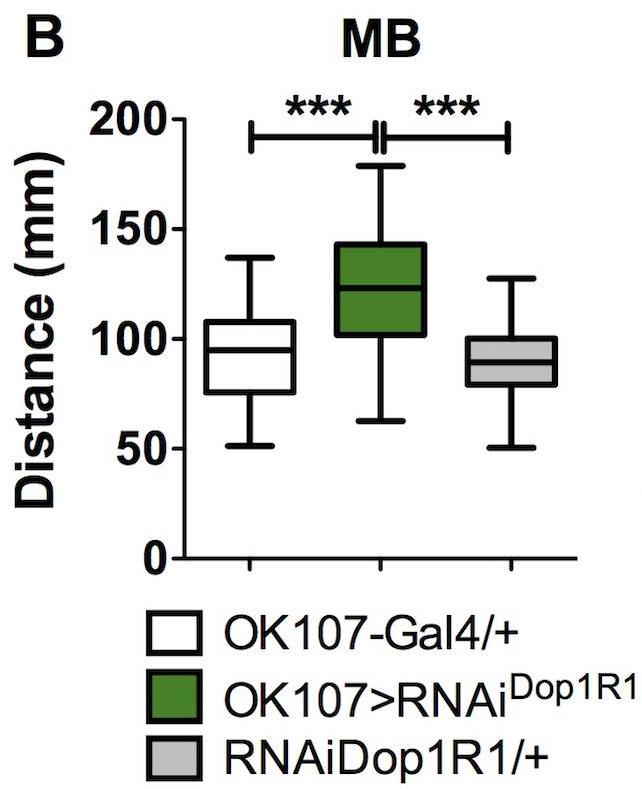
Fig1. Expression of RNAiDop1R1 in the entire MB neuronal population (OK107>RNAiDop1R1).
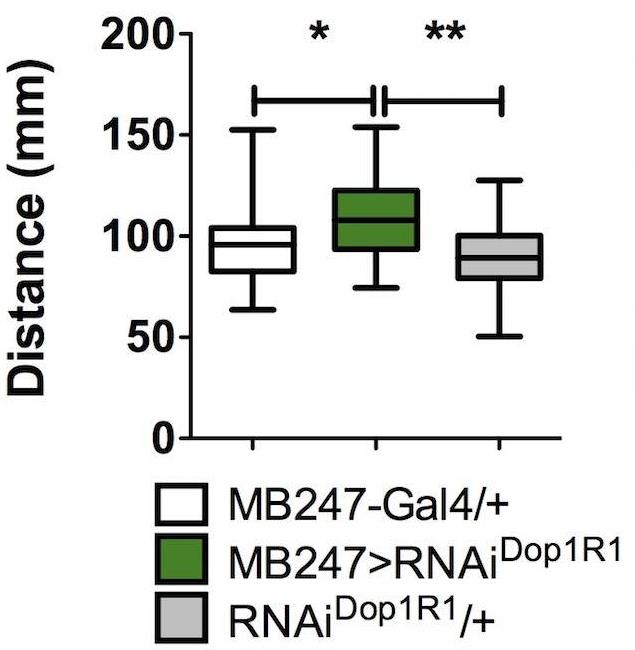
Fig2. Expression of RNAiDop1R1 in the γ-lobe MB neurons affects motor output in Drosophila larvae.
Case 2: Lecroisey A, et al. Eur J Biochem. 1983
Dysregulated motivation to consume psychoactive substances leads to addictive behaviors that often result in serious health consequences. Understanding the neuronal mechanisms that drive drug consumption is crucial for developing new therapeutic strategies. The fruit fly Drosophila melanogaster offers a unique opportunity to approach this problem with a battery of sophisticated neurogenetic tools available, but how they consume these drugs remains largely unknown. Here, researchers examined drug self-administration behavior of Drosophila and the underlying neuronal mechanisms. They measured the preference of flies for five different psychoactive substances using a two-choice feeding assay and monitored its long-term changes. Preference for methamphetamine and the long-term escalation of ethanol preference required the dopamine receptor Dop1R1 in the mushroom body. The protein level of Dop1R1 increased after repeated intake of ethanol, but not methamphetamine, which correlates with the acquired preference. Genetic overexpression of Dop1R1 enhanced ethanol preference.
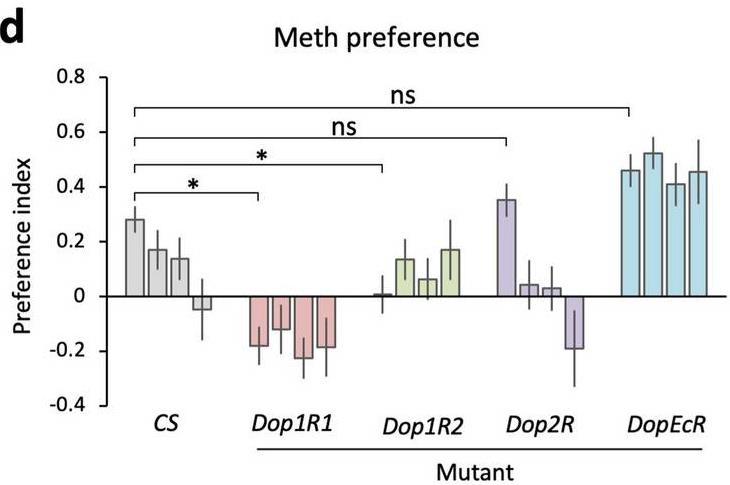
Fig1. Dop1R1 is necessary for acute methamphetamine preference.
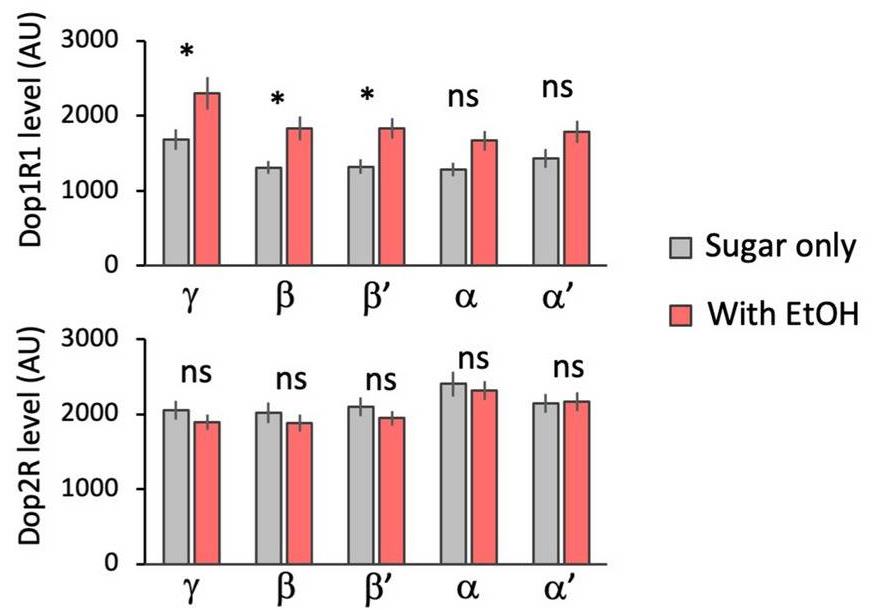
Fig2. Increased Dop1R1 (up) or Dop2R (down) protein in the medial lobe of the MB.
1. Nervous system research. The study found that male flies with the Dopr mutation exhibited male-male courtship behavior, and this abnormal behavior was mainly due to the increased courtship tendency of male flies towards other males. In the nervous system, the Dop1R1 receptor is expressed in mushroom bodies, and its activation reduces motor output by increasing intracellular cAMP levels.
2. Drug screening and neuropharmacological research: Due to Dopr's role in regulating specific behaviors, it can be used as a model to study the mechanism of drug action in the dopamine system and help develop drugs to treat related behavioral disorders.
3, Neurodegenerative disease research: Dopr research contributes to the understanding of the role of the dopamine system in neurodegenerative diseases such as Parkinson's disease, and in turn drives the development of treatments.
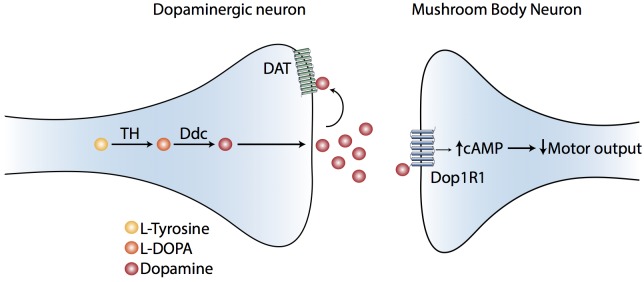
Fig1. A model to explain the contribution of Dop1R1 expressed in MB to Drosophila larval locomotion. (Bryon Silva, 2020)

Not For Human Consumption!
Inquiry
- Reviews (0)
- Q&As (0)


Ask a Question for All Dop1R1 Products
Required fields are marked with *
My Review for All Dop1R1 Products
Required fields are marked with *
Recently Viewed