

Fcγ Receptor Proteins for Antibody Effector Function Research
Fc gamma receptors (FcγRs) are the central molecular interface between the antigen-binding specificity of IgG antibodies and the cellular arm of the innate immune system. As the primary mediators of antibody effector function, FcγR proteins determine whether therapeutic antibodies clear tumors, drive phagocytosis of pathogens, or trigger inflammatory cytokine cascades. This guide focuses exclusively on the IgG-binding FcγR family—CD64, CD32, CD16, and FCGR3B—and their roles in ADCC, ADCP, and therapeutic antibody development.
Contents
What Are Fcγ Receptors?
Fcγ receptors are transmembrane glycoproteins expressed primarily on hematopoietic cells that bind the Fc (fragment crystallizable) portion of IgG antibodies. Upon engagement by IgG-coated target cells or immune complexes, FcγRs transduce signals that direct phagocytosis, cytotoxicity, cytokine release, and immune complex clearance.
Structurally, FcγRs belong to the immunoglobulin superfamily. Their extracellular domains contain two or three Ig-like domains that recognize the hinge and CH2 region of IgG Fc. The intracellular—or associated—signaling motifs define their functional output: ITAMs (Immunoreceptor Tyrosine-based Activation Motifs) drive activation, while ITIMs (Immunoreceptor Tyrosine-based Inhibition Motifs) suppress it.
FcγRs do not operate in isolation. Their binding affinity varies dramatically across the four human IgG subclasses (IgG1–IgG4), and single-nucleotide polymorphisms (e.g., FcγRIIIa-V158F, FcγRIIa-H131R) alter receptor affinity, directly impacting clinical responses to monoclonal antibody therapy.
Major FcγR Members: CD64, CD32, CD16, FCGR3B
The human FcγR family is encoded by a cluster of genes on chromosome 1q21–q23. The following table summarizes the five principal human FcγR proteins, their IgG binding profiles, signaling motifs, and cellular distribution:
| Receptor (CD) | Affinity for IgG | IgG Subclass Preference | Signaling Motif | Functional Class | Primary Cell Distribution | Key Effector Role |
|---|---|---|---|---|---|---|
| FcγRI (CD64) | High (~10⁻⁹–10⁻¹⁰ M) | IgG1 = IgG3 >> IgG4 >> IgG2 | ITAM (FcRγ chain) | Activating | Monocytes, Macrophages, DCs, PMNs (inducible) | Phagocytosis, ADCP, Cytokine release |
| FcγRIIa (CD32a) | Low (~10⁻⁶ M) | IgG3 ≥ IgG1 >> IgG4 > IgG2 (H131) | ITAM (cytoplasmic) | Activating | Monocytes, Macrophages, DCs, PMNs, Platelets | ADCP, Phagocytosis, Platelet activation |
| FcγRIIb (CD32b) | Low (~10⁻⁶ M) | IgG3 ≥ IgG1 >> IgG4 > IgG2 | ITIM (cytoplasmic) | Inhibitory | B cells, Monocytes, Macrophages, DCs | B-cell inhibition, Threshold modulation |
| FcγRIIIa (CD16a) | Low (~10⁻⁷ M) | IgG1 = IgG3 >> IgG2 > IgG4 (V158) | ITAM (FcRγ chain) | Activating | NK cells, Monocytes, Macrophages, γδ T cells | ADCC (NK cells), ADCP (macrophages) |
| FcγRIIIb (CD16b) | Low (~10⁻⁷ M) | IgG1 = IgG3 >> IgG2 > IgG4 | GPI-anchored | Decoy/Activating | Neutrophils exclusively | Neutrophil activation, IC capture |
Key distinctions within the FcγR family:
- CD64 (FcγRI) is the only high-affinity receptor, capable of binding monomeric IgG. It is essential for macrophage and dendritic cell activation.
- CD32a (FcγRIIa) and CD32b (FcγRIIb) share similar extracellular domains but deliver opposite signals via ITAM versus ITIM. CD32b is the sole inhibitory FcγR and acts as a critical brake on B-cell and myeloid activation.
- CD16a (FcγRIIIa) is the dominant receptor driving NK cell-mediated ADCC. The V158 allotype binds IgG1 with ~3-fold higher affinity than F158, correlating with improved clinical responses to rituximab and trastuzumab.
- FCGR3B (CD16b) is GPI-anchored and lacks a cytoplasmic tail. Expressed exclusively on neutrophils, it functions primarily as a decoy receptor to capture immune complexes from circulation, though it can participate in activation through co-aggregation with other receptors.
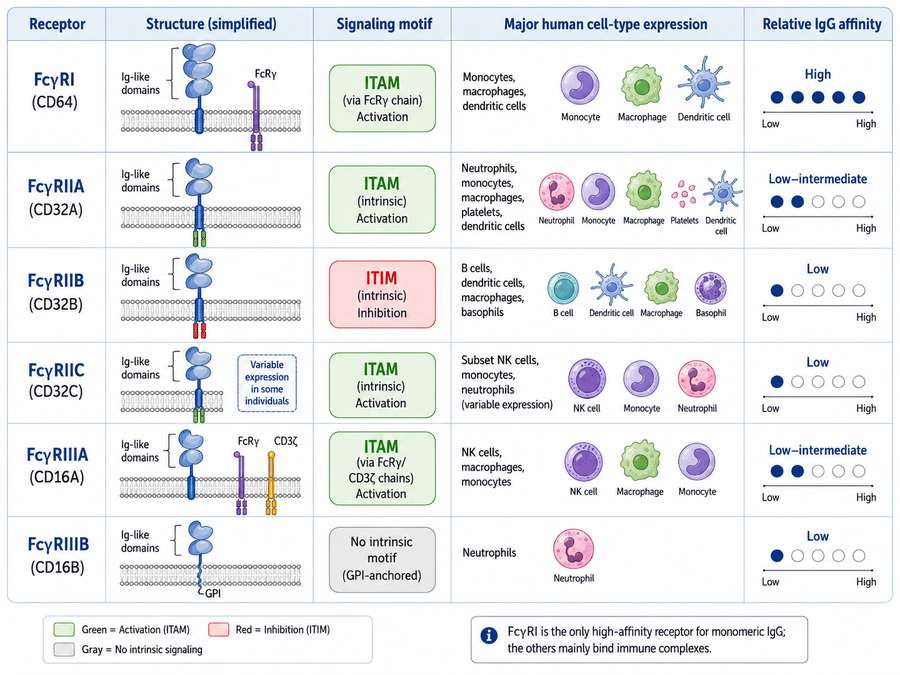 Fig1. Human FcγR family overview: structure, cell-type expression, and relative IgG affinity. ITAM (green) drives activation; ITIM (red) mediates inhibition.
Activating vs Inhibitory Fcγ Receptors
The functional outcome of IgG-FcγR engagement is governed by the A:I ratio—the balance between activating (A) and inhibitory (I) receptor signals.
Activating FcγRs (ITAM-bearing)
Activating receptors—FcγRI, FcγRIIa, and FcγRIIIa—signal through ITAMs located either in their cytoplasmic tails (FcγRIIa) or in the associated FcRγ common chain (FcγRI and FcγRIIIa). Upon IgG immune complex cross-linking, Src family kinases phosphorylate ITAM tyrosines, recruiting Syk kinase and initiating downstream cascades involving PI3K, PLCγ, and Vav. These pathways culminate in:
- Degranulation and cytotoxic granule release (NK cells)
- Phagosome formation (macrophages, neutrophils)
- Pro-inflammatory cytokine and chemokine production (TNF-α, IL-6, IL-1β)
- Superoxide generation via NADPH oxidase
Inhibitory FcγR: FcγRIIb (CD32b)
FcγRIIb is unique among FcγRs as the sole inhibitory member. Its cytoplasmic ITIM motif recruits SH2-domain-containing phosphatases—SHIP-1/2 and SHP-1—upon co-aggregation with activating receptors. This results in:
- Hydrolysis of PIP3, blocking PI3K/Akt signaling
- Inhibition of calcium mobilization and degranulation
- Raising the activation threshold for B-cell receptor signaling
- Suppressing myeloid cell effector responses
The A:I ratio is a critical parameter in therapeutic antibody design. Preclinical studies demonstrate that antibodies engineered to increase A:I binding ratios exhibit superior tumor clearance, whereas enhanced FcγRIIb engagement can suppress unwanted inflammatory toxicity.
FcγR in ADCC, ADCP, Cytokine Release, and Immune Complex Clearance
Antibody-Dependent Cellular Cytotoxicity (ADCC)
ADCC is the lysis of antibody-coated target cells by cytotoxic effector cells, predominantly NK cells via CD16a (FcγRIIIa). Upon IgG1 binding, CD16a triggers perforin/granzyme release and FasL-mediated apoptosis. The V158 polymorphism significantly enhances ADCC potency due to higher IgG1 affinity.
Antibody-Dependent Cellular Phagocytosis (ADCP)
ADCP is mediated primarily by macrophages, monocytes, and neutrophils expressing CD32a (FcγRIIa) and CD64 (FcγRI). CD32a is considered the principal phagocytic receptor; blocking studies indicate it dominates immune complex uptake. ADCP is essential for clearing tumor cells, viral particles, and apoptotic debris.
Cytokine Release
Cross-linking of activating FcγRs on macrophages and dendritic cells induces robust secretion of pro-inflammatory cytokines (IL-6, TNF-α, IL-1β) and type I interferons. This response underlies both therapeutic efficacy (e.g., anti-tumor immunity) and adverse effects (e.g., cytokine release syndrome, CRS). The balance between CD64/CD32a-driven activation and CD32b-mediated suppression tunes the magnitude and duration of cytokine storms.
Immune Complex Clearance
Soluble immune complexes (ICs) are cleared from circulation via FcγR-mediated uptake by splenic macrophages and hepatic Kupffer cells. CD64 (FcγRI) and CD16b play pivotal roles in IC capture. Deficiencies in FcγR-mediated clearance are associated with autoimmune pathologies such as systemic lupus erythematosus (SLE), where IC deposition drives tissue inflammation.
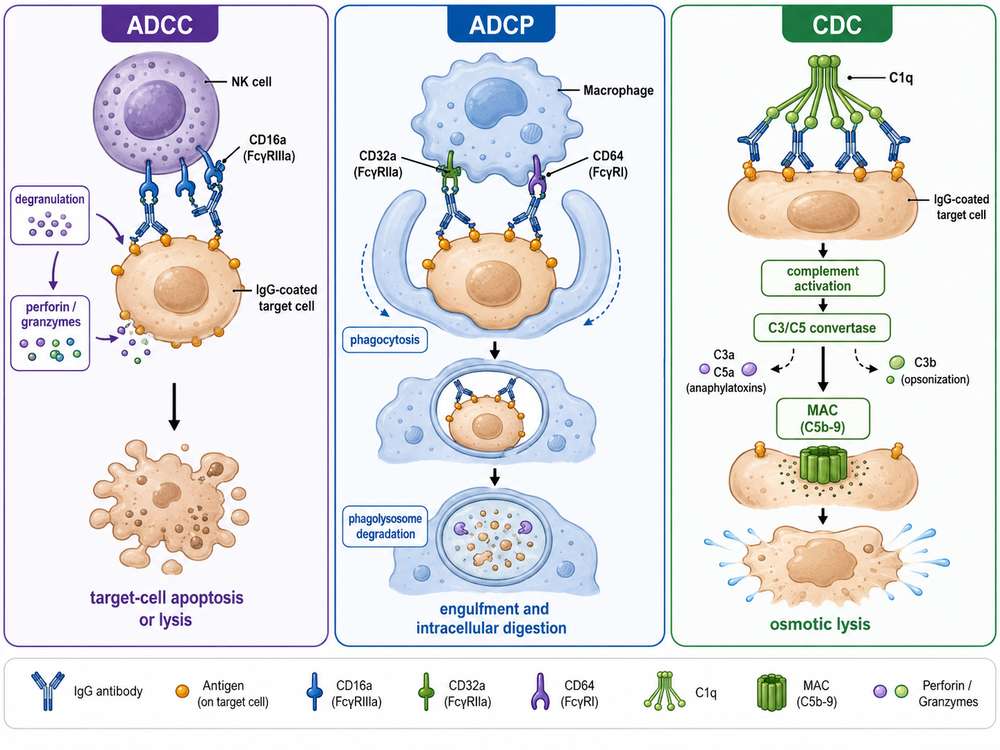 Fig 2. Mechanisms of antibody-mediated target cell clearance: ADCC (NK cell via CD16a), ADCP (macrophage via CD32a/CD64), and CDC (complement C1q).
FcγR Binding in Therapeutic Antibody Development
FcγR interactions are a cornerstone of modern antibody engineering. Two dominant strategies—protein engineering and glyco-engineering—are employed to modulate FcγR binding profiles:
Protein Engineering (Amino Acid Substitution)
Directed mutation of Fc residues alters the affinity landscape across FcγRs. Key examples include:
| Fc Variant | FcγRIIIa Binding | FcγRIIb Binding | ADCC Induction | Clinical Status |
|---|---|---|---|---|
| S239D-I332E | ↑↑↑ | ↑↑ | Strongly enhanced | Margetuximab (approved) |
| S298A-E333A-K334A | ↑↑ | ↓ | Enhanced | Preclinical |
| L234F/L235E/P331S (LALA) | ↓↓ | ↓↓ | Silenced | Multiple approved silent Fc mAbs |
The S239D-I332E variant increases affinity to both activating FcγRIIIa and FcγRIIa while retaining CDC activity. In non-human primates, S239D-I332E rituximab achieved B-cell depletion at ~50-fold lower doses than wild-type IgG1.
Glyco-Engineering (N297 Glycan Modification)
The N-linked glycan at Asn297 is obligatory for FcγR binding. Removal of core fucose eliminates steric hindrance and dramatically improves FcγRIIIa affinity, enhancing ADCC by 10–100-fold. This strategy is clinically validated in obinutuzumab (Gazyva®, anti-CD20) and mogamulizumab (Poteligeo®, anti-CCR4), both of which are defucosylated to maximize NK cell cytotoxicity.
A:I Ratio Optimization
For agonistic antibodies (e.g., anti-CD40, anti-DR5), enhanced FcγRIIb binding paradoxically promotes receptor clustering and pro-apoptotic signaling. Conversely, for cytotoxic antibodies (e.g., anti-CD20, anti-HER2), reduced FcγRIIb and enhanced activating FcγR binding improves tumor clearance. Thus, Fc engineering must be mechanism-specific.
FcγR Product Selection Guide
Choosing the right Fcγ receptor proteins depends on your assay format, species model, and engineering objective. The following guide matches research applications to recommended products:
| Research Application | Recommended FcγR Products | Product Formats | Species Available |
|---|---|---|---|
| ADCC Reporter Assays | FcγRIIIa (CD16a) V158 & F158 variants, FcγRI (CD64) | His-tag, Fc-tag, Biotinylated, PE-labeled | Human, Cynomolgus, Mouse |
| ADCP Phagocytosis Assays | FcγRIIa (CD32a) H131 & R131 variants, FcγRI (CD64) | His-tag, Fc-tag, Avi-tag, Fluorophore-conjugated | Human, Cynomolgus, Mouse, Rat |
| Binding Affinity & Kinetics (SPR/BLI) | Full panel: CD64, CD32a, CD32b, CD16a, CD16b | His-tag, Fc-tag, Unlabeled, Biotinylated | Human, Cynomolgus, Mouse, Rat, Rabbit |
| Fc Engineering Screening | CD16a, CD32a, CD32b (A:I ratio optimization) | His-tag, Fc-tag, Site-specific biotinylation | Human, Cynomolgus, Mouse |
| Immune Complex Clearance Studies | CD16b, CD32a, CD64 (whole blood/neutrophil models) | His-tag, Fc-tag, PE/APC-labeled | Human, Cynomolgus |
| Cytokine Release Profiling | CD64, CD16a (macrophage/NK activation readouts) | His-tag, Fc-tag, Unlabeled, Carrier-free | Human, Mouse |
| Structural Biology (Crystallography) | FcγRI (CD64) extracellular domain, FcγRIIIa ectodomain | His-tag, Unlabeled, High purity (>95%) | Human |
Selection tips:
- For ADCC optimization, always include both V158 and F158 allotypes of CD16a to capture population pharmacogenetic variability.
- For ADCP mechanistic studies, CD32a H131 and R131 variants are essential, as the R131 allotype binds IgG2 poorly.
- For inhibitory signaling research, CD32b is indispensable for A:I ratio calculations and checkpoint modeling.
Creative BioMart Fcγ Receptor Protein Solutions
Creative BioMart offers a comprehensive portfolio of recombinant Fcγ receptor proteins to accelerate antibody effector function research. Our product advantages include:
- Full allelic coverage: V158/F158 (CD16a), H131/R131 (CD32a) polymorphic variants
- Multiple species: Human, Cynomolgus, Mouse, Rat, Rabbit
- Diverse tags: His-tag, Fc-tag, Avi-tag, Biotinylated, Fluorophore-conjugated
- High purity: >95% by SDS-PAGE and HPLC; endotoxin <0.1 EU/µg
- Activity validated: SPR/BLI confirmed binding to human IgG subclasses
Whether you are developing next-generation cancer immunotherapies, characterizing biosimilars, or mapping FcγR polymorphism impacts, our Fc Receptor protein panel provides the critical reagents for robust, reproducible data.
Explore Our FcγR Product Lines
High-quality recombinant proteins for ADCC, ADCP, and Fc engineering research
FAQ
-
Q1: What is the difference between FcγRIIIa (CD16a) and FcγRIIIb (CD16b)?
A: CD16a is a transmembrane receptor with an ITAM-bearing FcRγ chain, expressed on NK cells and macrophages, and mediates ADCC and ADCP. CD16b is GPI-anchored, lacks a signaling domain, is expressed exclusively on neutrophils, and primarily functions in immune complex capture and decoy clearance.
-
Q2: Why is the V158 polymorphism of FcγRIIIa clinically significant?
A: The V158 allotype binds IgG1 with approximately 3-fold higher affinity than F158. Patients homozygous for V158 show improved response rates to rituximab, trastuzumab, and other IgG1-based therapeutics due to enhanced NK cell-mediated ADCC.
-
Q3: How does FcγRIIb (CD32b) influence therapeutic antibody efficacy?
A: CD32b is the sole inhibitory FcγR. It raises the activation threshold of B cells and myeloid cells. For cytotoxic antibodies, reducing CD32b engagement (increasing the A:I ratio) enhances tumor killing. For agonistic antibodies, increasing CD32b binding can promote receptor clustering and apoptosis.
-
Q4: Which FcγRs are most important for ADCP?
A: CD32a (FcγRIIa) is the dominant phagocytic receptor on macrophages and neutrophils. CD64 (FcγRI) also contributes, particularly when IgG density is high or under inflammatory conditions where CD64 is upregulated.
-
Q5: What Fc engineering strategies enhance FcγRIIIa binding and ADCC?
A: Two validated approaches are: (1) Glyco-engineering—removing core fucose at N297 (e.g., obinutuzumab); and (2) Protein engineering—amino acid substitutions such as S239D-I332E (e.g., margetuximab). Both increase affinity to CD16a and enhance NK cell cytotoxicity.
-
Q6: Are Creative BioMart FcγR proteins suitable for SPR and BLI assays?
A: Yes. We provide unlabeled and biotinylated FcγR proteins with confirmed binding activity to human IgG1–IgG4 by SPR and Octet BLI, enabling accurate affinity and kinetics measurements.
-
Q7: Does this page cover FcRn, FcεR, or FcαR?
A: No. This resource focuses exclusively on the IgG-binding FcγR family. For FcRn (neonatal Fc receptor, IgG half-life), FcεR (IgE receptor), or FcαR (IgA receptor), please refer to our broader Fc Receptor research area.
Related Products & Services
Resource
-
What Are Fc Receptors? The Immune System's Antibody Response Switch
-
FcRn: The Secret to Long-Lasting Antibodies!
-
ADCC vs ADCP: How Fcγ Receptors Drive Cancer Immunity
-
CD64: The Tiny Receptor with Big Implications!
-
Fc Receptor Polymorphisms: Why Antibody Responses Differ Between Patients
References
- Nimmerjahn F, Ravetch JV. Fcγ receptors as regulators of immune responses. Nat Rev Immunol. 2008;8(1):34-47.
- Bruhns P, et al. Specificity and affinity of human Fcγ receptors and their polymorphic variants for human IgG subclasses. Blood. 2009;113(16):3716-3725.
- Jefferis R. Glycosylation as a strategy to improve antibody-based therapeutics. Nat Rev Drug Discov. 2009;8(3):226-234.
- Lazar GA, et al. Engineered antibody Fc variants with enhanced effector function. Proc Natl Acad Sci USA. 2006;103(11):4005-4010.
- Li B, et al. Activating and inhibitory Fcγ receptors in monoclonal antibody therapy. Curr Opin Biotechnol. 2020;65:150-157.
- Quast I, et al. Sialylation of IgG Fc domain impairs complement-dependent cytotoxicity. J Clin Invest. 2015;125(11):4160-4170.

Contact us or send an email at for project quotations and more detailed information.
Quick Links
-

Papers’ PMID to Obtain Coupon
Submit Now -

Refer Friends & New Lab Start-up Promotions