

Fc Receptor-Like Proteins in B Cell Biology and Immune Regulation
Table of Contents
- What Are Fc Receptor-Like Proteins?
- Structural Features of FCRL Family Members
- FCRL Proteins in B Cell Development and Regulation
- FCRL1, FCRL3, FCRL4: Research Highlights
- FCRL Proteins as Immune Biomarkers
- FCRL in Autoimmune and Hematologic Disease Research
- Recombinant FCRL Protein Applications
- Creative BioMart FCRL Product Options
What Are Fc Receptor-Like Proteins?
Fc receptor-like (FCRL) proteins constitute a family of immunoglobulin superfamily (IgSF) members that share structural and genetic homology with classical Fc receptors but exhibit distinct expression patterns and functional properties. Discovered through multiple independent genomic approaches, these proteins were initially described under various nomenclatures—including Fc receptor homologs (FcRH), immunoglobulin superfamily receptor translocation-associated genes (IRTA), and Src homology 2 domain-containing phosphatase anchor proteins (SPAP)—before being unified under the FCRL designation.
Eight distinct human FCRL genes have been identified, encoding proteins that are primarily expressed in lymphocyte populations, with a strong bias toward B-lymphocytes.
Unlike classical Fc receptors that mediate antibody-dependent cellular functions through high-affinity Ig binding, FCRL proteins function primarily as immunoregulatory receptors that modulate B cell receptor (BCR) signaling and innate immune responses. Their preferential expression on B cells and possession of immunoreceptor tyrosine-based activation motifs (ITAM-like) and inhibitory motifs (ITIM) position them as critical modulators of B cell activation thresholds and immune tolerance.
The FCRL1–FCRL6 genes encode type 1 transmembrane glycoproteins containing 3–9 extracellular immunoglobulin-like domains, while FCRLA and FCRLB are intracellular proteins lacking transmembrane regions.
This structural diversity underlies their specialized roles in B cell development, immune regulation, and disease pathophysiology.
Structural Features of FCRL Family Members
The FCRL protein family exhibits remarkable structural diversity that correlates with their functional specialization in B cell biology.
Domain Architecture and Signaling Motifs
FCRL1–FCRL6 are all type 1 transmembrane glycoproteins featuring extracellular immunoglobulin-like domains and cytoplasmic signaling motifs. The key structural distinction from classical Fc receptors lies in their dual-modulatory capacity: most FCRL proteins contain both ITAM-like and ITIM sequences in their cytoplasmic tails, enabling them to function as bifunctional regulators of B cell signaling.
The following table summarizes the structural features of major FCRL family members:
| FCRL Member | Extracellular Ig-like Domains | Cytoplasmic Motifs | Transmembrane Region | Cellular Localization |
|---|---|---|---|---|
| FCRL1 | D1, D2, D3 (3 domains) | 2 ITAM-like | Charged (Glu) | Surface (B cells) |
| FCRL2 | D1–D4 (4 domains) | 1 ITAM + 1 ITIM | Hydrophobic | Surface (B cells) |
| FCRL3 | 2×D1, D2–D5 (5 domains) | 1 ITAM + 1 ITIM | Hydrophobic | Surface (B, NK, T cells) |
| FCRL4 | D2–D5 (4 domains) | 1 ITIM | Hydrophobic | Surface (tissue memory B cells) |
| FCRL5 | 6×D1, D3, D4, D5 (9 domains) | 1 ITAM + 2 ITIM | Hydrophobic | Surface (plasma cells) |
| FCRL6 | D1, D3, D4 (3 domains) | 1 ITIM | Hydrophobic | Surface (NK, CD8+ T cells) |
| FCRLA | 2–3 Ig-like domains | None (no ITAM/ITIM) | None | Intracellular (ER) |
| FCRLB | 2–3 Ig-like domains | None (no ITAM/ITIM) | None | Intracellular |
*Table adapted from Haque et al., J Clin Cell Immunol (2016).*
FCRL1 is unique among the family as the only member containing two ITAM-like sequences without ITIM motifs, and it is also distinguished by a charged glutamic acid residue in its transmembrane region—features that suggest a co-activatory rather than inhibitory function.
In contrast, FCRL3 and FCRL2 contain both activatory and inhibitory sequences, enabling dual modulation of B cell responses. FCRL4 contains only an ITIM sequence, consistent with its predominantly inhibitory role in tissue-based memory B cells.
Ligand Binding Properties
While ligands for most FCRL proteins remain unidentified, recent discoveries have illuminated selective binding capabilities:
- FCRL4: Binds heat-aggregated IgA, representing the only known receptor that inhibits IgA function
- FCRL5: Binds heat-aggregated IgA and IgG, with preferential affinity for IgG1 and IgG2
- FCRL6: Binds MHC class II/HLA-DR molecules, suggesting roles in cell-mediated immunity regulation
- FCRLA: Associates intracellularly with IgA, IgM, and IgG, potentially functioning as a molecular chaperone
The following illustration depicts the structural organization of FCRL family members and their signaling properties:
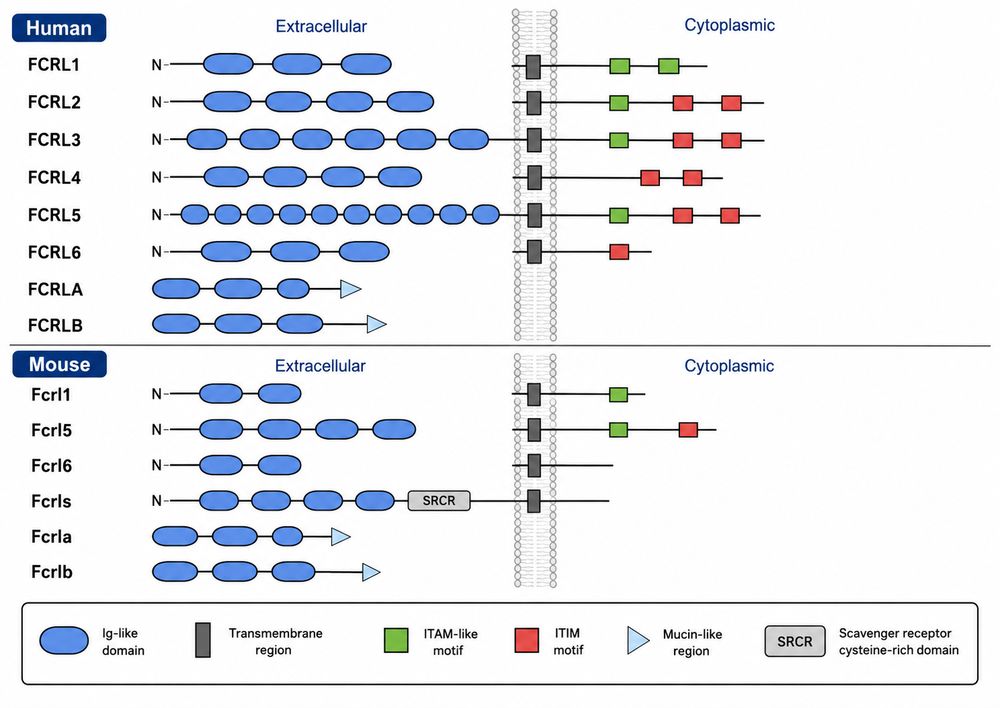 Fig 1. Structural comparison of human and mouse FCRL proteins showing extracellular Ig-like domains, transmembrane regions, and cytoplasmic signaling motifs (ITAM-like in green, ITIM in red).
FCRL Proteins in B Cell Development and Regulation
FCRL proteins are intimately involved in the regulation of B cell development, activation, and differentiation, functioning at the intersection of innate and adaptive immunity.
Expression Patterns Across B Cell Subsets
FCRL expression is tightly regulated throughout B cell ontogeny. Expression of FCRL1–FCRL5 increases during B cell differentiation, peaking in circulating and secondary lymphoid tissue-resident cells.
- Pro-B and Pre-B cells: Low FCRL1 expression
- Naive and memory B cells: High FCRL1; FCRL2 and FCRL3 peak on memory B cells
- Germinal center B cells: FCRL1 downregulated; FCRLA highly expressed in proliferating centroblasts
- Plasma cells: FCRL5 highly expressed on bone marrow plasma cells
- Tissue memory B cells: FCRL4 defines a distinctive population with innate-like characteristics
Dual Modulation of B Cell Receptor Signaling
The presence of both ITAM-like and ITIM motifs in most FCRL proteins enables sophisticated dual regulation of BCR signaling. Upon BCR cross-linking, phosphotyrosine activation results in docking of Src homology 2 (SH2) domain-containing phosphatases SHP-1 and/or SHP-2 at FCRL consensus ITIMs, attenuating downstream MAPK activation and calcium mobilization.
However, this inhibitory function is context-dependent. Studies demonstrate that FCRL5 exhibits unique binary regulatory properties: in SHP-1–deficient B cells, FCRL5 acquires enhancing rather than inhibitory function, recruiting Lyn kinase to its cytoplasmic motifs.
This subset-specific regulation—where marginal zone B cells show dominant inhibition due to higher SHP-1 levels, while B-1 B cells exhibit more balanced SHP-1/Lyn activity—reveals the complexity of FCRL-mediated immune modulation.
Innate Immune Modulation
Beyond adaptive BCR signaling, FCRL proteins significantly influence innate immune responses. FCRL3 engagement augments TLR9-mediated B cell proliferation, survival, and induction of activation markers (CD25, CD86, HLA-DR), while paradoxically suppressing antibody-secreting cell differentiation through ERK-dependent BLIMP1 suppression.
FCRL4 impairs immune synapse formation, blocks antigen-induced BCR signaling, and halts CD69 induction while upregulating CD23 upon BCR co-ligation.
These counter-regulatory functions position FCRL proteins as critical molecular switches that balance adaptive and innate B cell responses.
FCRL1, FCRL3, FCRL4: Research Highlights
FCRL1: A Co-Activation Receptor
FCRL1 stands apart as the only FCRL family member with exclusively activatory potential. Its two ITAM-like sequences and charged transmembrane residue support a co-activatory receptor function. Experimental evidence confirms that FCRL1 ligation triggers B cell proliferation, while cross-linking with the BCR enhances B cell activation through increased calcium flux.
Research highlights include:
- B cell proliferation: Receptor-specific mAb ligation induces pTyr activation and proliferative responses
- Autoimmune associations: Downregulation observed in Hashimoto's thyroiditis and Graves' disease; elevated expression in non-Hodgkin's B-cell lymphoma cell lines and patient samples
- PBMC expression: Significantly elevated in multiple sclerosis, lupus anticoagulans, and Takayasu's arteritis compared to healthy controls
FCRL3: The Autoimmune Susceptibility Gene
FCRL3 has emerged as one of the most intensively studied FCRL proteins due to its strong genetic associations with autoimmune diseases. The T169C promoter variant (rs7528684) affects an NF-κB-binding site, enhancing FCRL3 expression and conferring susceptibility to rheumatoid arthritis, systemic lupus erythematosus, Graves' disease, and multiple sclerosis.
Key research findings:
| Research Area | Key Finding | Clinical Relevance |
|---|---|---|
| Genetic polymorphism | T169C variant enhances NF-κB binding and FCRL3 expression | Autoimmune susceptibility marker |
| B cell signaling | Recruits Syk, Zap-70, SHP-1, and SHP-2 | Dual modulation of BCR and TLR9 pathways |
| TLR9 responses | Augments CpG-induced proliferation but blocks plasma cell differentiation | Potential therapeutic target in autoimmunity |
| Treg function | Inhibits regulatory T cell function and binds secretory IgA | Immune tolerance disruption |
| Autoimmune diseases | Associated with RA, SLE, Graves' disease, MS, NMO | Diagnostic/prognostic biomarker |
The following illustration summarizes FCRL3's role in rheumatoid arthritis pathophysiology:
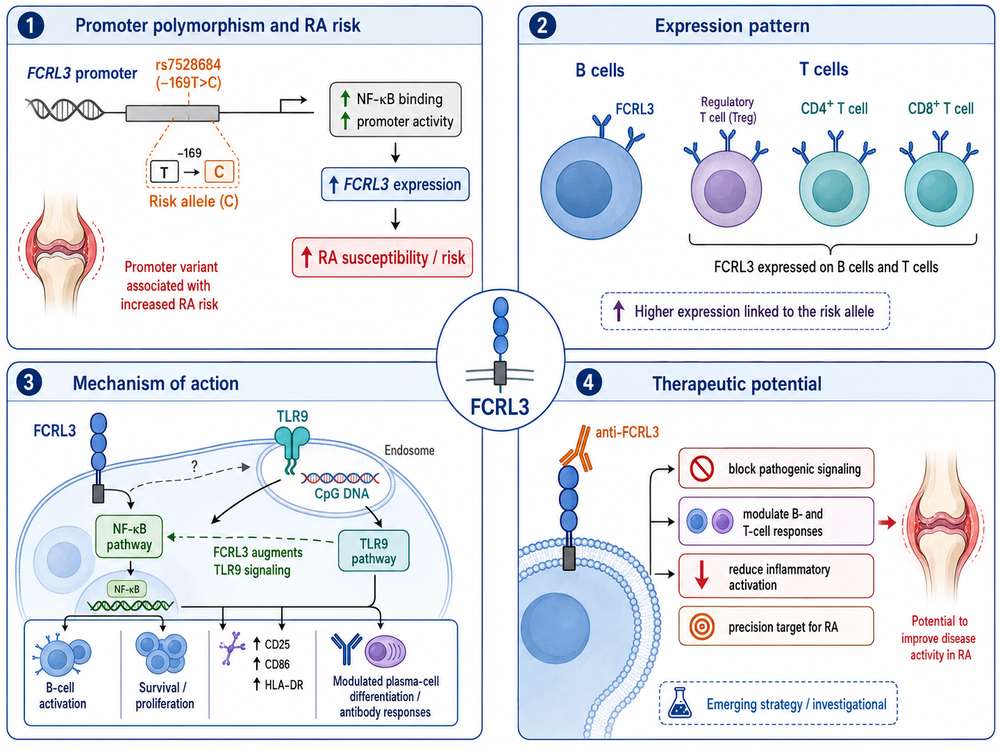 Fig2. FCRL3 in rheumatoid arthritis: promoter polymorphism (rs7528684) increases RA risk; expression on B cells and T cells; mechanism of action through NF-κB and TLR9 pathways; and therapeutic potential via anti-FCRL3 strategies.
FCRL4: The Tissue Memory B Cell Marker
FCRL4 defines a distinctive population of tissue-based memory B cells with innate-like characteristics. These cells exhibit features similar to marginal zone B cells and are found in mucosa-associated lymphoid tissue (MALT) lymphoma populations.
Research highlights include:
- IgA binding: Unique among FCRL proteins as the only receptor that inhibits IgA function through binding to heat-aggregated IgA
- BCR inhibition: Impairs immune synapse formation and blocks antigen-induced BCR signaling through SHP-1/SHP-2 recruitment
- Infectious disease: Upregulated in HIV and hepatitis C chronic infection, where HIV envelope protein gp120 induces FCRL4 expression via integrin binding, inhibiting B cell proliferation
- Lymphoma marker: Selectively expressed in nodal and extranodal marginal zone lymphomas (MZL), serving as a positive diagnostic marker
FCRL Proteins as Immune Biomarkers
The restricted lymphocyte expression and disease-associated regulation of FCRL proteins make them valuable immune biomarkers with diagnostic, prognostic, and therapeutic monitoring applications.
B Cell Malignancy Markers
FCRL expression profiles show significant alterations in B cell proliferative disorders:
| Disease | FCRL Alteration | Clinical Utility |
|---|---|---|
| Chronic lymphocytic leukemia (CLL) | FCRL1–5 upregulated; FCRL2 strongly predictive of IGHV mutation status (>94% concordance) | Prognostic stratification |
| Diffuse large B-cell lymphoma (DLBCL) | FCRL1–5 upregulated | Diagnostic marker |
| Follicular lymphoma (FL) | FCRL1–5 upregulated | Disease monitoring |
| Marginal zone lymphoma (MZL) | FCRL4 selectively expressed | Positive diagnostic marker |
| Multiple myeloma (MM) | FCRL5 strongly upregulated on bone marrow plasma cells | Immunotherapy target |
| Burkitt lymphoma (BL) | FCRL5 upregulated | Therapeutic target |
Autoimmune Disease Biomarkers
FCRL3 genetic polymorphisms represent established autoimmune susceptibility markers. The T169C variant has been reproducibly associated with:
- Rheumatoid arthritis
- Systemic lupus erythematosus
- Autoimmune thyroid disease (Hashimoto's thyroiditis, Graves' disease)
- Multiple sclerosis
- Neuromyelitis optica
Expression profiling reveals FCRL1 downregulation and FCRL2/FCRL4 upregulation in autoimmune thyroid diseases, while PBMC FCRL1 levels are elevated in multiple sclerosis and vasculitis.
Infectious Disease Markers
FCRL4 upregulation in chronic HIV and hepatitis C infection correlates with disease progression and B cell dysfunction. FCRL6 expression increases in late-stage HIV infection, suggesting roles in immune effector modulation.
FCRL in Autoimmune and Hematologic Disease Research
Autoimmune Diseases
FCRL proteins contribute to autoimmune pathogenesis through multiple mechanisms:
Rheumatoid Arthritis: FCRL3 promoter polymorphisms enhance expression, leading to dysregulated B cell activation and impaired tolerance. FCRL3-mediated TLR9 augmentation promotes autoreactive B cell survival while blocking regulatory mechanisms.
Systemic Lupus Erythematosus: FCRL3 variants confer genetic susceptibility. Altered FCRL expression profiles disrupt B cell activation thresholds and contribute to autoantibody production.
Autoimmune Thyroid Disease: FCRL1 downregulation and FCRL2/FCRL4 upregulation in Hashimoto's thyroiditis and Graves' disease suggest FCRL-mediated B cell dysregulation in organ-specific autoimmunity.
Hematologic Malignancies
FCRL proteins serve as both diagnostic markers and therapeutic targets in hematologic cancers:
Chronic Lymphocytic Leukemia (CLL): FCRL2 expression is strongly predictive of IGHV mutation status, with >94% concordance. This makes FCRL2 a reliable surrogate marker for prognostic stratification without requiring mutational analysis.
Multiple Myeloma: FCRL5 is strongly upregulated on bone marrow plasma cells in MM patients and has been designated as an immunotherapy target. Anti-FCRL5 antibody-drug conjugates and CAR-T cell therapies are under active development.
Marginal Zone Lymphoma: FCRL4 serves as a selective positive marker for nodal and extranodal MZL, aiding in differential diagnosis from other small B cell lymphomas.
Viral Infections
In HIV infection, gp120-induced FCRL4 upregulation on B cells impairs proliferation and contributes to the B cell dysfunction characteristic of chronic infection. Similar FCRL4 induction in hepatitis C suggests a common mechanism of virus-mediated immune dysregulation.
Recombinant FCRL Protein Applications
High-quality recombinant FCRL proteins are essential tools for advancing research in B cell biology, immune regulation, and disease mechanisms.
Research Applications
| Application | Description | Relevant FCRL Targets |
|---|---|---|
| Protein-protein interaction studies | Binding assays to identify novel ligands and interaction partners | FCRL1, FCRL3, FCRL4, FCRL5 |
| Structural biology | Crystallography and cryo-EM studies of extracellular domains | FCRL3, FCRL4, FCRL5 |
| Signaling pathway analysis | Reconstitution systems to study ITAM/ITIM function | FCRL1, FCRL3 |
| Therapeutic antibody development | Immunogen for anti-FCRL monoclonal antibody production | FCRL3, FCRL5 |
| Biomarker assay development | ELISA, flow cytometry, and immunohistochemistry standards | FCRL1, FCRL2, FCRL3, FCRL4 |
| Drug screening | High-throughput screening for FCRL modulators | FCRL3, FCRL4 |
Drug Development Potential
The disease associations of FCRL proteins position them as attractive therapeutic targets:
- Anti-FCRL3 strategies: Monoclonal antibodies or small molecules targeting FCRL3 could restore immune tolerance in autoimmune diseases by normalizing B cell activation thresholds and Treg function.
- Anti-FCRL5 immunotherapy: FCRL5-targeted antibody-drug conjugates show promise for multiple myeloma treatment, leveraging the selective plasma cell expression of this receptor.
- FCRL4-directed therapies: Potential applications in MZL diagnosis and targeted therapy, as well as restoration of B cell function in chronic viral infections.
Creative BioMart FCRL Product Options
Creative BioMart provides comprehensive Fc receptor and FCRL research tools to support your immunology and drug discovery programs.
Recombinant FCRL Proteins
| Product | Species | Tag Options | Applications |
|---|---|---|---|
| FCRL1 Protein | Human, Mouse | His, Fc, GST | Binding studies, antibody development, assay standards |
| FCRL3 Protein | Human, Cynomolgus | His, Fc, Biotin | Autoimmune research, biomarker assays, drug screening |
| FCRL4 Protein | Human | His, Fc | Lymphoma marker studies, IgA interaction research |
| FCRL5 Protein | Human, Mouse | His, Fc | Myeloma immunotherapy development, plasma cell research |
| FCRL6 Protein | Human | His, Fc | NK/T cell biology, MHC interaction studies |
Quality Assurance
All Creative BioMart FCRL products are manufactured under stringent quality control with:
- 95% purity by SDS-PAGE and HPLC
- Endotoxin levels <1.0 EU/µg
- Activity validation by binding assays
- Comprehensive lot-specific COAs
Explore the full Fc receptor product
Learn More
Resource
-
What Are Fc Receptors? The Immune System's Antibody Response Switch
-
FcRn: The Secret to Long-Lasting Antibodies!
-
ADCC vs ADCP: How Fcγ Receptors Drive Cancer Immunity
-
CD64: The Tiny Receptor with Big Implications!
-
Fc Receptor Polymorphisms: Why Antibody Responses Differ Between Patients
References
- Haque A, et al. Fc Receptor-Like Proteins in Pathophysiology of B-cell Disorder. J Clin Cell Immunol. 2016;7(3):427. doi:10.4172/2155-9899.1000427
- Li FJ, et al. Emerging roles for the FCRL family members in lymphocyte biology and disease. Curr Top Microbiol Immunol. 2014;382:29-50. doi:10.1007/978-3-319-07911-0_2
- Davis RS. FCRL regulation in innate-like B cells. Ann N Y Acad Sci. 2015;1362:110-116. doi:10.1111/nyas.12771
- Sohn HW, et al. FcRL4 acts as an adaptive to innate molecular switch dampening BCR signaling and enhancing TLR signaling. Blood. 2011;118:6332-6341. doi:10.1182/blood-2011-05-353102
- Kochi Y, et al. FCRL3, an autoimmune susceptibility gene, has inhibitory potential on B-cell receptor-mediated signaling. J Immunol. 2009;183:5502-5510. doi:10.4049/jimmunol.0901982
- Ehrhardt GR, et al. Expression of the immunoregulatory molecule FcRH4 defines a distinctive tissue-based population of memory B cells. J Exp Med. 2005;202:783-791. doi:10.1084/jem.20050879
- Wilson TJ, et al. Fc receptor-like molecules inhibit immunoreceptor tyrosine-based activation motif-induced signaling by binding to Src homology domain-containing phosphatase-1. J Immunol. 2012;188:2639-2647.
- Chistiakov DA, Chistiakov AP. Is FCRL3 a new general autoimmunity gene? Hum Immunol. 2007;68:375-383.
- Charles ED, et al. Clonal B cells in patients with hepatitis C virus-associated mixed cryoglobulinemia contain an expanded anergic CD21low B-cell subset. Blood. 2008;111:3815-3823.
- Jelicic K, et al. The HIV-1 envelope protein gp120 impairs B cell proliferation by inducing TGF-β1 production and FcRL4 expression. Nat Immunol. 2013;14:1256-1265.

Contact us or send an email at for project quotations and more detailed information.
Quick Links
-

Papers’ PMID to Obtain Coupon
Submit Now -

Refer Friends & New Lab Start-up Promotions